
The Carburetor
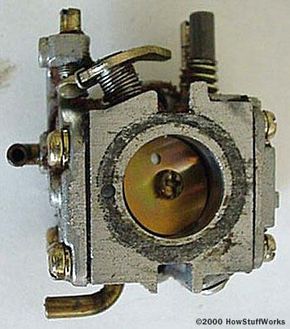
The carburetor on a chain saw is pretty simple, as carbs go, but it's not entirely uncomplicated. The job of the carb is to accurately meter extremely tiny quantities of fuel and mix it with the air entering the engine so that the engine runs properly.
If there is not enough fuel mixed with the air, the engine "runs lean" and either will not run or potentially gets damaged (in a two-stroke engine, the fuel also supplies the engine's lubricant). If there is too much fuel mixed with the air, the engine "runs rich" and either will not run (it floods), runs with a lot of smoke, runs poorly (bogs down, stalls easily) or, at the very least, wastes fuel. The carb is in charge of getting the mixture just right.
Advertisement
The carb on a chain saw is simpler than most carbs because it really has only three situations that it has to cover:
- It has to work when you are trying to start the engine cold.
- It has to work when the engine is idling.
- It has to work when the engine is wide open.
No one operating a chain saw is really interested in any gradations between idle and full throttle, so incremental performance between these two extremes is not very important. In a car, the many gradations are important, and this is why a car's carb is a lot more complex.
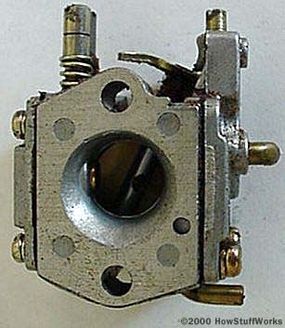
You can see the carb for the chain saw in the following two photos:
This short video (5.1 MB) takes you on a quick tour of the carb.
Here are the parts of a carb:
- A carburetor is essentially a tube.
- There is an adjustable plate across the tube called the throttle plate, which controls how much air can flow through the tube. You can see this circular brass plate in photo 1 above.
- At some point in the tube there is a narrowing, called the venturi, and in this narrowing a vacuum is created. The venturi is visible in photo 2.
- In this narrowing there is a hole, called a jet, that lets the vacuum draw in fuel. You can see the jet on the left side of the venturi in photo 2.
Watch the video for a better look at these parts.
The carb is operating "normally" at full throttle. In this case, the throttle plate is parallel to the length of the tube, allowing maximum air to flow through the carb. The air flow creates a nice vacuum in the venturi, and this vacuum draws in a metered amount of fuel through the jet. You can see a pair of screws on the top-right of the carb in photo 1. One of these screws (labeled "Hi" on the case of the chain saw) controls how much fuel flows into the venturi at full throttle.
When the engine is idling, the throttle plate is nearly closed (the position of the throttle plate in the photos is the idle position). There is not really enough air flowing through the venturi to create a vacuum. However, on the back side of the throttle plate there is a lot of vacuum (because the throttle plate is restricting the airflow). If a tiny hole is drilled into the side of the carb's tube, fuel can be drawn into the tube by the throttle vacuum. This tiny hole is called the idle jet. The other screw of the pair seen in photo 1 is labeled "Lo" and controls the amount of fuel that flows through the idle jet.
When the engine is cold and you try to start it with the pull-cord, the engine is running at an extremely low rpm. It is also cold, so it needs a very rich mixture to start. This is where the choke plate comes in.
When activated, the choke plate completely covers the venturi (watch this video of the choke plate to see it in action). If the throttle is wide open and the venturi is covered, the engine's vacuum draws a lot of fuel through the main jet and the idle jet. Usually, this very rich mixture will allow the engine to fire once or twice, or to run very slowly. If you then open the choke plate, the engine will start running normally.