
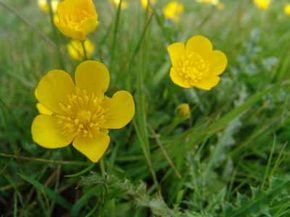
Years ago, creeping buttercups were held by children under their noses to test their fondness for butter. Children were warned not to chew the flowers or the leaves, because they are capable of raising blisters. Centuries ago, beggars used the sap to ulcerate their feet to arouse pity. Creeping buttercups, originally from Europe, are now naturalized over much of the Northeast. The genus is named from the Latin for "little frog," an allusion to the aquatic habitat of some species.
Description of creeping buttercup: Buttercups have long, creeping stems. Rooting at nodes are 3-lobed, cut, basal leaves, often with pale blotches. In spring, 5-petaled, yellow flowers, 1-inch wide, appear on 2-foot stems. The plants are poisonous to cattle. Ease of care: Easy.
Advertisement
: Any good moist soil will do in full sun or partial shade.
: By division in spring.
: Creeping buttercups are only for the wild or natural garden. They are not attractive enough for the formal garden.
Creeping buttercup related varieties: Flore Pleno is the preferred form of the creeping buttercup, since the double yellow flowers on 18-inch stems are quite beautiful. Although somewhat invasive, they can be easily controlled. Ranunculus acris, or the common buttercup, is available in a double form called Flore Pleno that is not a runner but grows in a clump with flowers on 2- to 3-foot stems. Plants require moist soil in full sun to partial shade.
Scientific name of creeping buttercup: Ranunculus repens
Advertisement