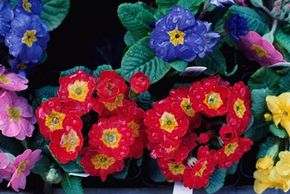
Primrose
Primroses are perennials that come from climates ranging from mild to extreme, in a range of sizes from a few inches to a few feet tall. Although there are many species, only a few are widely available. Find rare types through plant societies and catalogs. The colors are beautiful, sometimes improbable, shades of lipstick pink, deep blue, gold, yellow, red, and purple flowers, and many more. Not all species come in all colors.
![]() Primroses are multicolor perennial flowers, and are admired for their chromatic diversity. See more pictures of perennials. |
Propagation: By division and from seed.
Uses: Use primroses in pots, in garden beds, and naturalized in streamside gardens.
Related species: Primula veris is the wild type, primrose yellow, which has been used in many hybrids. P. denticulata, the drumstick primrose, has globes of flowers atop straight stems. P. heladoxa is a candelabra type with narrow whorls of flowers at intervals on the tall stems. P. japonica likes boggy soil. It is another candelabra with showy flower sprays or whorls two feet tall. P. viallii is pink and pointed, with flowers opening from the bottom up; and P. bulleyana has rusty orange flowers.
Scientific name: Primula species
If you love the primrose's surreal colors but don't have an outdoor garden, consider growing it as a house plant. We'll show you how in the next section.
Want more information? Try these:
- Perennial Flowers: Fill your garden with beautiful perennial flowers. They are organized by height, soil type, sunlight, and color.
- Perennials: There's more to a perennials garden than gorgeous flowers. Learn about all of the perennials that can complete your garden.
- Annual Flowers: Complement your perennials with these great annual flowers. We've organized them by color, sunlight, soil type, and height to make it easy to plan your garden.
Primroses are grown for their clusters of abundant flowers in a wide range of colors, often with a contrasting eye. Their leaves are generally hairy and can be tongue-shaped, rounded, or toothed, depending on the species grown.
![]() Primrose makes a fun house plant when different colors are intermixed in a display. |
Primrose Quick Facts:
Scientific Name: Primula sp.
Common Name: Primrose
Light Requirement for Primrose: Bright Light
Water Requirement for Primrose: Evenly Moist
Humidity for Primrose: Very High
Temperature for Primrose: Cool to Cold
Fertilizer for Primrose: Balanced
Potting Mix for Primrose: All-Purpose
Propagation of Primrose: Division, Seed
Decorative Use for Primrose: Table
Care Rating for Primrose: Temporary
Want to learn about house plants by type? Try these:
- House Plants
- Full Sun House Plants
- Bright Light House Plants
- Filtered Light House Plants
- Light Shade House Plants
- Hanging Basket House Plants
- Floor Plant House Plants
- Table Plant House Plants
- Terrarium Plant House Plants
- Very Easy House Plants
- Easy House Plants
- Demanding House Plants
- Temporary House Plants
- Flowering House Plants
- Climbing or Trailing House Plants
- House Plants with Colorful Foliage
- Fragrant House Plants
Learn how to care for house plants:
- Lighting House Plants
- Watering House Plants
- Humidity for House Plants
- Temperature for House Plants
- Fertilizing House Plants
- Potting House Plants
- Grooming House Plants
- Propagating House Plants
- Decorating with House Plants
- Preventing Pests and Diseases in House Plants
- Vacation Care for House Plants
- Gardening
ABOUT THE AUTHOR:
Larry Hodgson is a full time garden writer working out of Quebec City in the heart of French Canada where he grows well over 3,000 species and varieties. His book credits include Making the Most of Shade, The Garden Lovers Guide to Canada, Perennials for Every Purpose, Annuals for Every Purpose, Houseplants for Dummies, and Ortho’s Complete Guide to Houseplants, as well as other titles in English and French. He’s the winner of the Perennial Plant Association’s 2006 Garden Media Award.

