|
Decorating & Design
|
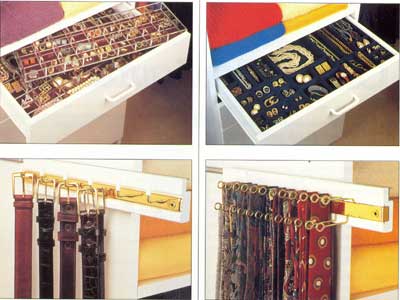
Clothes are not the only items in your closet that can create a disorganized mess. There are many more accessories that you may not consider preventing you from reaching closet nirvana. Belts, shoes, jewelry -- even the hangers themselves -- can all add up to an overwhelming nightmare. In this article, we will look at the different ways to organize the accessories in your closet. We begin in this section with a look at the benefits of plastic hangers.
Plastic Hangers To The Rescue
Keep wire hangers out of your closet! They are constantly tangled because their necks are too small and narrow. Wire hangers are dirty and they snag and damage clothing. They are always falling off the clothes rod, creating clutter on the floor. And they seem to multiply once the closet door is closed and the light turned off.
Simply switching from wire hangers to any one of the many alternative styles available will add uniformity and appeal to your closet. But don't be hasty. Some hangers perform their duty far better than others by implementing helpful features. Other hangers actually hinder the smooth functioning of a closet's performance by becoming snarled on the closet rod.
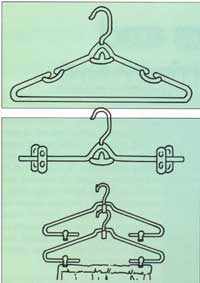
The plastic tubular hanger is usually the first alternative hanger to be considered. It's easily available and inexpensive, and it comes in a wide range of colors for decorative coordinating. But it only furnishes the single function of hanging clothes. Many varieties of plastic hangers are inferior in quality, and they break, bend, or sag. Purchase only the sturdier, thicker models. Many of these hangers include "notches," but the vast majority of these notched hangers are flawed. Whenever the thin shoulder straps or the hanging loops inside the waistband of a skirt are put in the notch, they slip and slide out.
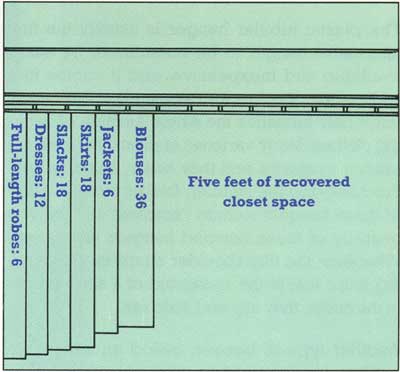
Another type of hanger, called an attachable hanger, can be used to take advantage of the amazing amount of usable space that is wasted in a traditional layout. We will explore the attachable hanger in the next section.
Advertisement