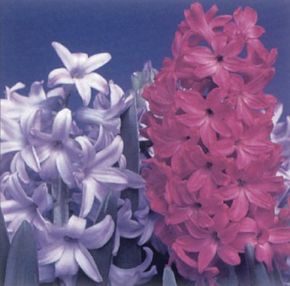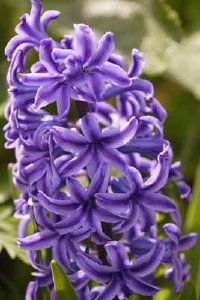
Colorful as its flowers may be, the true joy of the Dutch hyacinth lies in its delightful, pervading fragrance. Even a few bulbs suffice to instill the garden with a heady scent.
Description of hyacinth: Hyacinths are renowned for their dense 10-inch spikes of star-shaped flowers, generally one spike per bulb, over a vase-shaped rosette of swordlike green leaves. Their bloom is most intense the first year after planting. In following years, the flower clusters are looser and less impressive, although more than one spike may be borne per bulb. The color of the flowers ranges from pure white to yellow, salmon, pink, blue, purple, and near red.
Advertisement
Ease of care: Moderately easy.
Growing hyacinth: Plant bulbs 4 to 6 inches deep and 6 to 8 inches apart, in a sunny, well-drained area. Plant the bulbs in early fall. Winter mulching is advisable in colder regions. Hyacinth bulbs don't renew themselves well in cold climates and may need to be replaced every two or three years. They need some winter cold and so do poorly in zones 9 and 10.
Propagating hyacinth: By division and bulb sections.
Uses for hyacinth: Beds and borders. They are especially appropriate for formal plantings. Plant a few near a doorway so the heady perfume can waft inside with each visitor. They make excellent cut flowers and force well.
Uses for hyacinth: Beds and borders. They are especially appropriate for formal plantings. Plant a few near a doorway so the heady perfume can waft inside with each visitor. They make excellent cut flowers and force well.
Hyacinth related varieties: Some of the most popular varieties include Carnegie, white; City of Haarlem, yellow; Pink Pearl, pink; Delft Blue, blue; and Amsterdam, deep pink. Roman hyacinth (Hyacinthus orientalis albulus) bears looser spikes of white to light blue flowers. It is a bit less hardy than the Dutch hyacinth.
Hyacinth related varieties: Some of the most popular varieties include Carnegie, white; City of Haarlem, yellow; Pink Pearl, pink; Delft Blue, blue; and Amsterdam, deep pink. Roman hyacinth (Hyacinthus orientalis albulus) bears looser spikes of white to light blue flowers. It is a bit less hardy than the Dutch hyacinth.
Scientific name of hyacinth: Hyacinthus orientatlies
To really enjoy hyacinth's fragrance, try to let it come to bloom indoors. Go to the next page to learn how to care for hyacinth as a house plant.
Want more information? Try these links:
- Bulbs: Want to learn the basics of flower and plant bulbs? Try this article.
- Gardening: Want gardening basics – start here with our guide to gardening.
- Bulb Gardens: We answer all your questions about bulb gardens.
- Garden Types: Learn about the various types of gardens, and which is right for you.
Advertisement