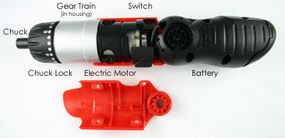
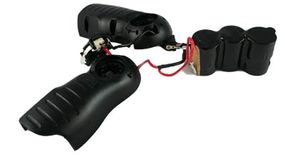
Electric screwdrivers are neat because they combine batteries, motors, gears and a switch into one extremely compact and powerful package. Let's take one apart and see what's inside! Here's the screwdriver we will be dissecting:
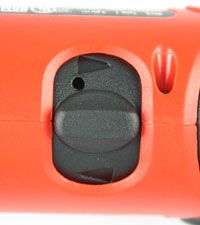
The switch block really has two roles in this screwdriver:
In the center position it prevents electricity from flowing to the motor.
It can supply power of either polarity to the motor, so the motor can spin in either a forward or reverse direction.
An outside and inside view of the screwdriver's switch
The two metal loops at the bottom of the switch are on either side of a contact that leads to the motor. With the switch in its neutral position, nothing touches the contact. But when you move the switch to one side or the other, one loop touches the contact, completing the circuit.
Advertisement
The two loops at the bottom of the switch slide to touch a metal contact.
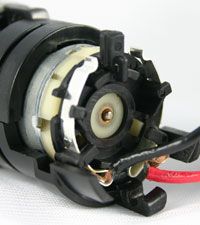
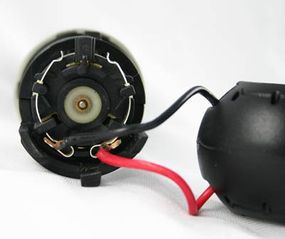
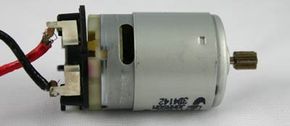
The electric motor is a standard DC electric motor. See How Electric Motors Work to see the parts inside an actual electric motor.
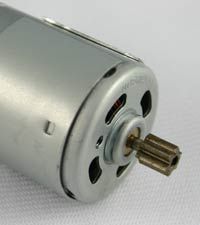
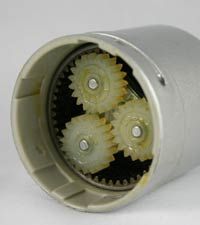
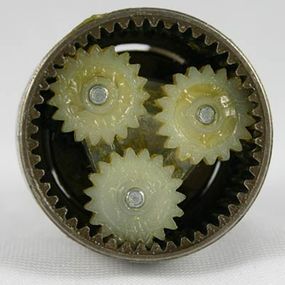
On the end of the motor is a small 6-tooth gear. This gear fits into the center of the planetary gear system, as shown here:
Advertisement
A gear attached to the motor fits in the middle of the three smaller gears.
This gear system is the heart of any electric screwdriver. An electric motor by itself is a pretty weak device. You can grab the axle and stop a small motor's rotation very easily. But if you gear the motor way down, it can have enough strength to drive a screw into a piece of wood effortlessly. In this screwdriver the dual planetary gear system has a 56:1 reduction ratio. With this reduction ratio, the motor will turn 56 times for the chuck to turn once. This means that the chuck moves very slowly relative to the motor, but that the chuck has a great deal of torque (it takes 56 times more strength to stop the motor from spinning because of the gear ratio).
Here's where that number comes from. The center gear has to turn about three times to turn its three neighboring gears once. These gears have to turn about two and a half times to travel around the outer ring once, for a total of about 7.5 turns. The outer ring is stationary -- other gears just move around inside it.
The gear set has two identical layers, one on the top and one on the bottom (you can't see the bottom layer in the pictures -- it's hidden behind the top). The top layer of the gear system mounts to a little table that has a second 6-tooth gear under it. Because of the movement of the top layer, this gear moves once for every 7.5 rotations of the motor. It takes 7.5 turns of the bottom 6-tooth gear for the bottom gears to travel around the ring once, for a total gear ratio of about 56.25:1. The bottom gears attach to a piece of metal that turns the chuck once for every 56 rotations of the motor.