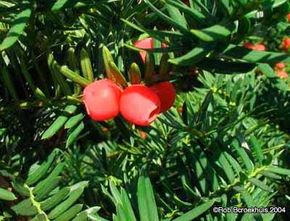
Japanese Yew

Most conifers are not shade tolerant, but yews are a major exception. Their dark green needles add a bit of color to the otherwise barren shade garden from fall through early spring.

japanese yew
www.robsplants.com
Japanese yew is a shade-tolerant conifer with bright berries.

Description of Japanese yew: In its original form, the Japanese yew is a single-trunked tree reaching 50 feet in height. The species is rarely grown in cultivation, having been replaced by the numerous dense, slow-growing varieties that may be globular, vase-shaped, pyramidal, or spreading, depending on the selection. Although they are labeled dwarf plants, most eventually become quite high: 20 feet or more. The dark green needles have rounded tips and are not "scratchy" like most other conifers. Female plants bear bright red berries. Ease of care of Japanese Yew: Easy.

Growing Japanese yew: Yews are perfectly tolerant of moderate shade, and even deep shade, as long as they get some spring sunlight. In dense shade, the shrubs need harsher pruning to help fill in the gaps formed by a more open growth pattern. Yews need fertile soil and ample moisture. They will not tolerate root competition from shallow-rooted trees. Protect them from strong, drying winds.

Propagating Japanese yew: By cuttings, usually carried out by professionals, or seed.

Uses of Japanese yew: The Japanese yew is widely used as a foundation plant, especially on the north or east sides of the home. It makes an excellent formal or natural hedge, and dwarf varieties -- of which there are many in different sizes, shapes, and colors -- are popularly used in rock gardens.

Related species of Japanese Yew: English yew (Taxus baccata) and the hybrid yew (T. x media) are similar to the Japanese yew, although the English yew is less hardy (USDA zone 6).

Scientific name of Japanese yew: Taxus cuspidata

If you love the Japanese yew's berries but don't have an outdoor garden, consider growing it as a house plant. We'll show you how in the next section.

Want more information on gardening and great plants you can grow? Try:

  • Shade Gardens: You don't need loads of direct sunlight to create a lush retreat in your yard, garden, or patio space. Learn how to plant a vital shade garden.
  • Shade Garden Plants: Find out about stunning options for planting that will make your shade garden unique and lovely.
  • Garden Types: There are many ways to cultivate a lush oasis around your home. Read about all the different types of gardens you can create.
  • Gardening: Get great tips on how to keep your garden healthy and thriving.

Japanese yew, one of the rare indoor conifers also known as the Buddhist pine, is not a pine at all. It belongs to its own family. It produces long, narrow, leathery, dark green leaves (actually needles) on a woody stem. It makes a nice, if slow-growing, indoor tree.

japanese yew
Japanese yew, also known as Buddhist pine, is slow-growing
enough to use as a bonsai house plant.

Often used as a bonsai specimen, it quickly forms an interestingly gnarled trunk when properly pruned. It seems to need cool to cold winter temperatures to do well. It is difficult to root.

Japanese Yew Quick Facts:

Scientific Name: Podocarpus macrophyllus
Common Names:
Buddhist Pine, Japanese Yew
Light Requirement for Japanese Yew: Bright Light to Filtered Light
Water Requirement for Japanese Yew: Drench, Let Dry
Humidity for Japanese Yew: Average Home
Temperature
for Japanese Yew: Cool to Cold
Fertilizer
for Japanese Yew: Balanced
Potting Mix
for Japanese Yew: All-Purpose
Propagation of Japanese Yew: Stem Cuttings
Decorative Use
for Japanese Yew: Floor, Table
Care Rating
for Japanese Yew: Demanding

Want to learn about house plants by type? Try these:

Learn how to care for house plants:

ABOUT THE AUTHOR:

Larry Hodgson is a full time garden writer working out of Quebec City in the heart of French Canada where he grows well over 3,000 species and varieties. His book credits include Making the Most of Shade, The Garden Lovers Guide to Canada, Perennials for Every Purpose, Annuals for Every Purpose, Houseplants for Dummies, and Ortho’s Complete Guide to Houseplants, as well as other titles in English and French. He’s the winner of the Perennial Plant Association’s 2006 Garden Media Award.