Search HowStuffWorks and the web:
 

Tools and hardware are the nuts and bolts of every home improvement project. Learn about different kinds of tools and hardware and find out how to use hardware correctly.
Related Categories:
> Adhesives
> Hand Tools
> Power Tools

Browse the article Nails
Nails

Nails

The easiest way to fasten two pieces of wood together is with nails. They are manufactured in a variety of shapes, sizes, and metals to complete almost any fastening job. Most commonly, nails are made of steel, but other types -- aluminum, brass, nickel, bronze, copper, and stainless steel -- are available for use where corrosion could occur. In addition, nails are manufactured with coatings -- galvanized, blued, or cemented -- to prevent rusting and to increase their holding power.

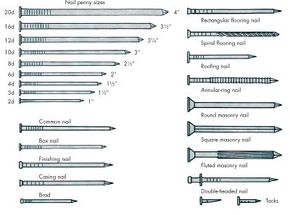
Nail size is designated by penny size, originally the price per hundred nails. Penny size, almost always referred to as "d," ranges from 2 penny, or 2d (1 inch long), to 60 penny, or 60d (6 inches long). Nails shorter than 1 inch are called brads; nails longer than 6 inches are called spikes. The length of the nail is important, because at least two-thirds of the nail should be driven into the base, or thicker, material. For example, a 1 X 3 nailed to a 4 X 4 beam should be fastened with an 8 penny, or 8d, nail. An 8d nail is 21/2 inches long; 3/4 inch of its length will go through the 1
X 3, and the remaining 13/4 inches will go into the beam.

Nails can be made of a variety of metals, but some are intended to be used with specific materials.
View Enlarged Image
Nails can be made of a variety of metals, but some
are intended to be used with specific materials.

Nails are usually sold by the pound; the smaller the nail, the more nails to the pound. You can buy bulk nails out of a nail keg; the nails are weighed and then priced by the retailer. Or you can buy packaged nails, sold in boxes ranging from 1 pound to 50 pounds. For most repairs, a few 1-pound boxes of popular nail sizes will last a long time. What follows are some of the most common nail types.
  • Common Nails: Used for most medium to heavy construction work, this type of nail has a thick head and can be driven into tough materials. Common nails are made from wire and cut to the proper length and are available in sizes 2d through 60d.

  • Box Nails: Lighter and smaller in diameter than common nails, box nails are designed for light construction and household use.

  • Finishing Nails: Finishing nails are lighter than common nails and have a small head. They are often used for installing paneling and trim where you do not want the nail head to show.

  • Roofing Nails: Usually galvanized, roofing nails have a much larger head than common nails. This helps to prevent damage to asphalt shingles.

  • Drywall Nails: Nails made for drywall installation are often ringed and have an indented head. Annular-ring nails have sharp ridges all along the nail shaft, providing greater holding power.

  • Masonry Nails: There are three types of masonry nails designed for use with concrete and concrete block: round, square, and fluted. Masonry nails should not be used where high strength is required. Fastening to brick, stone, or reinforced concrete should be made with screws or lag bolts.

  • Tacks: Available in both round and cut forms, tacks are used to hold carpet or fabric to wood. Upholstery tacks have decorative heads.

  • Corrugated Fasteners: Corrugated fasteners, also called wiggly nails, are used for light-duty joints where strength is not important. The fasteners are set at right angles to the joint.

Not what you're looking for? Try these:

  • Home Repair Tools: Whether you prefer to use the Yellow Pages for anything that needs fixing around the house or consider yourself a regular do-it-yourselfer, there are a handful of tools that everyone should have in their tool box. Learn all about them in this article.
  • Fasteners: Fasteners, such as nails and screws, are used to connect two things together. Learn about the types of fasteners available and what they are typically used for on this page.
  • Hammer: A hammer just might be the most common home repair tool around, used by even the least handy of people for simple projects like hanging a picture on a wall. Find out more about the types of hammers available on this page.