You can use apaint a room quickly and efficiently.
You don't need to be a professional to apply the right room painting techniques. You simply need to know some of the tricks of the trade.
That's where we come in. The links at the bottom of this page will take you to articles that describe a number of useful room painting techniques, from fine brush work to industrial-scale spraying. These articles contain instructions on how to perform each type of painting job, as well as precautions to keep you safe while working.
There's no quicker way to put paint on a wall, but a little practice and preparation is necessary to guarantee a professional look. Read more about how to use this device safely and easily.
When you embark on an interior painting job, you'll soon discover how easy it is to use brushes competently. Even so, there are a few techniques that will help postpone fatigue and provide a neater job.
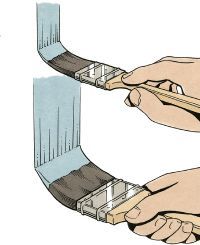
The grip you use depends on the brush you've chosen. Trim and sash brushes with pencil handles are grasped much as you would a pencil, with the thumb and the first two fingers of the hand. This technique gives you excellent control for intricate painting. With beaver-tail handles on larger brushes, you'll need a stronger grip because the brushes are wider and heavier. Hold the handle with the entire hand, letting the handle span the width of your palm as you would hold a tennis racket. This technique works best when you're painting large, flat surfaces.
Advertisement
The goal of loading a brush is to get as much paint on the wall as possible without dribbling it all over the floor and yourself in the process. It will take you only a few minutes to be able to gauge accurately how much paint your brush will hold along the way. Meanwhile, start the job by dampening the bristles of the brush (with water for latex or the appropriate thinner for other types of paint) to condition them and make them more efficient. Remove excess moisture by gently striking the metal band around the handle's base against the edge of your palm and into a sink or bucket.
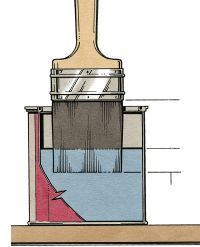
With the first dip, move the brush around a bit in the paint to open the bristles and let the brush fill completely. It will be easier to pick up a full load if you jab the brush gently into the paint with each dip. With most latex paints, you can simply dip the brush and let the excess drip off for a few seconds before moving the brush to the wall. With thinner coatings, however, you may have to gently slap the brush against the inside of the paint can or lightly drag it across the inside edge of the lip to remove excess paint.
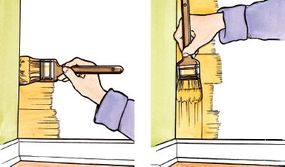
To neatly paint up to a line where two edges or colors meet, called "cutting in," use a trim brush with beveled bristles (the end of the brush resembles a chisel). Paint five or six strokes perpendicular to the edge of the ceiling or the wall. Next, smooth over these strokes with a single, long stroke, painting out from the corner first, then vertically. Where the wall and ceiling come together, use downward strokes on the wall first followed by smooth horizontal strokes.
On the ceiling itself, cut in strokes toward the center of the room, away from the wall. Then paint a smooth horizontal stroke on the ceiling that follows the direction of the wall. Even if you're using the same color of paint on adjoining surfaces, follow this method of cutting in with 2-inch-wide borders rather than just plopping a loaded brush directly into a corner. This will prevent drips, sags, and runs.
Another cutting-in approach, beading, can practically eliminate the need to use masking tape to protect one painted area from another. Use a beveled trim brush with nice long bristles. Hold the brush so that your thumb is on one side of the metal ferrule and your fingers on the other. Press the brush lightly against the surface, then, as you move the brush, add just enough pressure to make the bristles bend away from the direction of your brushstroke. Keep the brush about 1/16 inch away from the other colored surface. The bent bristles and the pressure will release a fine bead of paint that will spread into the gap.
With both methods of cutting in, but especially when you're dealing with two colors, it's better to have a brush that's too dry than one that's too wet. This is detail work. To do it effectively, go slowly and cut in 4 or 5 inches at a time. It will seem tedious at first, but your speed and accuracy will improve with practice, and even one ordinary-size room will give you lots of practice.
Not what you're looking for? Try these helpful articles:
House Painting: Ready to tackle a house painting project? Gather helpful tips on both interior and exterior painting in this home improvement article.
House Painting Tools: Before taking on any painting project, make sure you have the tools you'll need to do the job well. This article will help.
Painting Interiors: Learn the essentials of painting walls, doors, and everything inside the house on this page.
Paintbrushes: Learn about the variety of paintbrushes available for all different types of painting jobs on this page.
Working with a paint roller is even less exacting than working with a brush. Even a novice painter can get the feel of it in just a few minutes.
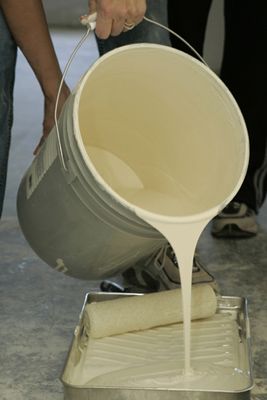
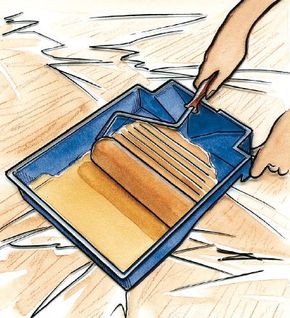
As with brushes, moisten the roller first with water for latex paint or the appropriate thinner for other types of paint. Roll out the excess moisture on a piece of scrap lumber or kraft paper or even on a paper grocery bag. Don't use newspaper because the roller may pick up the ink. Fill the well of the roller pan about half full, and set the roller into the middle of the well. Lift the roller and roll it down the slope of the pan, stopping just short of the well. Do this two or three times to allow the paint to work into the roller. Then, dip the roller into the well once more, and roll it on the slope until the pile is well saturated. You'll know immediately when you've overloaded the roller. It will drip en route to the wall and have a tendency to slide and smear instead of roll across the surface.
Advertisement
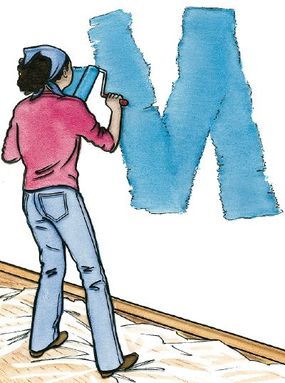
The most effective method of painting with a roller is to paint 2-or 3-square-foot areas at a time. Roll the paint on in a zigzag pattern without lifting the roller from the wall, as if you're painting a large M, W, or backward N. Then, still without lifting the roller, fill in the blanks of the letters with more horizontal or vertical zigzag strokes. Finish the area with light strokes that start in the unpainted area and roll into the paint. At the end of the stroke, raise the roller slowly so it does not leave a mark. Go to the next unpainted area, and repeat the zigzag technique, ending it just below or next to the first painted patch. Finally, smooth the new application, and blend it into the previously finished area.
Professional painters also suggest starting with a roller stroke that moves away from you. On walls, that means the first stroke should be up. If you roll down on the first stroke, the paint may puddle under the roller and run down the wall. In addition, be careful not to run the roller so rapidly across the wall that centrifugal force causes it to spray.
Not what you're looking for? Try these helpful articles:
House Painting: Ready to tackle a house painting project? Gather helpful tips on both interior and exterior painting in this home improvement article.
House Painting Tools: Before taking on any painting project, make sure you have the tools you'll need to do the job well. This article will help.
Painting Interiors: Learn the essentials of painting walls, doors, and everything inside the house on this page.
Paint Rollers: Find out when a paint roller is the best tool for the job on this page.
Advertisement
How To Use an Airless Sprayer
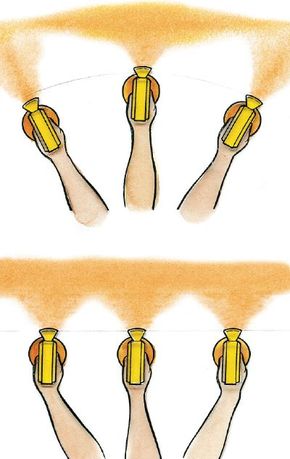
�2006 Publications International, Ltd. Keep the sprayer an equal distance from the wall with each pass. Sweeping back and forth (as shown in the top illustration) will concentrate the paint in the middle of the arc.
For larger painting jobs, an airless sprayer is the most efficient way to apply paint. An airless sprayer uses an electrically run hydraulic pump to move paint from a bucket or container, through a tube, into a high-pressure hose, to a spray gun, and, finally, to the surface. Once you get the knack of it, an airless sprayer is easy to use, but if you rent one, make sure you get a set of written instructions.
The instructions will tell you how to flush the system with solvent (usually water or mineral spirits, depending on the paint you'll be using) and how to pump the paint through the hose to the spray gun. For cleanup, the procedure is reversed: Pump the leftover paint out and flush with solvent.
Advertisement
You'll only need the spray rig for a day or two, but plan to spend at least another day beforehand to thoroughly mask off everything you don't want to paint. Tape drop cloths to every floor surface. Drape windows, the fireplace, and doors. Remove all hardware or cover it with masking tape. Mask switches and outlets. Paint from a sprayer travels on the tiniest of air currents and settles a fine mist of overspray on just about every surface in a room.
Plan to keep at least one window in each room open and set up an exhaust fan to draw paint vapor out of the room. Be sure, too, to wear a painters' mask, a hat, and old clothes with long sleeves to protect your arms.
Airless sprayers are equipped with several filters to keep paint particles and foreign matter from clogging the spray tip, but it's a good idea to filter the paint yourself through a nylon stocking or paint filter before you pump the paint through the hose.
Using an airless sprayer effectively takes some getting used to, so plan to practice on some scrap plywood or an inconspicuous part of the room or the house. The object is to cover the surface with a uniform coating of paint. Hold the spray gun a constant 6 to 12 inches from the surface and maintain this distance with each pass of the gun. Keep the gun precisely parallel to the wall. Don't sweep it back and forth or you'll end up with a wide arc of paint on the wall; the paint will be concentrated in the middle of the arc and almost transparent at each end.
Paint about a 3-foot horizontal strip at one time, then release the trigger and drop down to paint another strip of the same length, overlapping the first strip by one-third to one-half. Once you've covered a 3-foot-wide area from the top of the wall to the bottom, go back to the top and start another 3-foot section adjacent to the first, overlapping the edge of the first painted area by several inches as you work your way down the wall again.
Examine the painted areas to make sure the entire surface is receiving a uniform coat of paint. Too much will run or drip; too little will let the old paint show through. If you notice these flaws, it means you are not keeping the spray gun a uniform distance from the wall at all times or that you are tilting it. An upward tilt will deliver excess paint to the bottom of the painted strip. A downward tilt will concentrate paint at the top of the strip.
To prevent paint buildup at the end of each strip, release the trigger on the gun a fraction of a second before the spray gun stops moving at the end of your stroke. When beginning a new strip, start moving the gun a fraction of a second before compressing the trigger. Always keep the gun moving when it's spraying.
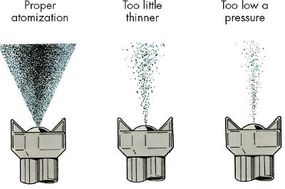
Be sure, too, that you've properly thinned the paint and adjusted the pressure control according to the manufacturer's instructions. If there is too much or too little thinner or too high or too low a pressure, the spray of paint won't atomize properly.
�2006 Publications International, Ltd. Be sure you have thinned the paint enough, and that you're using the right amount of pressure, or the paint won't atomize properly.
Using an Airless Sprayer Safely
Airless sprayers are fast and efficient because they supply pressures of up to 3,000 pounds per square inch. This force moves the paint at 100 to 200 miles an hour through the spray tip. All that power can be dangerous. Consequently, treat an airless sprayer with lots of respect, follow the manufacturer's instructions to the letter. Use the following precautions to prevent accident or injury:
Keep the spray gun's safety lock on when you're not painting.
Make sure the spray gun has a trigger guard and a safety shield around its tip.
If the spray tip becomes clogged, do not try to clear it by pressing your finger on it while the paint is being sprayed. Keep your fingers away from the tip when the sprayer is operating.
Never point the gun at anyone else or allow anyone to point it at you.
Always turn the sprayer off and disconnect it from its electrical source before you clean out the gun or the sprayer's filters. Even then, if you have to clean the tip, squeeze the trigger to release any built-up pressure in the hose.
Only work in a well-ventilated area, wear a painters' mask to avoid inhaling fumes, and don't smoke or work around open flames. If you're working outside, don't leave containers of solvents sitting in the hot sun; put them in the garage or another shady spot.
Never leave the sprayer within reach of children or pets.
Not what you're looking for? Try these helpful articles:
House Painting: Ready to tackle a house painting project? Gather helpful tips on both interior and exterior painting in this home improvement article.
House Painting Tools: Before taking on any painting project, make sure you have the tools you'll need to do the job well. This article will help.
Painting Interiors: Learn the essentials of painting walls, doors, and everything inside the house on this page.
How to Paint Safely: Learn tips in this article to ensure you don't put yourself in harm's way during a painting job.
Advertisement
How To Paint Safely
Except for the danger of falling off a ladder or scaffold, painting may not seem to pose much risk to the painter or other members of the family, but paint itself is a substance that can be hazardous to a person's health. Paint is a combination of chemicals and requires careful handling and proper precautions. Here are some tips to be aware of:
Water-thinned or solvent-thinned, paint ingredients are poisonous and should be kept away from children and pets. Antidotes are listed on can labels.
Work in well-ventilated areas at all times, even if you're using odorless paints. They still contain fumes that may be harmful if inhaled. Wear a paper painters' mask when painting indoors. Also wear one outdoors if you're using an airless sprayer. Do not sleep in a room until the odor has dissipated.
Do not smoke while painting and, if possible, extinguish pilot lights on gas appliances. Shut off gas to the unit first.
Toxic paint chemicals can be absorbed through the skin. Wash up as soon as possible.
When painting overhead, wear goggles to keep paint out of your eyes. Chemical ingredients can cause burns to sensitive eye tissue.
Never drink alcohol while you're painting. Combined with paint fumes it can be deadly.
Not what you're looking for? Try these helpful articles:
Advertisement
House Painting: Ready to tackle a house painting project? Gather helpful tips on both interior and exterior painting in this home improvement article.
House Painting Tools: Before taking on any painting project, make sure you have the tools you'll need to do the job well. This article will help.
Painting Interiors: Learn the essentials of painting walls, doors, and everything inside the house on this page.
Painting Cleanup: Cleanup is an important step to the painting process. Find helpful tips on cleaning brushes, rollers, and more in this article.
Advertisement
Cite This!
Please copy/paste the following text to properly cite this HowStuffWorks.com article: