How to Use Annuals
Annuals are garden mainstays, prized for their abundant flowers. When you plant annuals, you know you'll have bursts of color all summer long. In this article, learn about container annuals, annuals for cutting, annuals for fragrance, heirloom annuals, self-sown annuals, and edible annuals.
Annuals are plants that grow fast, so they have many practical uses in and out of the garden. Annuals can be used to fill gardens that will later be used for perennial borders when the budget permits or the plants have multiplied enough to fill the space. Because annuals stay in bloom for several months at a time, they are used for constancy in gardens where other plants come in and go out of bloom. This is why they are so often an important element in decorative containers and flowerbeds where high impact is wanted. There are annuals that evoke different styles and historical eras, used in theme gardens.
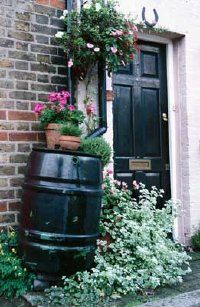
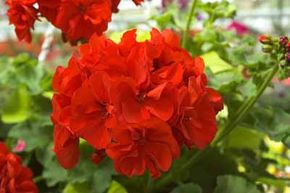
Annuals such as geraniums are versatile plants with abundant flowers.
If you're short on garden space or have a deck you'd like to adorn with flowers and greenery, container gardening might be the answer. On the next page, learn about growing annuals in a container garden.
Want more information about gardening with annuals? Try these:
- Annual Flowers: Plant these beauties for flowers all summer long.
- Annuals: Learn about all the different types of annual plants.
- Garden Design: Design your garden for beauty and practicality.
- Annuals Garden Design: Learn to combine color, texture, shape, and scale for a beautiful annuals garden.
- Tips for Growing Annuals and Biennials: Use our helpful tips to grow healthy annual and biennial plants.
- Gardening: Learn the basics of successful gardening.
Container Annuals

©2007 Jupiter Images Corporation
Containers let you grow annuals in
unexpected places.
Do a little research before planting to make sure your chosen plants will take to a container setting. These annuals do well in containers:
- Fibrous-rooted begonia
- Calendula
- Coleus
- Dracaena
- Impatiens
- Lobelia
- Marigold
- Nasturtium
- Ornamental pepper
- Pansy
- Perilla
- Phlox (P. drummondii)
- Sweet pea
- Verbena
- Viola
- Zonal geranium
Because annuals produce abundant flowers all season long, they're perfect for use in cutting gardens. On the next page, learn about annuals you can grow to grace your bouquets.
Want more information about gardening with annuals? Try these:
- Annual Flowers: Plant these beauties for flowers all summer long.
- Annuals: Learn about all the different types of annual plants.
- Garden Design: Design your garden for beauty and practicality.
- Annuals Garden Design: Learn to combine color, texture, shape, and scale for a beautiful annuals garden.
- Tips for Growing Annuals and Biennials: Use our helpful tips to grow healthy annual and biennial plants.
- Gardening: Learn the basics of successful gardening.
Annuals for Cutting
Use annuals in a cutting garden, and you'll have a steady source for beautiful bouquets. Annual flowers make great "cuts" because they are so productive. The flowers you cut for bouquets will soon be replaced by new flower growth.
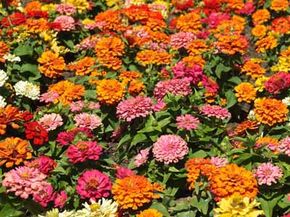
Zinnias are a good choice for a cutting garden.
If you have a choice, plant long-stem types for bouquets. Harvest in the morning, removing lower foliage on stems and putting them in deep room-temperature water in a bucket for several hours. Here are some annuals that look great in a vase:
- basil
- calendula
- capsicum
- cleome
- coleus
- cornflower
- cosmos
- dahlia
- lantana
- larkspur
- lisianthus
- love-in-a-mist
- nasturtium
- nicotiana
- perilla
- petunia
- poppy
- salvia
- snapdragon
- sunflower
- sweet pea
- tithonia
- verbena
- zinnia
Annual flowers can please the nose as well as the eyes -- many annuals are prized for their fragrance. Keep reading to learn about growing annuals for fragrance.
Want more information about gardening with annuals? Try these:
- Annual Flowers: Plant these beauties for flowers all summer long.
- Annuals: Learn about all the different types of annual plants.
- Garden Design: Design your garden for beauty and practicality.
- Annuals Garden Design: Learn to combine color, texture, shape, and scale for a beautiful annuals garden.
- Tips for Growing Annuals and Biennials: Use our helpful tips to grow healthy annual and biennial plants.
- Gardening: Learn the basics of successful gardening.
Annuals for Fragrance
Annuals can be used to fill your garden and your home with pleasing fragrance. Several annual flowers are grown for their scent, delighting both sight and smell. Why not plant some perfumed flowers under an open window or beside the patio? Here are some good choices:
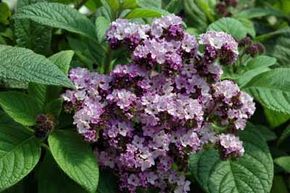
Heliotrope flowers are known for their fragrance.
- Heliotrope
- Lemon and orange gem marigold
- Moonflower
- Petunia
- Pink
- Stock
- Sweet pea
Heirloom flowers give your garden a blast from the past. Learn about these annuals on the next page.
Want more information about gardening with annuals? Try these:
- Annual Flowers: Plant these beauties for flowers all summer long.
- Annuals: Learn about all the different types of annual plants.
- Garden Design: Design your garden for beauty and practicality.
- Annuals Garden Design: Learn to combine color, texture, shape, and scale for a beautiful annuals garden.
- Tips for Growing Annuals and Biennials: Use our helpful tips to grow healthy annual and biennial plants.
- Gardening: Learn the basics of successful gardening.
Heirloom Annuals
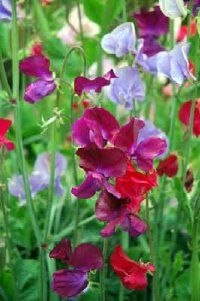
![]() Vining sweet peas bloom in vibrant colors. |
- Love-lies-bleeding: Long, dangling, crimson red seed heads form colorful streamers.
- Kiss-me-over-the-garden-gate: These six-foot-tall plants have pendulous pink flowers.
- Balsam: This impatiens relative sprinkles flowers amid the foliage along the stems.
- Sweet peas: Vining pea-shape plants that bear colorful pink, white, purple, and red flowers with delightful fragrances.
Some annuals will return on their own next summer from their own self-sown seeds. On the next page, learn about self-sown annuals.
Want more information about gardening with annuals? Try these:
- Annual Flowers: Plant these beauties for flowers all summer long.
- Annuals: Learn about all the different types of annual plants.
- Garden Design: Design your garden for beauty and practicality.
- Annuals Garden Design: Learn to combine color, texture, shape, and scale for a beautiful annuals garden.
- Tips for Growing Annuals and Biennials: Use our helpful tips to grow healthy annual and biennial plants.
- Gardening: Learn the basics of successful gardening.
Self-Sown Annuals
Some annual flowers will return on their own in the next growing season, thanks to self-sown seeds. In informal gardens, plant annuals, especially those that are not hybrids, that may return from self-sown seeds allowed to mature and fall to the ground.
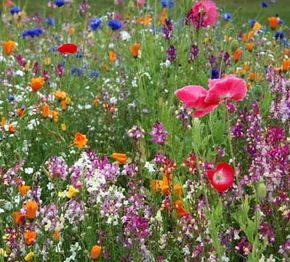
Self-sowing annuals will return from seeds in the next growing season.
Suitable annuals for self-sowing include the heirlooms love-lies-bleeding and kiss-me-over-the-garden-gate; wildflowers such as cornflowers, California poppies, and verbenas; and open-pollinated annuals such as snapdragons, portulaca, cockscomb, balsam, shirley poppies, larkspur, viola, and spider flowers (cleome). You can help them along by clearing away weeds and competing plants and lightly tilling the soil near the parent plants where you want the volunteers to grow.
So far, we've used annuals to delight sight and smell -- now let's discuss annuals to tempt your taste buds. Keep reading to learn about edible annuals to plant in your garden.
Want more information about gardening with annuals? Try these:
- Annual Flowers: Plant these beauties for flowers all summer long.
- Annuals: Learn about all the different types of annual plants.
- Garden Design: Design your garden for beauty and practicality.
- Annuals Garden Design: Learn to combine color, texture, shape, and scale for a beautiful annuals garden.
- Tips for Growing Annuals and Biennials: Use our helpful tips to grow healthy annual and biennial plants.
- Gardening: Learn the basics of successful gardening.
Edible Annuals
Most annuals like the same basic garden conditions: full sun and level, moist, rich, well-drained soil with a neutral pH. These conditions are exactly the ones preferred by most of our best garden vegetables and herbs. There is no reason to avoid combining vegetables, herbs, and flowers in the same garden or group of containers. Breeders have developed colorful types and also dwarf types to help everyone fit vegetables into the scene. You can have an ornamental garden that includes attractive edible plants, or you can have a traditional vegetable garden with a few rows for flowers or with a double row of French marigolds as a border. Here are some quick tips for incorporating something edible into your landscape:
Lettuce grows during cool weather in spring or fall. Even when crowded, it will produce usable leaves, but plants grow better when widely spaced. In flowerbeds, an edging or clump of lettuce does double duty. Leaves can be green or red, frilled or plain, depending on the cultivar.
Radish is another cool-weather crop. You can grow some nice spring radishes in the space you will use later for zinnias or other summer flowers-or for tomatoes.
Beans can sprawl and aren't particularly ornamental. They do not tolerate frost. If you choose climbing types, you can train them on tepees and pergolas for nice garden accents. Scarlet runner beans have great flowers and edible beans, and string beans and limas are favorites everywhere.
Cucumbers and squash include climbing or vining types for trellises as well as dwarf forms that squeeze into containers and tight spaces. Pumpkins take lots more space and a longer season, so they may not work as well for some gardeners. None of these plants tolerates frost.
Parsley, dill, fennel, and basil have aromatic foliage that is handsome enough for any garden. Basil is tender, but the others will survive a touch of frost.
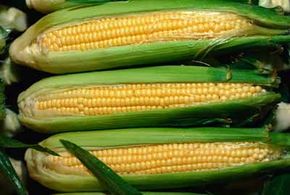
Edible corn needs to grow in a vegetable garden, but specialty varieties
can be used as ornamental grasses.
The tomato is on everyone's list, because there is nothing like a fresh, sun-warmed tomato. There are many types to consider, from beefsteak to cherry to heirloom varieties. There are also petite types bred for hanging baskets. Tall and rangy cherry types can be trained up a trellis or over an arch. In fact, in the 1800s, tomatoes were grown only as ornamentals (often near outhouses) because people thought they were toxic. Tomatoes do not tolerate frost.
Peppers of all types have good form, are not too rangy, and are colorful and attractive. They prefer hot weather and have no frost tolerance.
Eggplants exhibit preferences similar to peppers. They are very good-looking in any garden because of their purple flowers and colorful fruits. There are purple, white, or streaked fruits, elongated or globular, and even a red form.
Want more information about gardening with annuals? Try these:
- Annual Flowers: Plant these beauties for flowers all summer long.
- Annuals: Learn about all the different types of annual plants.
- Herb Gardens: Find out how to grow parsley, sage, rosemary, thyme, and much more.
- Vegetable Gardens: Learn about planting and caring for a vegetable garden.
- Tips for Growing Annuals and Biennials: Use our helpful tips to grow healthy annual and biennial plants.
- Gardening: Learn the basics of successful gardening.