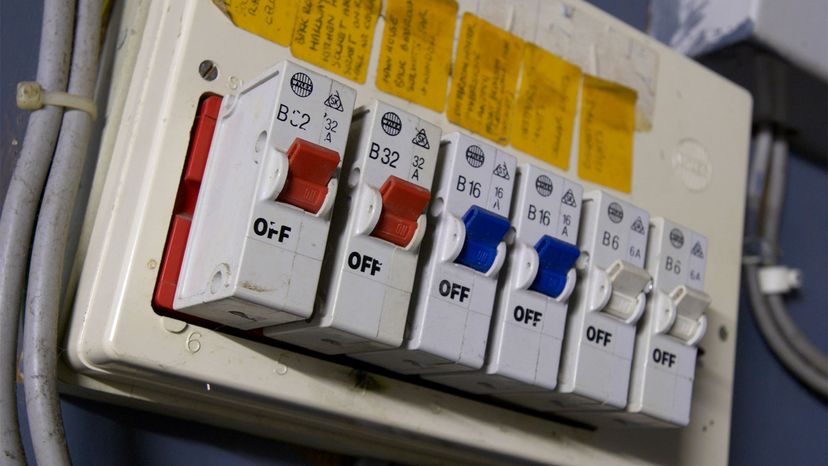
A circuit breaker is an incredibly simple tool used to control the flow of power to a household or business. Construction Photography/Avalon/Getty Images
The circuit breaker is an essential device in the modern world and one of the most important safety mechanisms in your home. Whenever electrical wiring in a building has too much current flowing through it, these simple machines cut the power until somebody can fix the problem. Without circuit breakers (or fuses), household electricity would be impractical because of the potential for fires and other mayhem resulting from simple wiring problems and equipment failures.
To understand how circuit breakers work, it helps to know how household electricity works.
Electricity is defined by three major attributes:
Advertisement
Voltage
Current
Resistance
You've probably heard of low-voltage circuit breakers and medium-voltage circuit breakers, but what is voltage? Voltage is the "pressure" that makes an electric charge move. Current is the charge's "flow" — the rate at which the charge moves through the conductor, measured at any particular point. The conductor offers a certain amount of resistance to this flow, which varies depending on the conductor's composition and size.
Voltage, current and resistance are all interrelated — you can't change one without changing another. Current is equal to voltage divided by resistance (commonly written as I = v / r). This makes intuitive sense: If you increase the pressure working on the electric charge or decrease the resistance, more charge will flow. If you decrease pressure or increase resistance, less charge will flow.
So how does all of this come together in your home? Let's find out.
Advertisement
Circuit Breaker: At Work in Your Home
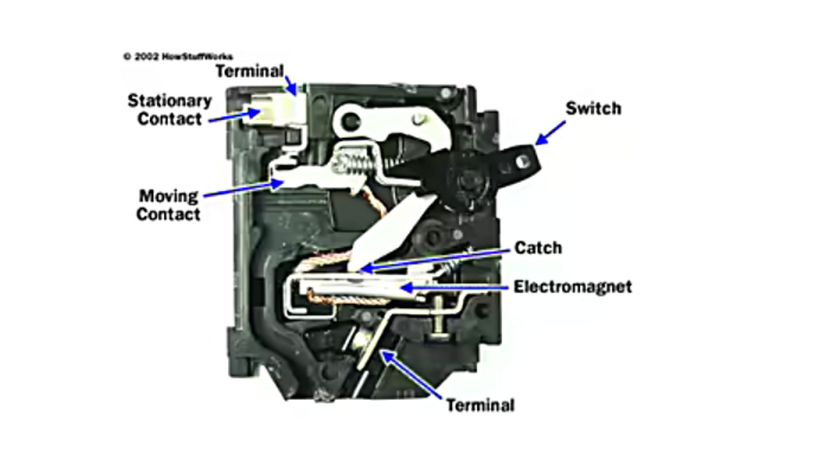
This diagram shows the basic parts and design of a circuit breaker. HowStuffWorks
The power distribution grid delivers electricity from a power plant to your house. Inside your house, the electric charge moves in a large circuit, which is composed of many smaller circuits. One end of the circuit, the hot wire, leads to the power plant. The other end, called the neutral wire, leads to the ground. Because the hot wire connects to a high energy source, and the neutral wire connects to an electrically neutral source (the earth), there is a voltage across the circuit — charge moves whenever the circuit is closed. The current is said to be an alternating current because it rapidly changes direction.
The power distribution grid delivers electricity at a consistent voltage (120 and 240 volts in the United States), but resistance (and therefore current) varies in a house. All of the different light bulbs and electrical appliances offer a certain amount of resistance, also described as the load. This resistance is what makes the appliance work. A light bulb, for example, has a filament inside that is very resistant to flowing charge. The charge has to work hard to move along, which heats up the filament, causing it to glow.
Advertisement
In building wiring, the hot wire and the neutral wire never touch directly. The charge running through the circuit always passes through an appliance, which acts as a resistor. In this way, the electrical resistance in appliances limits how much charge can flow through a circuit (with a constant voltage and a constant resistance, the current must also be constant). Appliances are designed to keep current at a relatively low level for safety purposes. Too much charge flowing through a circuit at a particular time would heat the appliance's wires and the building's wiring to unsafe levels, possibly causing a fire.
This keeps the electrical system running smoothly most of the time. But occasionally, something will connect the hot wire directly to the neutral wire or something else leading to the ground. For example, a fan motor might overheat and melt, fusing the hot and neutral wires together. Or someone might drive a nail into the wall, accidentally puncturing one of the power lines. When the hot wire is connected directly to the ground, there is minimal resistance in the circuit, so the voltage pushes a huge amount of charge through the wire. If this continues, the wires can overheat and start a fire.
The circuit breaker's job is to cut off the circuit whenever the current jumps above a safe level. In the following sections, we'll find out how it does this.
Advertisement
Breaker Design: Basic
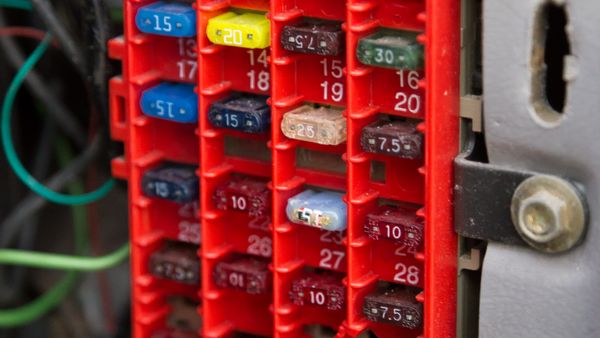
The simplest circuit protection device is the fuse. A fuse is just a thin wire, enclosed in a casing, that plugs into the circuit. When a circuit is closed, all charge flows through the fuse wire — the fuse experiences the same current as any other point along the circuit. The fuse is designed to disintegrate when it heats up above a certain level — if the current climbs too high, it burns up the wire. Destroying the fuse opens the circuit before the excess current can damage the building wiring.
The problem with fuses is they only work once. Every time you blow a fuse, you have to replace it with a new one. A circuit breaker does the same thing as a fuse — it opens a circuit as soon as the current climbs to unsafe levels — but you can use it over and over again.
Advertisement
The basic circuit breaker consists of a simple switch, connected to either a bimetallic strip or an electromagnet. The hot wire in the circuit connects to the two ends of the switch. When the switch is flipped to the on position, electricity can flow from the bottom terminal, through the electromagnet, up to the moving contact, across to the stationary contact, and out to the upper terminal.
The electricity magnetizes the electromagnet. Increasing current boosts the electromagnet's magnetic force, and decreasing current lowers the magnetism. When the current jumps to unsafe levels, the electromagnet is strong enough to pull down a metal lever connected to the switch linkage. The entire linkage shifts, tilting the moving contact away from the stationary contact to break the circuit. The electricity shuts off.
A bimetallic strip design works on the same principle, except that instead of energizing an electromagnet, the high current bends a thin strip to move the linkage. Some circuit breakers use an explosive charge to throw the switch. When the current rises above a certain level, it ignites explosive material, which drives a piston to open the switch.
Advertisement
Breaker Design: Advanced
More advanced circuit breakers use electronic components (semiconductor devices) to monitor current levels rather than simple electrical devices. These elements are a lot more precise, and they shut down the circuit more quickly, but they are also a lot more expensive. For this reason, most houses still use conventional electric circuit breakers.
One type that can be found built directly into outlets, particularly near bathroom sinks, is the ground fault circuit interrupter or GFCI. These sophisticated breakers are designed to protect people from electrical shock, rather than prevent damage to a building's wiring. The GFCI constantly monitors the current in a circuit's neutral wire and hot wire. When everything is working correctly, the current in both wires should be exactly the same. As soon as the hot wire connects directly to the ground (if somebody accidentally touches the hot wire, for example), the current level surges in the hot wire, but not in the neutral wire. The GFCI breaks the circuit as soon as this happens, preventing electrocution. Since it doesn't have to wait for the current to climb to unsafe levels, the GFCI reacts much more quickly than a conventional breaker.
Advertisement
All the wiring in a house runs through a central circuit breaker panel (or fuse box panel), usually in the basement or a closet. A typical central panel includes about a dozen circuit breaker switches leading to various circuits in the house. This box uses two sub-types of breakers, known as single-pole and double-pole. A single-pole breaker carries 120 volts of current and handles most home devices. A double-pole breaker features two switches fused into one and carries a 240-volt current to supply specialized outlets for more demanding things like ovens and clothes dryers. One circuit might include all of the outlets in the living room, and another might include all of the downstairs lighting. Larger appliances, such as a central air conditioning system or a refrigerator, are typically on their own circuit.
Another type being introduced into homes is called an arc fault circuit interrupter or AFCI. These breakers electronically monitor the home's power grid for arc faults that older styles of breaker can miss but can nonetheless lead to extreme heat in wiring and fire hazards in some cases. AFCIs are being installed in conjunction with typical central breakers in order to provide a wide range of protection.
Sources
Brian G. "Circuit Breaker 101." July 30, 2020 (Sept. 9, 2021) Lowe's.com. https://www.lowes.com/n/buying-guide/circuit-breaker-101
Gartenberg, Chaim. "Leviton’s new smart Load Center brings app control to your circuit breakers." The Verge. Feb. 19, 2019. (Sept. 19, 2021) https://www.theverge.com/circuitbreaker/2019/2/19/18231753/leviton-smart-load-center-app-control-circuit-breakers-ios-android
NEMA. "What is an AFCI Circuit Breaker? (Q&A)." (Sept. 15, 2021) https://www.afcisafety.org/afci/what-is-afci/
Occupational Safety and Health Administration (OSHA), United States Department of Labor. "Ground-Fault Circuit Interrupters (GFCI)." (Sept. 15, 2021) https://www.osha.gov/electrical/hazards/grounding/gfci
The three main types of circuit breakers are standard, GFCI, and AFCI — all have different amp capacities and operate in different parts of the home. Standard circuit breakers are either single- or double-pole.
How much does it cost to replace a circuit breaker panel?
According to Home Guide, the average cost to replace a breaker box is $1,475. A low-amp subpanel costs up to $1,000, a 200-amp panel upgrade runs up to $2,500, and a 400-amp panel can cost up to $4,000. Of course, prices will vary so contact an electrician for an exact quote on your home.
What is a circuit breaker?
A circuit breaker is an electrical safety device. It's essentially a resettable fuse that's an automatically operated electrical switch designed to interrupt current flow whenever the current jumps above a safe level, avoiding overheating, melting, and potential fires.
Do circuit breakers need to be the same brand as the panel?
In many cases, one brand of breaker can fit in another brand of panel, but that doesn't mean that you should use them interchangeably. Always install the correct brand of breakers in your breaker panel. Replacing a brand of breaker with another can be dangerous and may void your breaker or panel warranty.
Is a fuse or circuit breaker better?
Both have pros and cons associated with them. A fuse is generally more cost-effective. A circuit breaker, on the other hand, doesn't have to be replaced after every overload and is easier to handle safely. While it's extremely unlikely, there have been cases of them jamming and failing to cut off the circuit.
What are miniature circuit breakers?
A miniature circuit breaker is a short-circuit protection device. It's an automatic electrical switch with tripping mechanisms in the event of excess current. They're used for low-voltage systems.
Cite This!
Please copy/paste the following text to properly cite this HowStuffWorks.com article: