Appliance repair may be easier than you think. Check out step-by-step guides, diagrams and explanations for how to repair the appliances in your home.
Please copy/paste the following text to properly cite this How Stuff Works article:
Club, Fix-It. "How to Maintain an Air Conditioner." 03 May 2006. HowStuffWorks.com. <http://home.howstuffworks.com/how-to-maintain-an-air-conditioner.htm> 14 May 2008.
How to Maintain an Air Conditioner
Inside This Article
1.
How to Troubleshoot a Central Air Conditioning System
2.
How to Troubleshoot a Central Air Conditioning System
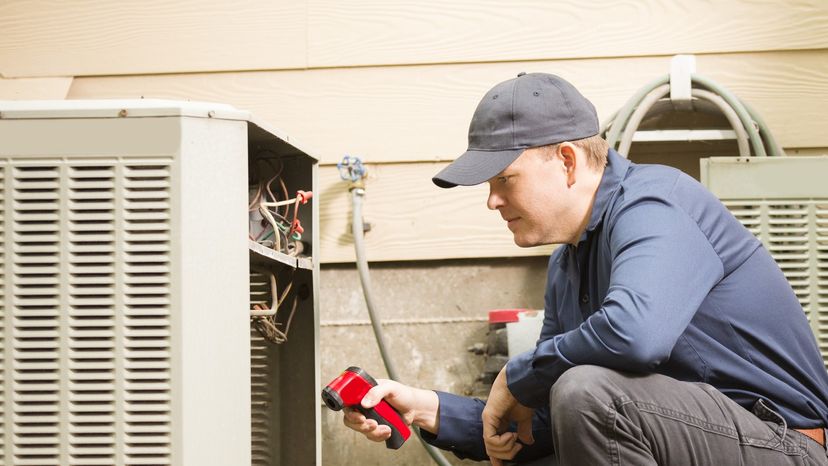
Central air conditioners have two separate components: the condenser and the evaporator. The condenser unit is usually located outside the house on a concrete slab. The evaporator coil is mounted in the plenum or main duct junction above the furnace.
Most central air conditioners are connected to a home's forced-air distribution system. Thus, the same motor, blower, and ductwork used for heating are used to distribute cool air from the air conditioning system. When a central air conditioner is operating, hot air inside the house flows to the furnace through the return-air duct. The hot air is moved by the blower across the cooled evaporator coil in the plenum and is then delivered through ducts to cool the house. When the air conditioner works but the house doesn't cool, the problem is probably in the distribution system.
 ©2006 Publications International, Ltd. Central air conditioners are made up of two separate components: the condenser unit, located outside the house on a concrete slab, and the evaporator coil above the furnace.
|
Both the evaporator and the condenser are sealed. Therefore, a professional service person should be called for almost any maintenance other than routine cleaning. Central air conditioners should be professionally inspected and adjusted before the beginning of every cooling season. However, don't let your maintenance end with this annual checkup. While there aren't many repairs you can make yourself, there are specific maintenance procedures you can follow to keep your system operating at peak efficiency.
Caution: Before doing any work on an air conditioning system, make sure the power to the system, both to the condenser and to the evaporator assembly, is turned off.
Cleaning the Evaporator
The evaporator for the central air system is located directly above the furnace in the plenum. The evaporator may not be accessible, but if it is, you should clean it once a year. If the plenum has foil-wrapped insulation at its front, you can clean the evaporator; if the plenum is a sealed sheet metal box, do not attempt to open it. Here's how to clean an accessible evaporator:
Step 1: Remove foil-wrapped insulation at front of plenum; it's probably taped in place. Remove tape carefully, because you'll have to replace it later. Behind insulation is access plate, which is held in place by several screws. Remove screws and lift off plate.
What You'll NeedYou'll want to have these tools on hand to clean the evaporator: - Screwdriver
- Stiff brush
- Large hand mirror
- Household bleach
- Wire
|
Step 2: Clean entire underside of evaporator unit with stiff brush. A large hand mirror can help you see what you're doing. If you can't reach all the way back to clean entire area, slide evaporator out a little. Evaporator can be slid out even if it has rigid pipes connected to it, but be careful not to bend pipes.
Step 3: Clean tray below evaporator unit. This tray carries condensation away from evaporator. Pour 1 tablespoon of household bleach into weep hole in tray to prevent fungus growth. In extremely humid weather, check condensate drain and pan every other day. If there's much moisture in pan, weep hole from pan to drain line may be clogged. Open weep hole with piece of wire.
Step 4: Put unit back into place, reinstall plate, and tape insulation back over it.
Step 5: Turn back on air conditioner, and check for air leaks. Seal any leaks with duct tape.
Maintaining the Condenser
In most air-conditioning systems, the condenser unit is located outside the house and is prone to accumulate dirt and debris from trees, lawn mowing, and airborne dust. The condenser has a fan that moves air across the condenser coil. You must clean the coil on the intake side, so, before you turn off the power to the air conditioner, check to see which direction the air moves across the coils. Here's how to clean the condenser:
Step 1: Cut down any grass, weeds, or vines that have grown around condenser unit; they could be obstructing airflow.
What You'll NeedYou'll want to have these tools on hand to clean the condenser: - Grass shears or pruners
- Spray bottle of coil cleaner
- Soft brush
- Fin comb
- Carpenter's level
- Pry bar or piece of 2-by-4
- Gravel or rocks
|
Step 2: Clean condenser with commercial coil cleaner, available at refrigerator supply stores. Instructions for use are included. Flush coil clean (do not use hose); let dry.
Step 3: Clean fins with soft brush to remove accumulated dirt. You may have to remove protective grille to reach them. Do not clean fins with garden hose, as water could turn dirt into mud and compact it between fins. Clean fins very carefully: They're made of light-gauge aluminum and are easily damaged. If fins are bent, straighten them with fin comb, sold at most appliance parts stores. A fin comb is designed to slide into spaces between fins. Use it carefully to avoid damaging fins.
Step 4: Check concrete pad on which condenser rests to make sure it's level. Set carpenters' level front to back and side to side on top of unit. If pad has settled, lift pad with pry bar or piece of 2-by-4, then force gravel or rocks under concrete to level it.
During the fall and winter, outside condenser units should be protected from the elements to prevent leaf blockage and ice damage. Cover the condenser unit with a commercial condenser cover made to fit the shape of the unit or use heavy plastic sheeting secured with sturdy cord.
Handling the Refrigerant
The coolant used in most air conditioning systems is a refrigerant called Freon. If the system does not contain the proper amount of Freon, little or no cooling will take place. If you suspect a Freon problem, call a professional service person to recharge the system. Caution: Do not try to charge your system's refrigerant lines.
System Care Guide Problems with your central air system can cause your brain to short-circuit. Never fear, click here for a complete troubleshooting guide. |
Here's how you can repair the system's coolant lines. Examine the lines running from the condenser outside the evaporator inside the house. If the insulation is damaged or worn, it will cut down on the cooling efficiency of the unit and, therefore, should be replaced.
Replace damaged or worn coolant line insulation with new insulation of the same type as soon as possible. Follow manufacturer's instructions for installation.
Many homes or apartments use window-unit air conditioners, so it's also important to know how to maintain or service these smaller units. Learn how to head off problems and keep these units running smoothly in the next section.
Inside This Article
1.
How to Troubleshoot a Central Air Conditioning System
2.
-
VIDEO SELECTIONS
Condensation, Freezing and Sublimation
Melting and Vaporization
-
TOP SELLING
AIR CONDITIONERS
Portable, 10000 BTU/hr, 9.5 EER, With Remote Control, 3 Fan Speeds, Reusable Filter
$300 - $369
Portable, 1000 BTU/hr, Reusable Filter
$200 - $225
Thru-Wall/Window, 5000 BTU/hr, 9.7 EER, 2 Fan Speeds, Reusable Filter
$99 - $120