How to Troubleshoot a Window Unit

window air conditioner
Publications International, Ltd.
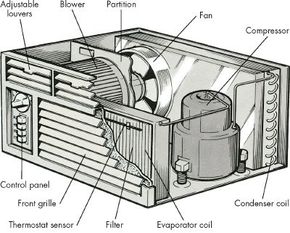
Both of the major components of a room air conditioner are contained in one housing. The condenser coil faces outside, and the evaporator faces inside.

Room air c­onditioners, also called window units, work the same way central air conditioners do. They are smaller than central systems and often more expensive to operate. Depending on its size, a room unit may cool only the room in which it's located, or it may be able to cool adjoining rooms as well.

Sandwiched between the coils are a compressor, two fans, a motor, and thermostat controls. Dirt is the biggest enemy of window air conditioners; it can lower the efficiency of the evaporator coil, block the operation of the fan that blows out the cool air, clog filters, and block drain ports.

The coils, the compressor, and the motor of a room air conditioner are sealed components, so any repairs to them should be left to a professional service person. However, you can make minor repairs, and regular maintenance will keep your unit running well. When extensive repairs are needed, you can also save the cost of a service call by removing the air conditioner from its mounting and taking it to the repair shop.

During the winter, room air conditioners should be protected from the elements. Either remove the unit from its mounting and store it or cover the outside portion of the unit with a commercial room air conditioner cover or with heavy plastic sheeting, held in place with duct tape.

Caution: Before doing any work on a room air conditioner, make sure it's unplugged. Room air conditioners have either one or two capacitors, located behind the control panel and near the fan. Capacitors store electricity, even when the power to the unit is turned off. Before you do any work on an air conditioner, unplug it and discharge the capacitor or you could receive a severe shock. The unit's owner's manual will show the location of capacitors and tell how to discharge them. Otherwise, let an air conditioning technician do it.

Maintaining Key Components

The filter, power cord, coils, switch, thermostat, drain ports, and fan are important to service on a routine basis to avoid larger problems. Below are guidelines on how to maintain these key parts.

Filter
At the beginning of every cooling season and once a month during the season, remove the front grille and clean or replace the filter. If you live in a very dusty area, clean or replace the filter more often. Most room air conditioners have a washable filter that looks like sponge rubber.

Clean the filter with a solution of mild household detergent and water; rinse well. Let the filter dry completely before reinstalling it. Some units have a throwaway filter, similar to a furnace filter. When this type of filter becomes dirty, replace it with a new one of the same type.

Power Cord
The power cord that connects the air conditioner to the wall outlet may become worn and fail to supply electricity to the unit. To check the cord, remove the control panel. Unscrew the cord terminals and then attach a test wire across the bare lead wires.

Hook the clips of a volt-ohm-milliammeter (VOM) set to the RX1 scale to the prongs of the cord's plug. If the meter reads zero, the cord is functioning. If the meter reads higher than zero, replace the cord.

Evaporator and Condenser Coils
Clean the evaporator and condenser coils at the beginning of the cooling season and every month during the season. If you live in a very dusty area, clean the coils more often. Use a vacuum cleaner on these components.

If the fins on the coils are bent, straighten them with a fin comb, sold at most appliance parts outlets. A fin comb is designed to slide into the spaces between the fins. Use it carefully as the fins are made of light-gauge aluminum and are easily damaged.

Switch
The selector switch, located directly behind the control panel, turns the unit on. If the air conditioner does not run at any setting, and it is receiving power, chances are the switch is faulty. To correct the problem, remove the control panel and locate the switch. Check the switch terminals for burnt insulation or burn marks on the terminals. If you see any indication of burning, replace the switch with a new one of the same type.

The switch is held to the control panel or frame with screws; unscrew it and connect the new one the same way. If you determine the problem may not be the switch, call a professional service person.

Maintaining the thermostat and drain ports on your home air-conditioning window unit is vital to keep the whole system working properly. It won't be a difficult or burdensome task if you folllow the guidelines mentioned below.

Thermostat
The thermostat is located behind the control panel. Here's how to test and/or replace the thermostat:

What You'll Need
You'll want to have these tools on hand to test or replace a thermostat:
  • Screwdriver
  • Volt-ohmmeter or multimeter
  • Replacement thermostat

Step 1: Remove grille and control panel from unit. Thermostat has special sensing bulb attached to it; this part extends from thermostat into evaporator coil area. Its role is to sense temperature, which is controlled by thermostat.

Step 2: Remove thermostat carefully because you must return sensing bulb to identical spot later. To make replacement easier, tag location of bulb before you remove thermostat.

Step 3: Check thermostat with VOM set to RX1 scale. Clip probes of tester to thermostat terminals, and turn temperature control dial to coldest setting. If meter reads zero, thermostat is functioning properly. If reading is higher than zero, replace thermostat with new one of same type. If thermostat is held to control panel or frame with screws, clips, or metal tabs, connect new thermostat the same way the old one was connected.

Note: If the thermostat has more than two lead wires connected to it (not counting the sensing bulb wire) do not try to test or replace it. Instead, call a professional service person.

Drain Ports
As the air conditioner operates, condensed moisture and water vapor from the evaporator coil are funneled through drain ports or an opening between the partition in the middle of the evaporator coil and the condenser coil. At this point, the fan blows the moisture against the condenser coil, where the water is dissipated.

Drain ports can become clogged with dirt. The result is water leaking from the appliance, usually through the bottom of the grille. To prevent clogging, clean the ports with a short piece of wire hanger or the blade of a pocketknife. Do this at the beginning of every cooling season and every month during the season. Also check the condenser side of the air conditioner. Some models have a drain port along the bottom edge of the cabinet frame. If your air conditioner has this drain port, clean it out when you clean the other ports.

The fan, motor, and compressor require routine maintenance to keep your air-conditioning unit running at its most efficient. The following are some simple guidelines.

Fan
When a fan malfunctions, the problem is usually loose or dirty blades. If the fan won't operate or if it's noisy, cleaning and tightening will usually fix it. Here's how to repair a room air conditioner's fan:

What You'll Need
You'll want to have these tools on hand to repair a room air conditioner's fan:
  • Vacuum
  • Soft cloth
  • Screwdriver or Allen wrench
  • Long-blade screwdriver
  • Wrench 20-weight nondetergent motor oil
  • Volt-ohmmeter or multimeter

Step 1: Open cabinet and locate fan.

Step 2: Clean away any debris with vacuum and soft cloth.

Step 3: Check fan blade on motor shaft for looseness. Blade is fastened to shaft with setscrew at hub of blade.

Tighten setscrew with screwdriver or Allen wrench. If air conditioner has round vent fan, tighten fan on motor shaft by inserting long-blade screwdriver through port in fan.

Fan is installed in its h­ousing with bolts, and vibration can loosen these fasteners. Then tighten them with wrench.

Step 4: If fan has oil ports, apply several drops of 20-weight nondetergent motor oil (not all-purpose oil) to each port at beginning of cooling season.

Step 5: If you suspect fan motor is faulty, test it with VOM set to RX1 scale. Disconnect terminal wires from terminals, and clip probes of VOM to wires.

If meter reads between about 3 and 30 ohms, motor is functioning properly. If meter reads either zero or an extremely high number, replace motor.

To remove the fan motor, remove the fan, the power wires, and several mounting bolts. Install the new motor with the reverse procedure. However, if the condenser coil must be moved to get the fan out, do not try to remove the motor. Call a professional service person.

Motor and Compressor
If problems occur in the motor or compressor of the air conditioner, call a professional service person.

By following the routine maintenance mentioned in this article, you will be able to handle most problems that occur with your central air conditioning or window unit.