Please copy/paste the following text to properly cite this How Stuff Works article:
Club, Fix-It. "How to Repair a Refrigerator." 03 May 2006. HowStuffWorks.com. <http://home.howstuffworks.com/how-to-repair-a-refrigerator.htm> 13 May 2008.
The inner-workings of a refrigerator can be a mixed bag. Some components are fairly easy to service or repair, while others should only be handled by professionals.
Servicing the Limit Switch
The limit switch is found only on frost-free refrigerators and freezers. Its function is to keep the defrost heating element from exceeding certain set temperatures. If a refrigerator has lots of frost in the freezer compartment, the problem may be the limit switch. However, other components -- the evaporator fan, the defrost timer, and the defrost heater -- can cause the same problem. Check these for malfunctions, as detailed below. If these parts are in working condition, the problem is most likely in the limit switch. Don't try to fix the limit switch yourself; call a professional service person for replacement.
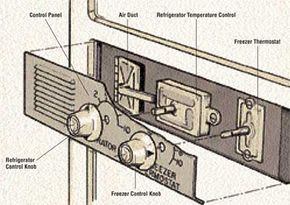
The thermostat control is usually mounted inside the refrigerator. Its visible control knob is turned to regulate the refrigerator/freezer temperature. The workability of this control can be tested in various ways, depending on the problem. To test the thermostat control:
Step 1: If the compressor runs all the time, turn the control knob to the OFF position. If the compressor still runs, unplug the unit, then pull off the control knob and remove the screws holding the thermostat in place. Pull out the thermostat and remove either the red or the blue wire from its terminal. Plug in the unit. If the compressor doesn't run, the thermostat is faulty. Replace it with a new thermostat.
Step 2:If the compressor runs after the wire is removed from its terminal, there is probably a short circuit somewhere in the unit's wiring. In this case, don't try to fix the problem yourself; call a professional service person.
Step 3:If the refrigerator or freezer runs but the box doesn't cool, unplug the unit and remove the thermostat with a screwdriver. Disconnect both wires from the thermostat. Tape the ends of the wires together with electrical tape, and plug in the appliance. If the refrigerator starts and runs normally, the thermostat is faulty. Replace it with a new one of the same type. Connect the new thermostat the same way the old one was connected.
Step 4:If the freezer compartment is normal but the refrigerator box doesn't cool, set the dials that control both compartments to mid-range. Remove these knobs (they're usually friction-fit). Then unscrew the temperature control housing; you'll see an air duct near the control. Replace the knob on the freezer thermostat and turn the control to the OFF position. Open the refrigerator door and look closely at the air duct. If this duct doesn't open wider in about ten minutes, the control is faulty. Replace the control with a new one of the same type. Connect the new control the same way the old one was connected.
Servicing the Evaporator Fan
In some cases, a faulty thermostat may not be the cause of a warm refrigerator or freezer. A warm box may also be caused by a defective fan, a blocked fan, or broken or bent fan blades. If the blades are jammed, try to free them. If they're bent, straighten them with pliers. If this doesn't solve the problem, call a professional service person.
On some refrigerators, the door switch operates the evaporator fan. If the fan seems to be malfunctioning, the door switch could be faulty. Test the switch as detailed in the last page, and replace it if necessary.
Servicing the Defrost Timer
If the compressor doesn't run, it is likely that the defrost timer is malfunctioning. This part is located near the compressor. To test the defrost timer: Step 1:Unplug the refrigerator.
Step 2:Disconnect the wires from the timer and timer motor. Remove the timer from its brackets by backing out two retaining screws. Step 3:Test the defrost timer with a VOM set to the RX1 scale. Clip one probe of the VOM to each defrost timer -- not motor -- wire, and turn the timer control screw shaft until it clicks. If the defrost timer is functioning, the meter will read zero. If the needle jumps, the defrost timer is faulty. Replace it with a new one of the same type. Step 4:Connect the new defrost timer the same way the old one was connected.
To check the defrost timer motor, clip one probe of the VOM to each motor wire, setting the scale to RX100. If the meter reads between about 500 and 3,000 ohms, the motor is functioning properly. If the meter reads higher than 3,000 ohms, the timer motor is faulty. Replace it with a new one of the same type. Connect the new motor the same way the old one was connected.
Servicing the Defrost Heater
This component is a heating element located on the evaporator coil. When the refrigerator or freezer switches to the defrost cycle, the defrost heater is turned on to melt the frost in the compartment. Failure of the defrost heater causes failure to defrost.
Test the element with a VOM set to the RX1 scale. To gain access to the heating element, remove the compartment's wall panels. Clip one probe of the VOM to each element terminal. The meter should read between 5 and 20 ohms. If it doesn't, the heating element is faulty and should be replaced. Replace the heater with a new one of the same type and electrical rating. Connect the new heater the same way the old one was connected. Servicing the Condenser Fan
The condenser fan is located under the unit. If the fan is malfunctioning, the refrigerator or freezer won't cool properly, or it will run continuously or not at all.
Test the fan with a VOM set to the RX1 scale. Disconnect the electrical wires to the fan motor and clip one probe of the VOM to each fan motor terminal. If the meter reads from 50 to 200 ohms, the motor is functioning properly. If the meter reads higher than 200 ohms, the fan motor is faulty and you should replace it.
While you're working on the fan motor, make sure the fan blades are clean and unobstructed. If the blades are bent, carefully straighten them with pliers.
Clearing the Drain Ports
The drain ports are located along the bottom of both the freezer and the refrigerator sections of the unit. These holes can become clogged with debris or ice, causing a drainage problem when the unit is defrosting. To clear the ports, use a short section of wire that will fit the holes. Do not use a toothpick, because the wood may break off in the port and become stuck. On some refrigerators, the drain ports are located near the defrost heater at the evaporator coils. A lot of disassembly is required to clean this type of unit. If the refrigerator or freezer is this type, you may be better off calling a professional service person to clear the ports.
On some freezer compartments, the drain is located under the freezer compartment and shaped like a shoehorn. This type of drain can usually be unscrewed so that the drain area can be cleaned. Servicing the Drain Hose and Pan
The condenser fan is located under the bottom of the refrigerator. During the defrosting cycle, water may run through a small hose into the drain pan and is naturally evaporated. On some refrigerators, the drain hose is rubber instead of metal. This type of hose can become cracked, causing leaks. Examine the hose. If it's damaged, replace it with a new one of the same type. If you spot water on the floor, the drain pan may be tipped on its brackets, or the pan may be cracked or rusted. To eliminate the leak, realign or replace the pan. Servicing Ice Makers
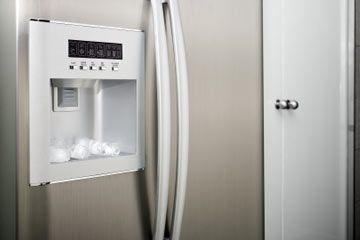
Freezers with automatic ice makers sometimes malfunction because the water inlet valve strainer that feeds water to the ice maker becomes clogged. To correct this problem, unplug the appliance and disconnect the water supply. Remove the water line where it enters the valve--usually at the bottom edge of the unit. Locate the wire strainer and remove it. Clean the strainer with a stiff brush, using mild household detergent. Reassemble the component in reverse fashion.
Servicing a Refrigerant Leak
Coolant leaks are identifiable by their acrid smell. There is nothing you can do to repair a coolant leak except call a professional service person to deal with the problem.
Servicing the Motor/Compressor
The compressor and motor of a refrigerator or freezer are contained in a sealed unit. If you trace problems to either of these components, do not try to fix the unit yourself. Call a professional service person. As you've seen, some common refrigerator problems (like faulty gaskets) can easily be repaired at home, while others (like a motor or compressor) are beyond the scope of the average handyman. Now you know how to make the small repairs, as well as when you've met your match.
Please copy/paste the following text to properly cite this How Stuff Works article:
Club, Fix-It. "How to Repair a Refrigerator." 03 May 2006. HowStuffWorks.com. <http://home.howstuffworks.com/how-to-repair-a-refrigerator.htm> 13 May 2008.