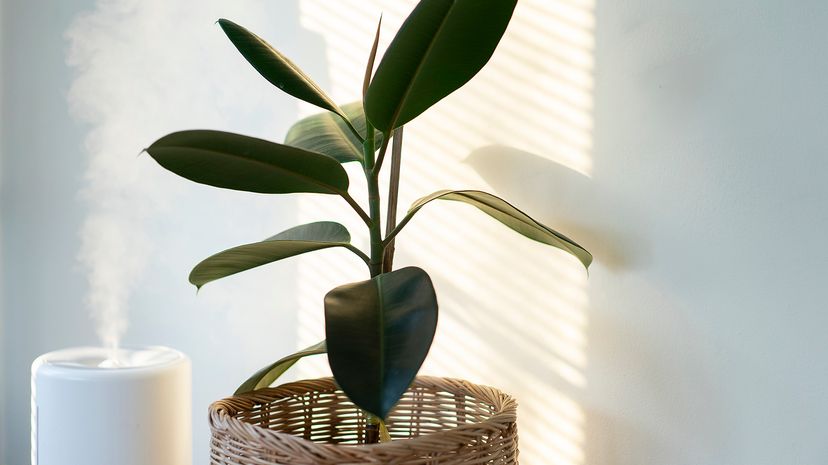
Humidifiers can make your home more comfortable, especially for plants that are native to humid environments and people with dry skin. skaman306/Getty Images
There are many reasons why people use humidifiers, from relieving sinus congestion to creating a more habitable environment for tropical plants. But what does a humidifier do, exactly?
One thing that makes winter uncomfortable for humans, even inside a nice warm building, is low humidity. People need a certain level of humidity to be comfortable. In the winter, indoor humidity can be extremely low and the lack of humidity can dry out your skin and mucous membranes.
Advertisement
Moreover, low humidity makes the air feel colder than it actually is. Dry air can also dry out the wood in the walls and floors of our houses. As the drying wood shrinks, it can cause creaks in floors and cracks in drywall and plaster.
In this article, you'll learn how a humidifier can help make things more comfortable and even save a little wear and tear on your house by adding moisture to the dry indoor air. It's surprising how big a difference a little water can make!
The relative humidity of the air affects how comfortable we feel. But what is humidity, and what is "relative humidity" relative to?
Humidity is the amount of moisture in the air. If you are standing in the bathroom after a hot shower and can see the steam hanging in the air, or if you are outside after a heavy rain, then you are in an area of high humidity.
Advertisement
If you are standing in the middle of a desert that has not seen rainfall for two months, or if you are breathing air out of a SCUBA tank, then you are experiencing low humidity.
Water Vapor and Temperature
Air contains a certain amount of water vapor. The amount of water vapor any mass of air can contain depends on the temperature of that air: The warmer the air is, the more water it can hold. A low relative humidity means that the air is dry and could hold a lot more moisture at that temperature.
For example, at 20 degrees C (68 degrees F), a cubic meter of air can hold a maximum of 18 grams of water. At 25 degrees C (77 degrees F), it can hold 22 grams of water.
If the temperature is 25 degrees C and a cubic meter of air contains 22 grams of water, then the relative humidity is 100 percent. If it contains 11 grams of water, the relative humidity is 50 percent. If it contains zero grams of water, relative humidity is zero percent.
Relative Humidity and the Heat Index
The relative humidity plays a large role in determining our comfort level. If the relative humidity is 100 percent, it means that water will not evaporate; the air is already saturated with moisture.
Our bodies rely on the evaporation of moisture from our skin for cooling. The lower the relative humidity, the easier it is for moisture to evaporate from our skin and the cooler we feel.
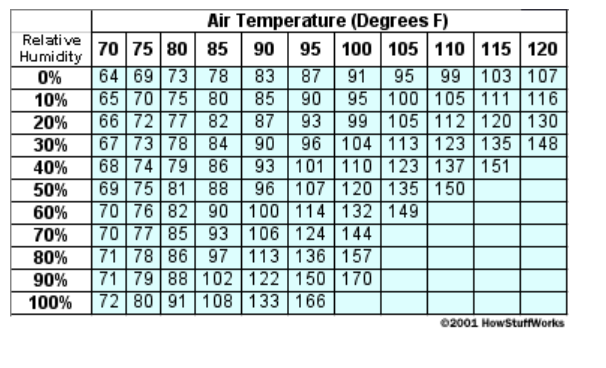
You may have heard of the heat index. This chart lists how hot a given temperature will feel to us in various relative-humidity levels.
If the relative humidity is 100 percent, we feel much hotter than the actual temperature indicates because our sweat does not evaporate at all. If the relative humidity is low, we feel cooler than the actual temperature because our sweat evaporates easily; we can also feel extremely dry.
Advertisement
Effects of Low Humidity
Low humidity has at least three effects on human beings:
Increased Dryness
It dries out your skin and mucous membranes. If your home has low humidity, you will notice things like chapped lips, dry and itchy skin, and a dry sore throat when you wake up in the morning. (Low humidity also dries out plants and furniture.)
Advertisement
Increased Static Electricity
It increases static electricity, and most people dislike getting sparked every time they touch something metallic.
Decreased Perceived Temperature
It makes it seem colder than it actually is. In the summer, high humidity makes it seem warmer than it is because sweat cannot evaporate from your body. In the winter, low humidity has the opposite effect.
If you take a look at the chart above, you'll see that if it is 70 degrees F (21 degrees C) inside your home and the humidity is 10 percent, it feels like it is 65 degrees F (18 degrees C). Simply by bringing the humidity up to 70 percent, you can make it feel 5 degrees F (3 degrees C) warmer in your home.
How Humidifiers Can Improve Indoor Air Quality
Since it costs a lot less to humidify the air than to heat it, a humidifier can save you a lot of money!
For best indoor comfort and health, a relative humidity of about 45 percent is ideal. At temperatures typically found indoors, this humidity level makes the air feels approximately what the temperature indicates, and your skin and lungs do not dry out and become irritated.
Most buildings cannot maintain this level of humidity without help. In the winter, relative humidity is often much lower than 45 percent, and in the summer it is sometimes higher.
Humidity in the Winter
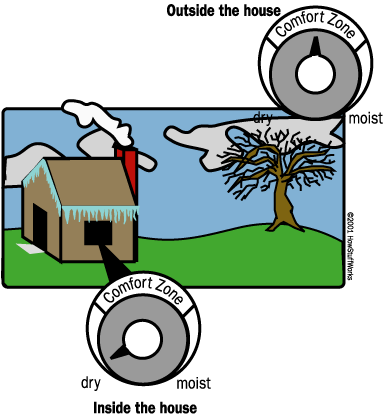
The outside air might have a comfortable level of humidity, but when that air is heated, the relative humidity drops, causing the air to be very dry inside the house.
HowStuffWorks
Here's what happens in winter to make it feel so dry in our houses.
Let's say that the outdoor temperature is 0 degrees C, or 32 degrees F. The maximum amount of water that a cubic meter of air can hold at this temperature is 5 grams. Now you bring this cubic meter of air inside and heat it to 25 degrees C or 77 degrees F. The relative humidity is only 23 percent:
5 grams of water in the air / 22 grams possible = 23 percent relative humidity
It gets worse as the temperature outside falls lower. This is why the air inside any heated building in the winter feels so dry. Any time the temperature outside is below freezing, relative humidity inside will be below 20 percent unless you do something to increase the humidity.
Advertisement
Inside a Humidifier
The most common type of humidifier is called an evaporative humidifier. This type of humidifier is actually quite simple and, for the most part, self-regulating.
A reservoir holds cold water and dispenses it into a basin. A wicking filter absorbs the water from the basin. A fan then blows air through the moistened filter.
Advertisement
As the air passes through the filter, it evaporates some of the water there. The higher the relative humidity, the harder it is to evaporate water from the filter, which is why a humidifier is self-regulating — as humidity increases, the humidifier's water-vapor output naturally decreases.
Sometimes an evaporative humidifier will be hooked up to the heating and cooling system of a house or building. These systems work in a similar way.
A metal mesh or screen is located in the duct coming from the furnace and/or air conditioner. Water from the building's pipes flows down the screen. As air coming from the duct blows across the screen, it picks up moisture.
Advertisement
Types of Humidifiers
There are many different ways to raise the humidity in your home. For example, you can put a pan of water on the stove or on the radiator, or you hang wet towels near a heater duct. But most people use a mechanical humidifier to do the job. Here are the four most popular technologies.
Vaporizers
Often referred to as a "vaporizer" or warm mist humidifier, a steam humidifier boils water and releases the warm steam into the room. This is the simplest, and therefore the least expensive, technology for adding moisture to the air.
Advertisement
You can find inexpensive warm mist humidifiers for less than $10 at discount stores. Another advantage of this technology is that you can use a medicated inhalant with the unit to help reduce coughs.
Impellers
In an impeller, a rotating disc flings water at a comb-like diffuser. The diffuser breaks the water into fine droplets that float into the air. You normally see these droplets as a cool fog exiting the humidifier. This is one of two types of cool mist humidifiers.
Ultrasonic Humidifiers
An ultrasonic humidifier, also known as a cool mist humidifier, uses a metal diaphragm vibrating at an ultrasonic frequency, much like the element in a high-frequency speaker, to create water droplets. Ultrasonic humidifiers are usually silent and also produce a cool fog.
Wick Systems
The wick system uses a paper, cloth or foam wick or sheet to draw water out of the reservoir. A fan blowing over the wick lets the air absorb moisture. This is one of those self-regulating humidifiers we mentioned earlier. Evaporative humidifiers use a wick system and a fan.
Advertisement
Choosing a Humidifier
Here are some things to keep in mind as you are weighing the advantages and disadvantages of the different technologies.
Burn Risks
Steam vaporizers can be dangerous around children because they can cause burns. They also have the highest energy costs. However, there are no bacterial or mineral concerns with this technology.
Advertisement
Spreading Bacteria
Impeller and ultrasonic designs have low energy costs but raise two concerns. First, if the water gets stagnant, these designs will spray the stagnant water, and any bacteria it contains, into your home. This is why it is important to clean the tank regularly and refill it with clean water when you haven't been running it.
Many high-end ultrasonic units therefore have antibacterial features built in. For example, some units use ultraviolet light to kill bacteria.
Spreading Dust
The second concern is minerals in the water. Impeller humidifiers and ultrasonic designs send these minerals into the air. If the water in your area contains a lot of minerals, you will notice them as dust.
The Environmental Protection Agency (EPA) does not issue health warnings about minerals in the air, but does recommend using low-mineral water (such as distilled water) in your humidifier. Many ultrasonic models feature a demineralization cartridge that filters minerals out of the water to prevent the dust.
Preset Features
Some humidifiers monitor the relative humidity of the air and will turn on and off as appropriate to maintain a preset level.
Portability
Humidifiers can be installed as small portable room units, or they can be integrated into your furnace for full-house humidity control.
Tracking Humidity Levels
If you are interested in tracking your home's humidity, an inexpensive hygrometer will show you the relative humidity in your house. You may be surprised to learn how low it is!