Once upon a time, lawns were green country pastures kept trim by the sheep and other animals that grazed them. Today, powerful tractors, robots and even hovercraft keep them neat and tidy, but most have one thing in common -- a rotating blade powered by a motor.
Before the middle of the 20th century, lawn mowers were mostly reel mowers with a cylindrical blade that got all its power from the person pushing it. British engineer Edwin Bunning invented the first one in 1830, and the first lawn mower powered by an internal combustion engine became available in 1902. An electric version became available in 1926.
Advertisement
But a new type of lawn mower emerged after World War II, with the development of suburban housing and the larger lots that came with it. For these new lawns, the push mower just wouldn't cut it.
As small engines became more powerful, a new type of lawn mower that could cut larger and longer swaths of grass became more popular. Instead of cutting grass like scissors cut paper as a reel mower does, the rotary mower spins a horizontal blade around fast enough to cut the grass as it hits it.
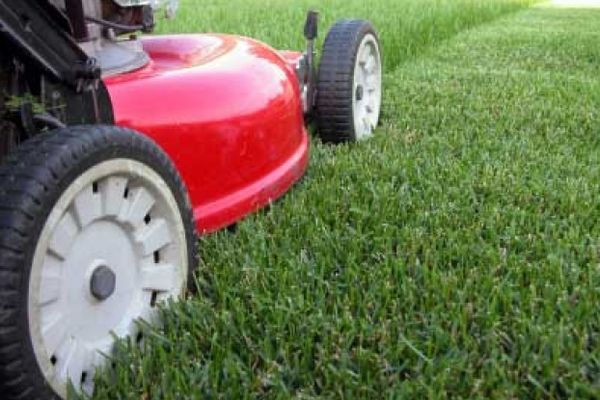
The blade sits within a casing called a deck, which keeps the grass and other objects from flying in all directions when struck. Typically, the deck rides on four wheels, with a motor sitting on top of it and a bag attached to it to collect the cut grass.
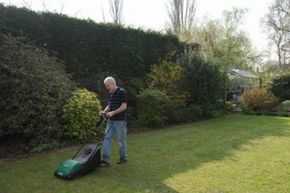
The basic version of a rotary mower has a handlebar attached to it that the operator stands behind and pushes to make it move forward. Self-propelled versions have a transmission that turn the wheels using the power of the motor. Of course, not everybody wants to walk behind their lawn mower, and some people have lawns large enough that they need something with more power and larger cutting areas. For them, the riding lawn mower is the answer to their lawn care needs.
And if you're looking for something more unique, there are hovercraft lawn mowers that ride on a curtain of air instead of wheels, and robotic lawn mowers that don't need a human operator at all.
Still, these mowers all need the same things to work right -- a motor, a rotating blade, a means of getting around and a way to get rid of the grass clippings. In this article, we'll look into each of those systems and find out what it takes to keep the yard looking good.
Advertisement