How to Install Weatherstripping
Rising energy costs can make a cold, drafty house a misery that grows increasingly expensive. Sealing your home with tight-fitting weatherstripping can make you feel warm all winter long. You'll also enjoy the lower utility bills.
If you had a 6-inch-square hole in the middle of your front door, you would certainly do something in order to plug it up. Yet there are thousands of homes in which a 1/8-inch-wide crack exists all the way around the door, and this gap is just about the equivalent air loss of that 6-inch-square hole. Letting these cracks exist is like throwing dollars out the door or window. Fortunately, weatherstripping can reduce your heating/cooling bills by as much as 30 percent while reducing drafts that can cause discomfort.
Your home may or may not need weatherstripping. Luckily, there are some very simple ways to find out. If you can feel cold air coming in around doors and windows on a windy day, you know the answer. If you are uncertain, you can create your own windstorm at the precise spot where you suspect air might be leaking. Go outside with a handheld hair dryer and have a helper inside move his or her hands around the door and/or window frame as you move the hair dryer.
Learn More
|
You may discover that all your doors and windows are airtight. Or you may find a door or window that is airtight around three edges but needs help along the fourth edge. What you will probably conclude, however, is that your home has several drafty areas that would benefit from weatherstripping.
In this article, we'll show you how to install weatherstripping on all parts of your house. We'll also examine the various types of weatherstripping, which is our first order of business.
Types of Weatherstripping

©2006 Publications International, Ltd.
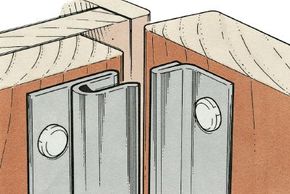
Interlocking metal weatherstripping can provide a secure seal as long as the separate pieces fit together as they should. Installation is tricky, and maintenance requires careful examination for bent pieces.
There are several types of weatherstripping because different situations call for different kinds of material. All of the following types are available to homeowners, and most can be used for either doors or windows.
Pressure-sensitive adhesive-backed foam is the easiest weatherstripping to apply, and it is quite inexpensive. Available in both rubber and plastic, adhesive-backed foam comes in rolls of varying lengths and thicknesses. When compressed by a door or window, the foam seals out the air. As an added advantage, these strips also provide a cushioning effect that silences slamming. Though not permanent, this type of weatherstripping can last from one to three years. Avoid getting paint on the material because paint causes the foam to lose its resiliency.
Spring-metal strips (V-shape or single) are available in bronze, copper, stainless-steel, and aluminum finishes. Most manufacturers package spring-metal weatherstripping in rolls, and they include the brads necessary for installation. Although this kind of weatherstripping seems like a simple installation, it does require patience.
Self-sticking spring metal has a peel-and-stick backing. These are like the standard spring-metal strips just described, but they are far easier to install.
Felt is one of the old standbys
and is very economical. It comes in a variety of widths, thicknesses,
qualities, and colors (brown, gray, and black). Felt strips are usually
nailed in place, but they are also available with a pressure-sensitive
adhesive backing.
Serrated metal is felt-or
vinyl-backed weatherstripping that combines the sturdiness of metal
with the application ease of felt. Most manufacturers package
serrated-metal weatherstripping in rolls that include brads for
installation.
Tubular gasket weatherstripping
is made of extremely flexible vinyl. It is usually applied outside
where it easily conforms to uneven places. Available in white and gray,
it cannot be painted because paint causes the tube to stiffen and lose
its flexibility.
Foam-filled tubular gasket weatherstripping
includes a foam core in the tubular part of the gasket just described.
The foam provides extra insulating qualities and extra strength.
Moreover, the foam-filled tubular gasket will hold its shape better
than the hollow-tube type. It should not be painted.
Interlocking metal weatherstripping requires two separate pieces along each edge. One part fits inside the other to form the seal. One piece goes on the door, while the other is attached to the jamb. Because installation generally requires professional-level cutting (rabbeting), no step-by-step installation instructions are provided for this type of weatherstripping. If you already have interlocking metal weatherstripping, keep it working right by straightening any bent pieces with a screwdriver, pliers, or a putty knife. Casement window gaskets are specially made vinyl channels that slip over the lip of the casement frame. No adhesives or tools -- except scissors for cutting the gasket to the proper length -- are needed. This weatherstripping is generally available only in shades of gray.
Jalousie gaskets are clear vinyl tracks that can be cut to fit over the edges of jalousie louvers. They snap in place for a friction fit.Read the next page to learn how to put all of these types of weatherstripping to good use.
How to Install Weatherstripping
Most homes have a leak or two around doors and windows. Installing weatherstripping to block those leaks can reduce drafts and save you a bundle on your heating and cooling bills. In this section, we'll discuss how to install the various types of weatherstripping.
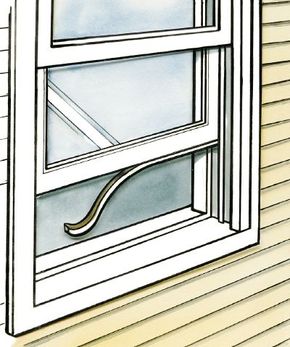
![]() ©2006 Publications International, Ltd. Apply pressure-sensitive types of weatherstripping only on the friction-free parts of a wooden window. |
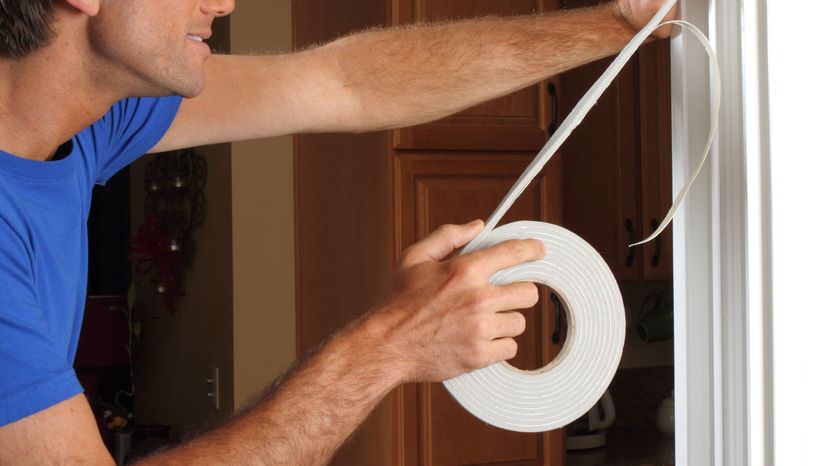
Pressure-sensitive adhesive-backed foam is the easiest weatherstripping to apply, and it is quite inexpensive. Available in both rubber and plastic, adhesive-backed foam comes in rolls of varying lengths and thicknesses. Pressure-sensitive types of weatherstripping can be used only on the friction-free parts of a wooden window, such as the lower sash or the top of the upper sash. If the strips were installed snugly against the gap between upper and lower sashes, the movement of the window would pull it loose.
|
Step 1: Clean entire surface to which weatherstripping is to be attached. Use dishwashing detergent and water, and make certain no dirt or grease remains. If pressure-sensitive weatherstripping had been installed previously, use petroleum jelly to remove any old adhesive. Dry surface with rags.
Step 2: Use scissors to cut strip to fit, but do not remove backing paper yet. Starting at one end, slowly peel paper backing as you push sticky foam strips into place. If backing proves stubborn at beginning, stretch foam until seal between backing and the foam breaks.
Pressure-Sensitive Felt
Felt is one of the old standbys and is very economical. It comes in a variety of widths, thicknesses, qualities, and colors (brown, gray, and black). To apply pressure-sensitive felt, follow the same steps as you would to attach pressure-sensitive foam. Felt strips also come without the adhesive backing, but this type must be nailed into place.
Installing Spring-metal and Other Weatherstripping Types
What You'll Need Here are the tools you'll want to have on hand to apply spring-metal weatherstripping:
|
Spring-metal strips (V-shape or single) are available in bronze, copper, stainless-steel, and aluminum finishes. Most manufacturers package spring-metal weatherstripping in rolls, and they include the brads necessary for installation. Although this kind of weatherstripping seems like a simple installation, it does require patience.
Spring-metal weatherstripping fits into the tracks around the windows. Each strip should be about 2 inches longer than the sash so the end of the strip is exposed when the windows are closed. Here's how to install spring-metal weatherstripping:
Step 1: Position vertical strips so flared flange faces outside. Center strip should be mounted to upper sash with flare aimed down, while other horizontal strips are mounted to top of upper sash and bottom of lower sash with flared flange facing out. Using snips, cut spring-metal weatherstripping to size. Be sure to allow for window pulley mechanisms.
Step 2: Attach strips to window frame. Position strip properly and note any hinges, locks, or other hardware that might interfere. Trim away metal where needed. Then trim ends of strip at an angle where vertical and horizontal strips meet. Tap in one nail at top and one nail at bottom of strip. Do not put in more nails and do not drive top and bottom nails all the way in. Since some vertical strips do not come with nail holes, you may have to make pilot holes with an ice pick or awl.
Step 3: Check
to make sure strips are straight and properly positioned. Then drive
nail in center of strip -- but, again, only partway. Add more nails
between starter nails. To avoid damaging strip, never drive any of the
nails all the way in with hammer. Instead, drive nails flush with nail
set.
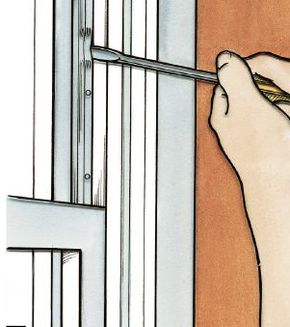
![]() ©2006 Publications International, Ltd. Flare the edge of a spring-metal strip with a screwdriver to render a snug fit. |
Step 4: Flare out edge of strip with screwdriver to render snug fit.
Self-Sticking Spring Metal
Self-sticking
spring metal has a peel-and-stick backing. These are like standard
spring-metal strips, but they are far easier to install. This type of
weatherstripping works best on wood-framed windows. Here's how to
install this self-sticking spring metal weatherstripping:
What You'll Need Here are the tools you'll want to have to apply self-sticking spring metal weatherstripping:
|
Step 1:
Measure and cut strips to fit window, then clean surface where strips are to be placed.
Step 2: Put strips in place without removing backing paper, and mark spots for trimming (for example, indicate hardware points and where vertical and horizontal strips meet).
Step 3: Peel off backing at one end, and press strip in place, peeling and pressing as you work toward other end.
Felt Weatherstripping
What You'll Need Here are the tools you'll want to have on hand to apply felt weatherstripping:
|
Felt strips are somewhat unsightly for sealing gaps on wooden-frame windows. There are places where felt can be used to good advantage, however. Attach felt strips to the bottom of the lower sash, the top of the upper sash, and to the interior side of the upper sash. The strips will then function as horizontal gaskets. Here's how to install felt weatherstripping:
Step 1: Measure and cut felt to fit window. Keep in mind that felt strips can go around corners. Push material snugly against gap.
Step 2: Nail ends of each strip first, but do not drive nails flush; leave room to pry them out. Start at one end and drive a tack every 2 to 3 inches, pulling felt tight as you go. If you find slack when you reach other end, remove nail, pull to tighten, and trim off any excess.
Note: If possible, do this job on a warm day. The adhesive forms a better bond if applied when the temperature is at least 60 degrees Farenheit.
Pressure-Sensitive Felt
Follow the same steps you would to attach pressure-sensitive foam weatherstripping.
Tubular and Foam-Filled Gasket Weatherstripping
Generally, the only kind of weatherstripping that can be applied to metal windows is the pressure-sensitive type. Screws would go through the metal and impede movement of the window. To install, apply weatherstripping to top of upper sash (if it is movable) and to bottom of lower sash. These are usually the only spots where metal windows allow for air movement. If you find any other gaps, attach a vinyl tubular gasket to the area with a special adhesive formulated to hold vinyl to metal.
What You'll Need Here are the tools you'll want to have on hand to apply tubular and foam-filled gasket weatherstripping:
|
Tubular gasket weatherstripping is made of extremely flexible vinyl. It is usually applied outside where it easily conforms to uneven places. Foam-filled tubular gasket weatherstripping includes a foam core in the tubular part of the gasket. The foam provides extra insulating qualities and extra strength. Both types should not be painted.
Tubular types of weatherstripping are unsightly. They are best used when installed on the outside of the window. If the window is easily accessible from outside the house, then tubular weatherstripping is worth considering. It can also be used to improve existing weatherstripping. Here's how to install tubular and foam-filled gasket weatherstripping:
Step 1: Begin by measuring strips and cutting them to size with scissors. Cutting all strips for window at one time will save you trips up and down ladder later on.Step 2: Position each strip carefully and drive nail into one end. Space nails every 2 to 3 inches, pulling weatherstripping tight before you drive each nail.
Most metal windows are grooved around the edges so the metal flanges will interlock and preclude the need for weatherstripping. Sometimes, though, gaps do exist, and you must apply weatherstripping in such instances.
On the next page, we'll discuss techniques for installing different types of weatherstripping onto doors and sliding windows.
How to Install Weatherstripping Onto Sliding Windows and Doors
Installing weatherstripping onto sliding windows and doors presents some unique challenges. We'll show you in this section how to solve the various problems associated with these tasks.
Installing Weatherstripping Onto Sliding Windows
Sliding windows, those in which the sash moves laterally, come in both wood and metal frames. Weatherstrip the wooden frames much as you would a double-hung window turned sideways. If only one sash moves, weatherstrip it and caulk the stationary sash. For metal frames, follow the instructions for weatherstripping standard metal windows.
Special gaskets are designed for sealing gaps in jalousie and casement windows. To weatherstrip jalousies, measure the edge of the glass louver, cut the gasket to size with scissors, and snap the gasket in place. To weatherstrip casement windows, measure the edges of the frame, cut strips of gasket to size, miter the ends of the gasket strips where they will intersect, and slip the strips in place over the lip of the frame.
Double-hung wood windows almost always require weatherstripping, although if the top sash is never opened, you can solve an air leak problem by caulking to seal any cracks. You may find it advantageous to use more than one type of weatherstripping to complete the job. Be sure to follow the correct installation procedures for each type of weatherstripping.
Installing Weatherstripping Onto Doors
All four edges around a door can permit air to leak in and out of your house. In fact, the average door has more gaps than a loose-fitting window. Doors, moreover, don't run in grooves as windows do, so any crack area around a door is likely to be far greater than the area around a window. Weatherstripping your doors can seal those gaps, get rid of drafts, and help to reduce your heating and cooling bills. In this article, we'll review the various types of weatherstripping for doors and how to install them.
Before you start weatherstripping, inspect the door to be sure it fits properly in the frame opening. Close the door and observe it from the inside. Look to see that the distance between the door and the frame is uniform all along both sides and at the top. The distance does not have to be precisely the same all the way around, but, if the door rests crooked in the frame, weatherstripping may make it impossible to open or close. Naturally, if there is great variance in the opening between the door and frame, it will be difficult to fit weatherstripping snugly at all points, and gaps will result.
The cause of most door problems is the hinges. Therefore, the first thing to do is open the door and tighten all the hinge screws. Even slightly loose screws can cause the door to sag. If the screw holes have been reamed out and are now too big to hold the screws, you can use larger screws as long as they will still fit in the hinge's countersunk holes. If even the larger screws won't work, pack the holes with toothpicks dipped in glue, and use a knife to cut off the toothpicks even with the surface. Now the screws have new wood in which to bite.
Sometimes the door must be planed off to prevent binding. If so, you can usually plane the top with the door still in place. Always move the plane toward the center of the door to avoid splintering off the edges. If you must plane wood off the sides, take the door off its hinges, plane the hinge side, and always move toward the edges.
Spring metal is quite popular for door weatherstripping. It works effectively when installed properly and is not visible with the door closed. In the packages designated as door kits, most manufacturers include the triangular piece that fits next to the striker plate on the jamb.
Applying Spring-metal Strips
Spring-metal strips (V-shape or single) are available in bronze,
copper, stainless-steel, and aluminum finishes. Most manufacturers
package spring-metal weatherstripping in rolls, and they include the
brads necessary for installation. Although this kind of
weatherstripping seems like a simple installation, it does require
patience. Here's how to install spring-metal weatherstripping around a
door:
What You'll Need Here are the tools you'll want to have to install spring-metal strips around doors:
|
Step 1: Measure and cut spring-metal strips to size.
Step 2: Position side strips so flared flange almost touches door stop. Trim away metal where needed to accommodate any hinges, locks, or other hardware.
Step 3: Tap in one nail at top and one nail at bottom of each side strip. Do not put in any more nails, and don't drive top and bottom nails in all the way. If strips do not have prepunched holes, make pilot holes with ice pick or awl. Check to make sure side strips are straight and properly positioned.
Step 4: Drive nail in center of side strip but only partway in. Then add nails spaced at regular intervals between ends. To avoid damaging strip, never drive nails all the way in with hammer. Instead, drive nails flush with nail set. Repeat procedure for other side strip.
Step 5: Put top strip in last, and miter it to fit. Flare out edge of each strip with screwdriver to render snug fit.
What You'll Need Here are the tools you'll want to have on hand to install self-sticking spring metal around doors:
|
Applying self-sticking spring metal around doors: Self-sticking
spring metal has a peel-and-stick backing. These are like the standard
spring-metal strips just described, but they are far easier to install.
Self-sticking spring metal can be used in the same places as regular
spring metal. To install the self-sticking spring metal around a door,
follow these steps: Step 1: Clean surface where strips are to be placed. Measure and cut strips to size with tin snips. Step 2:
Put strips in place without removing backing paper. Mark spots for
trimming (for example, hardware points and where vertical and
horizontal strips meet). Step 3: Peel off backing at one end and press strip in place, peeling and pressing as you work toward other end.
Applying pressure-sensitive Foam
Pressure-sensitive adhesive-backed foam is the easiest weatherstripping to apply, and it is quite inexpensive. Available in both rubber and plastic, adhesive-backed foam comes in rolls of varying lengths and thicknesses. When compressed by a door or window, the foam seals out the air.
What You'll Need Here are the tools you'll need to install pressure-sensitive foam weatherstripping around doors:
|
As an added advantage, these strips also provide a cushioning effect that silences slamming. Though not permanent, this type of weatherstripping can last from one to three years.
To install pressure-sensitive foam weatherstripping around doors:
Step 1: Select warm day to work, if possible. Adhesive forms a better bond if applied when temperature is at least 60 degrees Farenheit.
Step 2:
Clean surface where weatherstripping is to be attached with detergent
and water. Make sure no dirt or grease remains. If pressure-sensitive
weatherstripping had been previously installed, use petroleum jelly to
remove any old adhesive. Dry surface with rags.
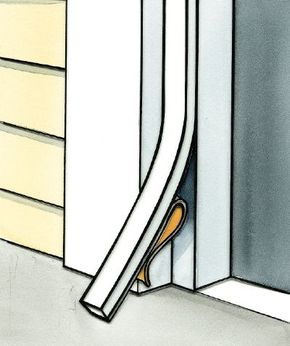
![]() ©2006 Publications International, Ltd. Seal the top and sides of a door with adhesive-backed foam weatherstripping. To install the foam, peel off the backing and stick the strip down. |
Step 3: Use scissors to cut strip to fit, but don't remove backing paper yet.
Step 4: Starting at one end, slowly peel paper backing as you push sticky foam strips into place. If backing proves stubborn at beginning, stretch foam until seal between backing and foam breaks.
Step 5: Attach strips on hinge side to doorjamb.
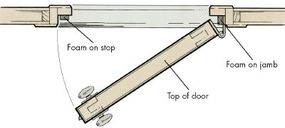
![]() ©2006 Publications International, Ltd. Attach strips of pressure-sensitive foam on the hinge side of the doorjamb and on the doorstop. The adhesive backing on the foam will form a secure bond only when applied to a clean, grease-free surface. |
Step 6: Attach other two strips to doorstop. If corner of door catches weatherstripping as you close it, trim top piece of foam on hinge side. Serrated-metal weatherstripping, usually with a felt-strip insert running the length of the serrated groove, also can be used to seal air gaps around doors. To install this type of weatherstripping, measure the length of strips required, and then use tin snips or heavy-duty scissors to cut the serrated-metal material to the proper lengths. Nail each strip at both ends, add a nail to the center of each strip, and drive additional nails every 2 to 3 inches along the rest of the strip.
Creating a weathertight threshold: The
gap at the bottom of the door is treated differently from the gaps on
the sides and along the top.The wood or metal hump on the floor along
the bottom of the door is called the threshold.
What You'll Need Here are the tools you'll want to have to make a weathertight threshold around doors:
|
Many of the metal types feature a flexible vinyl insert that creates a tight seal when the door closes against it. Other thresholds consist of one unit on the floor and a mating piece on the bottom of the door. These two pieces interlock to form a weathertight barrier.
In most cases, the threshold with a flexible vinyl insert is the easiest to install. Interlock systems are quite effective when properly installed, but they require a perfect fit or they will not work satisfactorily.
Wooden thresholds often wear down to the point where they must be replaced. This is an easy installation, and there are many types of replacement thresholds from which to choose. Most are aluminum and come in standard door widths; however, if your door is not standard width, you can trim the aluminum threshold with a hacksaw. Here's how to install a replacement threshold:
Step 1: Remove old threshold. If it is wood, there are two ways to remove it. In most cases, you can pry it up after removing doorstops with small flat pry bar or putty knife, but you must work carefully and slowly. If jamb itself rests on threshold, saw through old threshold at each end.
Use
backsaw placed right against jamb, and saw down through threshold,
being careful not to scar floor. Once you make cuts, threshold should
be easy to pry up. If prying doesn't work, use chisel and hammer to
split piece. Metal thresholds are frequently held down by screws
concealed under vinyl inserts. Once you remove screws, threshold will
come up easily.
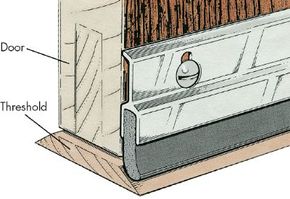
![]() ©2006 Publications International, Ltd. A door sweep can create a tight seal when a gap exists between the bottom of the door and the threshold. Door sweeps can be made of wood and felt, wood and foam, or metal and vinyl. All are effective in sealing out drafts. |
Step 2: Install replacement threshold by driving screws through metal unit and into floor. If you don't want aluminum threshold, cut replacement from wood, using original one as pattern.
Step 3:
Install door sweep to seal gap. Most sweeps are attached to inside of
door with nails or screws. Cut sweep to size, and close door. Tack both
ends of sweep to door, then install remaining nails or screws. If you
are using screws, drill pilot holes first.
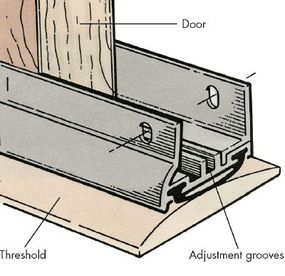
![]() ©2006 Publications International, Ltd. A bottom sweep slides on over the bottom of the door; adjustment grooves adapt it to any door thickness. |
Some types of sweeps slip under the door and wrap around the bottom. Still another type fits on the outside, with a section of it flipping upward to miss the threshold when the door is opened. When the door is closed, this section flips back down to provide a seal against the threshold. You can adjust this type of door sweep so it renders a snug fit.
Weatherstripping and weather-proofing your doors -- and the rest of your home -- can help keep you comfortable when the weather is inclement. And the good news is that you can make these improvements to your home without having to call a professional.©Publications International, Ltd.