When you want to refinish old wooden furniture, the best place to look is the family storeroom: Check the attic, basement, garage, or wherever unwanted furniture has collected. You may also discover a real antique or two -- pieces handed down through the family for generations. Other good sources are secondhand stores, household auctions, and garage sales. With furniture, as with anything else, one person's junk is another another's treasure.
Antique stores are a good place to find furniture to refinish, but expect to pay for these pieces. If you're interested in antiques, recent or old, research before you buy anything. Real antiques and many reproductions are extremely valuable, but there are also many imitations. If you aren't sure an antique is really antique, pay for an expert opinion. Never buy an antique, or try to refinish it, until you know what you have. In this article, we'll discuss how to assess whether a piece of furniture is an antique and whether it is worth saving through the refinishing process.
Advertisement
When is Old an Antique?
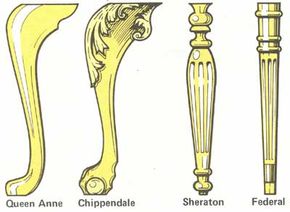
There are many different styles of furniture, and each type has distinguishing features. For the most part, the furniture you'll encounter will probably be limited to traditional English and American Colonial styles; you aren't likely to find a Louis XV chair at a garage sale. The basic English and American styles run the gamut from ornate to severely functional, from massive to delicate. Just remember, if you like it, the style is right.
Technically, an antique is a piece of furniture with special value because of its age, particularly those pieces embellished with fine artistry. The age factor is subjective: general antique stores label objects 50 years or older as antiques. Fine antique dealers consider objects 150 years and older to be antique.
In the East, an antique is Queen Anne or earlier; in the West, it's any piece of furniture that came across the mountains in a wagon. A southern antique is a piece made before the Civil War. Wherever you look, it's a sure bet that you won't find a genuine antique from 1500 or 1600. What you may find is a genuine reproduction, and these can be extremely valuable.
There are several ways you can spot an antique. The first giveaway is the joinery; machine-cut furniture wasn't made until about 1860. If the piece has drawers, remove a drawer and look closely where the front and back of the drawer are fastened to the sides of the drawer. If a joint was dovetailed by hand, it has only a few dovetails, and they aren't exactly even; if it has closely spaced, precisely cut dovetails, it was machine-cut. Handmade dovetails almost always indicate a piece made before 1860.
Look carefully at the bottom, sides, and back of the drawer; if the wood shows nicks or cuts, it was probably cut with a plane, a spokeshave, or a drawknife. Straight saw marks also indicate an old piece. If the wood shows circular or arc-shaped marks, it was cut by a circular saw, not in use until about 1860.
Exact symmetry is another sign that the piece was machine-made. On handmade furniture, rungs, slats, spindles, rockers, and other small-diameter components are not uniform. Examine these parts carefully; slight differences in size or shape are not always easy to spot. A real antique is not perfectly cut; a reproduction with the same components is, because it was cut by machine.
The finish on the wood can also date the piece. Until Victorian times, shellac was the only clear surface finish; lacquer and varnish were not developed until the mid-1800s. The finish on a piece made before 1860 is usually shellac; if the piece is very old, it may be oil, wax, or milk paint. Fine old pieces are often French-polished, a variation of the shellac finish. A lacquer or varnish finish is a sure sign of later manufacture.
Testing a finish isn't always possible in a dealer's showroom, but if you can manage it, identify the finish before you buy. Test the piece in an inconspicuous spot with denatured alcohol; if finish dissolves, it's shellac. If the piece is painted, test it with ammonia; very old pieces may be finished with milk paint, which can be removed only with ammonia. If the piece of furniture is very dirty or encrusted with wax, clean it first with a mixture of denatured alcohol, white vinegar, and kerosene, in equal parts.
The wood itself is the final clue. Very early furniture -- before 1700 -- is mostly oak, but from 1700 on, mahogany and walnut were widely used. In America, pine has always been used because it's easy to find and easy to work; better furniture may be made with maple, oak, walnut, cherry, or mahogany. But because the same woods have always been favored for furniture, workmanship and finish are probably a better indicator of age than the wood itself.
Let's look at the differences between basic English and American furniture styles in the next section.
Advertisement