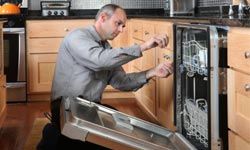
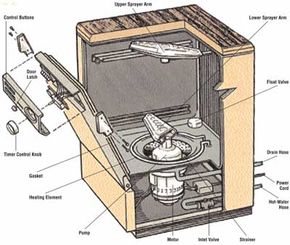
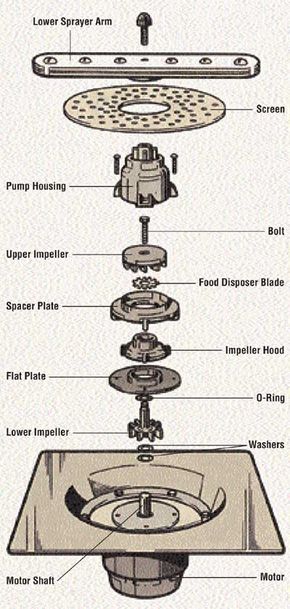
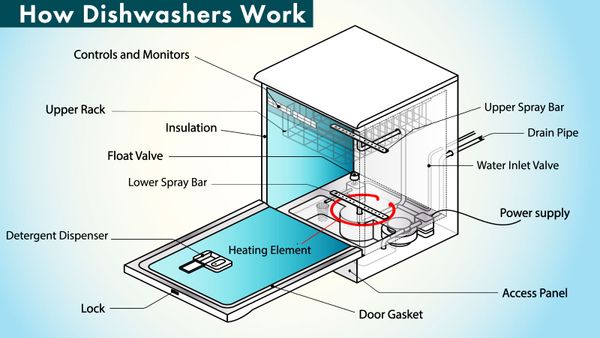
When your dishwasher isn't working properly, you should check several main components, such as the door gasket, door latch, switches, and timer.
Replacing the Door Gasket
If water leaks through the dishwasher door, the gasket is probably faulty. Open the door and examine the gasket. It should be soft and resilient. If it's worn, cracked, or hard, it should be replaced.
Once the gasket is in place, check it for fit against the door frame. It should fit tightly with no cracks or bulges between the gasket and the frame. If necessary, tighten or loosen the retaining screws, or refit the gasket in the clips or the door channel. Then run the machine through a washing sequence and check for leaks.
If you spot a leak, and the gasket seems to be properly in place, try adjusting the door latch. The trick is to position the gasket against the frame of the door without flattening the gasket or squeezing it too flat when the door is latched properly. Adjust the latch or the gasket until it fits snugly against the door frame.
Servicing the Door Latch
The latch on a dishwasher door is opened and closed repeatedly, and this hard use can lead to mechanical problems. The latch may be loose, or it may have slipped out of position, throwing the alignment off and preventing the door from closing properly. When this happens, the latch does not engage properly, and the dishwasher will not start.
In many cases, you may be able to solve the problem by adjusting the position of the latch. Move the latch slightly by loosening the screws that hold it. Slide the latch with your fingers or pliers; the screw slots are made especially for this purpose. Close and open the door to see whether the latch is properly aligned. Tighten the screws to hold it in the correct position.
After repositioning the latch, check to see if it's working properly. Close and latch the door and turn the control knob to the ON position. If the dishwasher doesn't start, the latch is faulty. Replace it with a new latch, connecting it the same way the old one was connected. You may have to move the new latch back and forth several times before it works properly.
Servicing the Door Switch
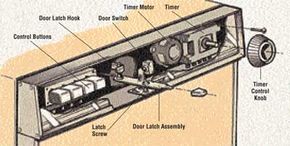
On many dishwashers, the latch engages a switch to activate the timer and other control components. If the latch is not completely engaged or if the switch is faulty, the machine will not operate. Here's how to test and repair a door switch:
Step 1: Latch the door and hold the latch tightly in the closed position. This works best on a unit with a lever-type latch. Then turn the control to the ON position. If the unit works, the problem is probably a misaligned lock unit. Adjust the lock unit with a screwdriver. If this doesn't solve the problem, the switch may be faulty.
Step 2: Test the switch with a volt-ohm-milliammeter (VOM) set to the RX1 scale. Remove the panel covering the door switch and remove one of the electrical lead wires of the switch from its terminals. Clip one probe of the VOM to each switch terminal and shut the dishwasher's door. If the meter reads zero, the switch is working. If the meter reads higher than zero, the switch is faulty and should be replaced.
Step 3: Replace the switch with a new one of the same type. Connect the new switch the same way the old one was connected.
Servicing the Float Switch
Dishwashers are usually protected from overfilling by a float switch. This switch is located in the bottom of the unit. Here's how to check and replace it:
Step 1: Open the door and remove the bottom dish rack. Check to see if the float valve is stuck. If it is, clean away food debris around the float. With a screwdriver handle, lightly tap the top of the float to free it.
Step 2: If tapping doesn't work, remove the lower access panel and locate the bottom portion of the float and float switch. Test the float switch with a VOM set to the RX1 scale. Unscrew one electrical lead wire to the switch terminal, and clip one probe of the VOM to each terminal. If the meter reads zero, the switch is not faulty. The trouble is probably in the timer. If the meter reads higher than zero, the switch is faulty.
Step 3: Replace the switch with a new one made to fit the dishwasher. The switch is held to a mounting bracket with screws; remove the screws to get the old switch out.
Step 4: Connect the new switch the same way the old one was connected.
Servicing Timer and Control Switches
Because the timer controls many operations, a faulty timer can cause many problems. The timer is a complex component, so you shouldn't attempt a do-it-yourself repair. Test the timer with a VOM set to the RX1 scale. To gain access to the timer, remove the front control panel. The timer is directly behind the main timer control knob. Disconnect one of the timer's terminal wires and clip one probe of the VOM to each terminal. If the meter reads zero, the timer is working. If the meter reads higher than zero, the timer is faulty and should be replaced.
If possible, use the same procedure to test the selector and cycle switches. The wiring hookup, however, may be too complicated to figure out on either of these switches. If you aren't sure you can deal with these switches, call a professional service person. Replace a faulty timer -- or a faulty control switch -- with a new one made for the dishwasher.
The timer is connected to several wires that supply power to operate the various functions of the dishwasher. To replace the timer, have a helper hold the new timer next to the old one. Connect the wires of the new timer one by one, removing the old wire and connecting the new, to make sure you connect the wires correctly. The wires may be friction-fit on the terminals. If they are, use long-nosed pliers to remove the wires. Don't pull up on the wires, or you may break the connection between the wires and the clips.
After connecting the wires, set the new timer in position, secure it the way the old one was secured, and replace the control panel and knobs.
If your dishwasher won't fill with water properly or isn't drying the dishes, you most likely have a valve or heating element problem. In the next section, we'll discuss how you can assess these types of problems.