
Let's start with a normal electric light bulb like you see in any normal household lamp. A normal light bulb is made up of a fairly large, thin, frosted glass envelope. Inside the glass is a gas such as argon and/or nitrogen. At the center of the lamp is a tungsten filament. Electricity heats this filament up to about 4,500 degrees F (2,500 degrees Celsius). Just like any hot metal, the tungsten gets "white hot" at that heat and emits a great deal of visible light in a process called incandescence. See How Gas Lanterns Work for more information on incandescence.
A normal light bulb is not very efficient, and it only lasts about 750 to 1,000 hours in normal use. It's not very efficient because, in the process of radiating light, it also radiates a huge amount of infrared heat -- far more heat than light. Since the purpose of a light bulb is to generate light, the heat is wasted energy. It doesn't last very long because the tungsten in the filament evaporates and deposits on the glass. Eventually, a thin spot in the filament causes the filament to break, and the bulb "burns out."
Advertisement
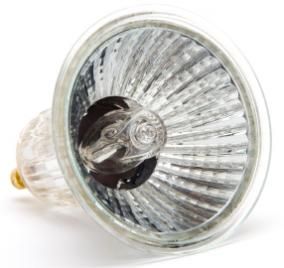
A halogen lamp also uses a tungsten filament, but it is encased inside a much smaller quartz envelope. Because the envelope is so close to the filament, it would melt if it were made from glass. The gas inside the envelope is also different -- it consists of a gas from the halogen group. These gases have a very interesting property: They combine with tungsten vapor. If the temperature is high enough, the halogen gas will combine with tungsten atoms as they evaporate and redeposit them on the filament. This recycling process lets the filament last a lot longer. In addition, it is now possible to run the filament hotter, meaning you get more light per unit of energy. You still get a lot of heat, though; and because the quartz envelope is so close to the filament, it is extremely hot compared to a normal light bulb.
Advertisement