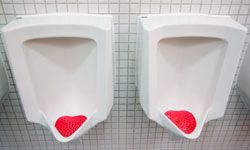
In the United States alone, there are about 8 million urinals operating everywhere, from small office buildings and huge skyscrapers to giant sports arenas [source: Waterless]. About 100 million people use those urinals, and they consume somewhere in the neighborhood of 160 billion gallons (605 billion liters) of water every year [source: Waterless]. The less traditional waterless urinals, however, can actually save a huge amount of water. Just imagine if those 160 billion gallons of water were cut in half, or even reduced to zero.
Today, waterless urinals still haven't quite broken through to the mainstream. It's not hard to understand why. Hearing the phrase "waterless urinals" can lead to a lot of questions. "Don't they stink?" "Aren't they unsanitary?" "Where is all that urine going if you don't flush it?" Read on to find out the answers to these and other questions about these waterless wonders.
Advertisement