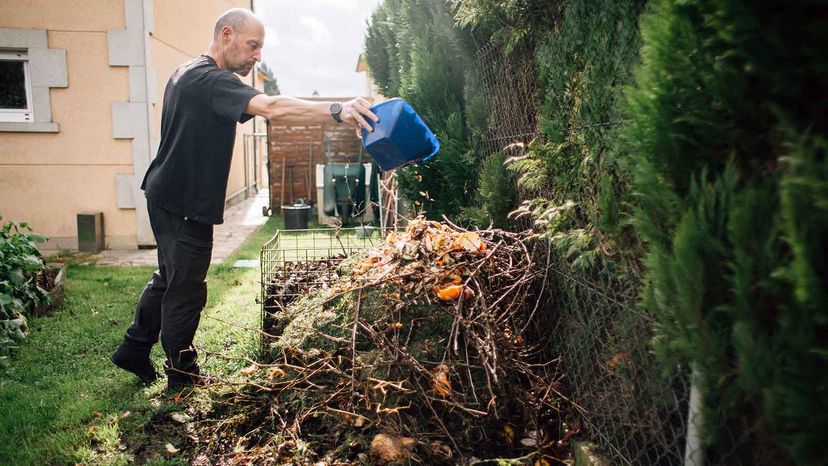
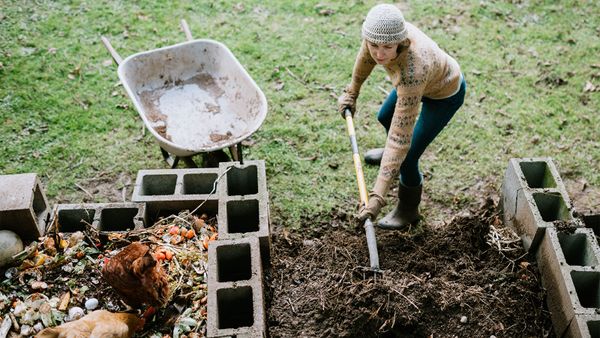
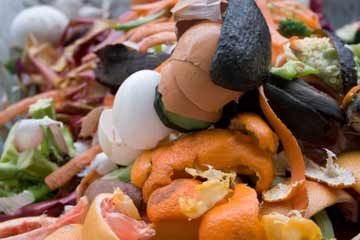
Composting is an inexpensive way to make rich fertilizer out of yard waste and kitchen scraps. Os Tartarouchos/Getty Images
Americans generate about 292 million tons (265.3 million metric tons) of trash, or municipal solid waste, each year [source: EPA]. About half of this trash (52 percent) gets placed in municipal landfills. The rest is recovered through either recycling (glass, paper products, plastic or metal) or through composting (yard waste). But what is compost?
Composting is a method for turning organic materials — think fresh grass clippings, pine straw, leaves, food scraps even coffee grounds — into valuable fertilizer. It's a natural process in which the organic materials are broken down by microorganisms with the help of oxygen. You can compost at home and it's not inexpensive, but you'll end up with a rich finished product — compost or humus — that can benefit your yard as a natural fertilizer and soil amendment for gardening.
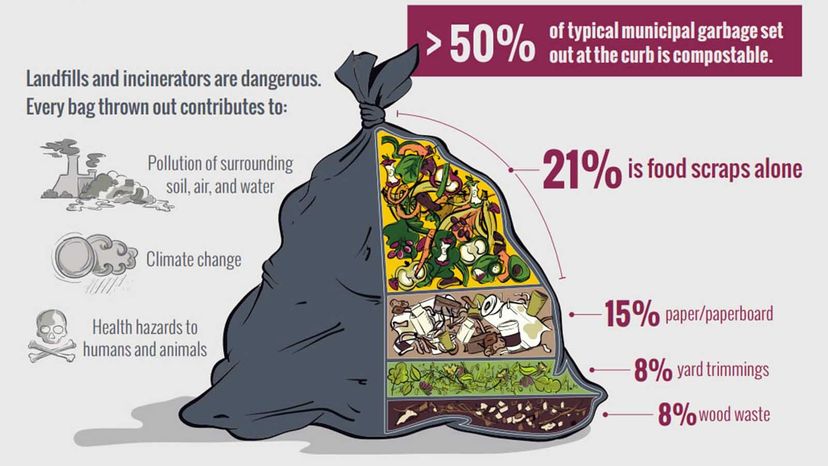
Composting helps keep tons (literally) of trash out of the landfill, so it benefits everybody. EPA
Composting creates the ideal conditions for the natural decaying and rotting processes that occur in nature. Composting requires the following:
organic waste: newspaper, leaves, grass, kitchen waste (fruit and vegetable scraps), woody materials, coffee grounds, etc.
water
oxygen
During composting, microorganisms eat the organic (carbon containing) waste and break it down into its simplest parts. This produces a fiber-rich, carbon-containing humus with inorganic nutrients like nitrogen, phosphorus and potassium. The microorganisms break the material down through aerobic respiration. All that really means is they need oxygen. That's where you come in. They get that oxygen from air you introduce when you turn the compost (more on that in a minute).
Advertisement
The microorganisms also need water to live and multiply. Through the respiration process, the microorganisms give off carbon dioxide and heat. Temperatures within a compost pile can rise as high as 100 to 150 degrees Fahrenheit (38 to 66 degrees Celsius). If you manage your compost pile by turning and watering it regularly, it will decompose into finished compost within a few weeks.
But conditions have to be balanced for efficient decomposition. You have to make sure your compost pile gets:
Proper mix of carbon to nitrogen: the ratio should be about 30:1.
Small pieces: Break big chunks up, as smaller particles will break down faster.
Why Compost?
The major goal of composting is to reduce the amount of solid waste you generate and keep it out of the municipal landfills, which could ultimately save you tax money. Finished compost also can be useful as a natural fertilizer and it's way more environmentally friendly than synthetic fertilizers.
Bacteria and fungi primarily break down the organic matter in the compost. Single-celled organisms (protozoa), small worms (nematodes) and mites feed on the bacteria and fungi. Predatory nematodes, predatory mites and other invertebrates (sowbugs, millipedes, beetles) feed on the protozoa, mites and nematodes. All of these organisms work to balance the population of organisms within the compost, which increases the efficiency of the entire process.
Advertisement
Making Compost
To start making compost, you need to first choose a site and then start adding your ingredients. Yifei Fang/Getty Images
Making compost is pretty simple, once you get started:
Choose a site for the compost pile.
Choose a structure.
Add the compost materials.
Care for and feed the compost pile.
Collect the finished compost for use.
Choose a Site
Where to place your compost pile is an important thing to consider. You want to be able to keep the pile away from your house, but not so far away that you won't go out and attend to it. But you don't want it too close to the boundaries of your property that your neighbors might complain. Your local housing ordinances or homeowner organization rules may specify where you can place it. Other factors to consider include the following:
Advertisement
Downwind from your house: Even a well-managed compost pile may occasionally emit unpleasant odors. Although wind provides air, too much wind can dry and/or scatter the material.
Sunlight: Sunshine can help warm the compost pile in the winter, but too much sunlight can dry it out. If the pile is located by a large deciduous tree, you will have cool shade in the summer and sunlight in the winter.
Drainage: You want good drainage so too much water doesn't collect by the pile.
Surface: Bare earth is better than concrete. Make sure to give yourself a sufficient work area around the pile (6 to 8 feet or about 2 meters).
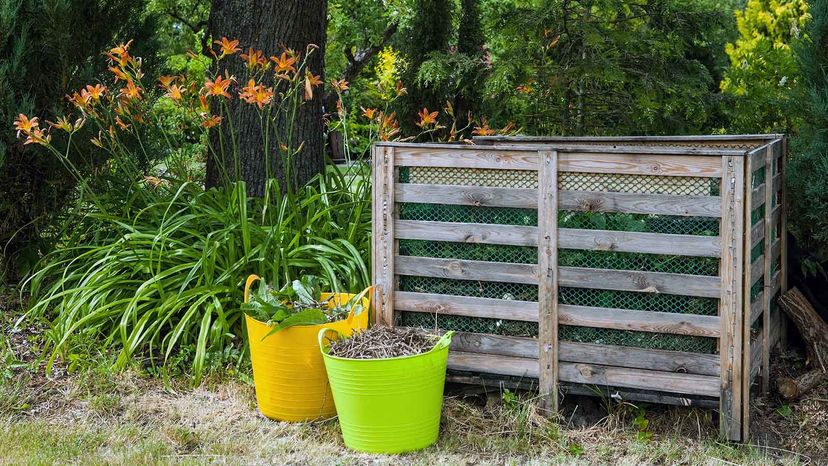
Compost bins come in all shapes and sizes. You can build one yourself or buy one at a home improvement store.
JurateBuiviene/Shutterstock
Choose a Structure
Compost structures can be as simple as a heap where you just pile all the ingredients and let nature take its course; this is passive composting. Passive composting is less efficient and slower than active composting, in which you manage the compost process daily.
You can also build more complicated compost bins out of chicken wire, wood or concrete blocks. They can be simple, one-compartment structures in which you add new materials to the top, turn the compost frequently and collect the finished compost from the bottom.
Multi-compartment (three-bin) structures allow you to add new material to one bin, transfer partially completed compost to the middle bin and move finished compost to the final bin. There should be some covering on the top of the bin to minimize excess rainwater and reduce scattering from the wind.
You don't have to do it yourself, however. There are many kinds of compost bins you can buy, including tumblers that allow you to turn the compost with a handle. There also are stacked bins for composting with the help of worms. And don't forget to check with your city or garbage collection company. They may offer inexpensive or even free composting bins.
The choice depends entirely on the effort and expense you wish to devote to the project, as well as the amount of compost you want to make. Also, local ordinances may dictate what kind of bin you can use.
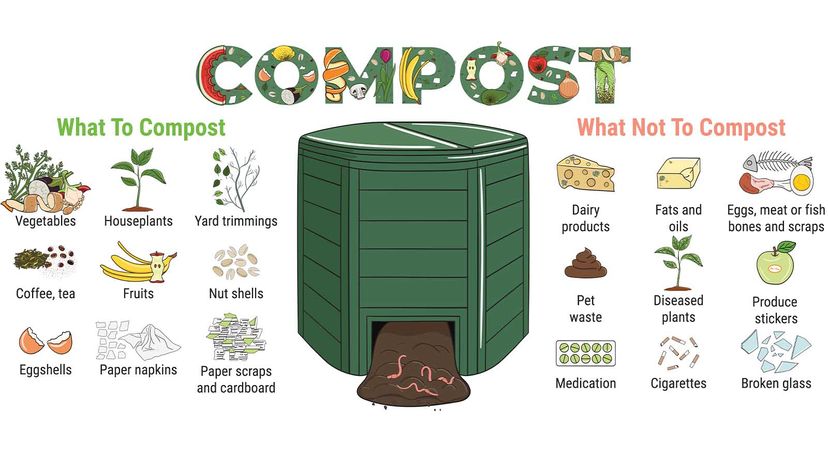
You can compost the following materials easily:
Kitchen Waste
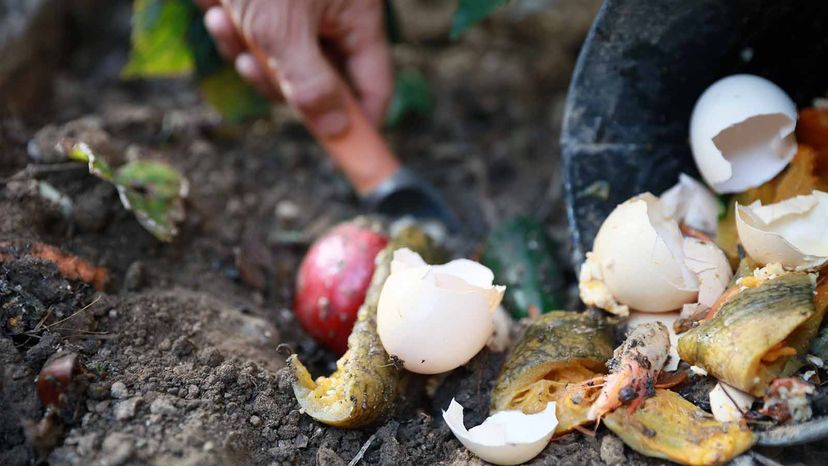
Almost anything you chop on a cutting board can go in the compost bin. This forms the "green layer" that you'll often read about in composting guides. These provide plenty of carbon for the microorganisms to break down.
fruit and vegetable waste: peels, skins, seeds, leaves
eggshells
coffee grounds (including paper filters)
corncobs: shredded so they break down quickly
nut shells
tea bags
used paper napkins
Yard Waste
Anytime you do yard chores, collect the debris in a bucket and dump it into the compost bin. This forms the "brown layer," which provides lots of the nitrogen necessary for the composting process.
Word to the wise: Weeds will technically break down to become compost, but they are tough buggers. Home compost bins don't usually get hot enough to break weeds down all the way, so adding weedy compost to your garden can introduce weeds to your flower veggie beds. Not what we're looking for here.
grass clippings: Some grass is OK, but too much will add excess nitrogen to the compost pile and make it smell bad. It may be best to use a mulching lawn mower instead.
leaves
pine needles
woody materials (branches, twigs)
straw or hay
sawdust
fireplace ash
What you should and should not put in your compost bin or pile is pretty straightforward.
m.malinika/Shutterstock
The following materials SHOULD NOT BE COMPOSTED:
Human or pet waste, or cat litter: They carry diseases and parasites, as well as cause an unpleasant odor.
Diseased garden plants: They can infect the compost pile and influence the finished product.
Invasive weeds: Spores and seeds of invasive weeds (buttercups, morning glory, quack grass) can survive the decomposition process and spread to your desired plants when you use the finished compost.
Charcoal ash: It is toxic to the soil microorganisms.
Pesticide-treated plant material: These are harmful to microorganisms, and pesticides may survive into the finished compost.
You might be wondering about composting meat, since you can compost eggs. Meat and bones take a long time to compost, especially in at-home compost bins. As we mentioned, they usually don't get hot enough to break down meat quickly, which means it sits in your compost for a long time. Long enough to become stinky, which means your yard will start to smell bad and attract critters who would love a meat buffet and a side of greens that haven't broken down yet.
Large-scale municipal composters, which your city might have, do get hot enough to handle meat and bones, so you can usually compost those materials at the curb.
Advertisement
Care and Feeding of Your Compost
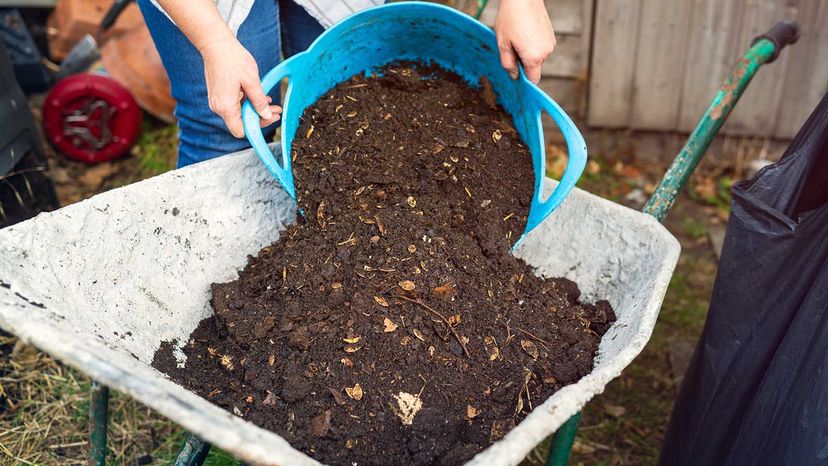
Your finished compost should be rich and warm, and the color should be dark brown or black. Christopher Hopefitch/Getty Images
It's best to arrange carbon-rich and nitrogen-rich materials in alternating layers, "green" then "brown." Add new layers of composting material to the top along with fresh soil. Water the compost bin regularly to keep the compost moist. Turn the compost every few days to ensure an adequate supply of oxygen. You'll either turn the pile with a pitchfork or shovel, or crank a handle on your tumbler to mix it up.
Worm Composting
Composting with worms, called vermicomposting, means your compost will be ready earlier. Any compost pile that touches the ground will naturally attract local worms, but vermicomposting involves adding worms to the pile on purpose. You can seed your compost pile with earthworms or buy special composting worms.
Advertisement
As you add new layers and turn the compost, you will be mixing new layers of intact trash with partially decomposed layers. The partially and nearly finished material will settle to the bottom because the particles are smaller. The finished compost will come out of the bottom of the bin. Most bins that you can buy have a hatch at the bottom to make it easy to scoop a few shovels full out when you need it. In three-bin systems, you add intact trash to the first bin and actively transfer partially and finished compost to the second and third bins.
Collect the Finished Compost
The finished compost will collect at the bottom of the bin in a single bin system or at the third bin in a three-bin system. There is no strict definition of when the compost is done. Basically, if you think it's done, it's done.
Here are some signs that your compost pile is working properly:
Size: The volume should be reduced by 50 to 75 percent and you may even see some gas bubbles in the pile. That means carbon dioxide is being released as the microorganisms do their work.
Color: It should be dark brown or black.
Texture: It should be smooth and crumbly.
Smell: It should not smell bad. It should have a sweet, earthy smell, like peat moss.
Temperature: It should be warm. The microorganisms are "cooking away," and you may even see some steam rising from the pile, especially on a cool morning.
Once your compost is done, it is ready to use. Finished composts can do the following:
Improve the soil structure in your garden or yard
Increase the activity of soil microbes
Enhance the nutrients of your soil
Improve the chemistry of your soil, particularly the degree of acidity (pH)
Insulate the changes in soil temperature around plants and trees
Improve insect and disease resistance in your garden plants and trees
Most home composters use their finished product around their own home, for their trees or gardens. Some home composters sell their finished compost to local nurseries or other family gardeners.
Advertisement
Composting in the 21st Century
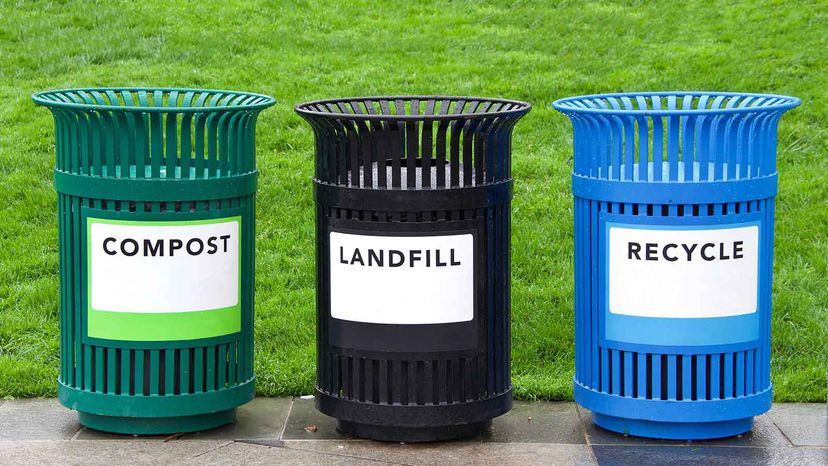
Many major cities in the U.S. now offer curbside composting as part of their municipal trash service. Some even have compost cans alongside landfill and recycling cans, as well. Sheila Fitzgerald/Shutterstock
Composting has come a long way in the past few decades. Most people can — and many do — compost, no matter where they live or what they grow. Suburban flowerbeds, rooftop herb gardens, and country vegetable gardens all benefit from compost made at home. It also keeps a lot of garbage out of landfills.
Speaking of garbage collection, many municipalities offer composting at the curb. San Francisco led the way with its citywide composting program, with Portland, Oregon; Seattle, Washington; and Boulder and Denver, Colorado adding programs in recent years. In cities like these, residents are given a garbage can, a recycling bin, and a compost bin for all yard waste and food scraps. It's collected along with the other trash and processed at massive composting sites.
Advertisement
Other companies, including CompostNow, WasteNot Compost and Compost for Life Miami, specialize in residential and commercial collection of food waste. They also sell the compost they create back to homeowners so it's a win-win for everybody.
Some restaurants and food carts offer compostable or biodegradable takeout containers, but these can't be broken down by your at-home compost pile. They are meant to be industrially composted in cities like San Francisco and Portland. You can even toss non-greasy pizza boxes in those city compost bins.
Advertisement
Why Bother With Composting?
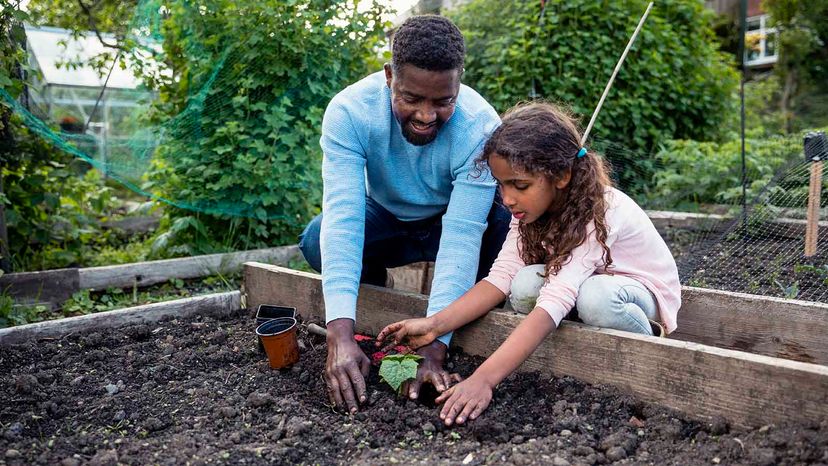
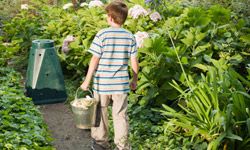
Teaching your children about composting is just another way they can learn how to protect the environment, and how to encourage them to nourish the planet for the future. SolStock/Getty Images
This can seem like a lot of work for a little dirt, but it's worth it for a lot of reasons. Let's start with one people don't often talk about: money.
Take a city like Portland, Oregon, which has citywide composting. The green compost bin is picked up every week all year, just like the recycling bins. The garbage bin is only picked up every two weeks. Depending on the size of your family that garbage can is going to fill up fast. If you throw every bit of your trash in the garbage, you're going to need a large bin to hold two weeks' worth of trash, which is expensive. If you can shift the bulk of that material to the compost and recycle bins, you can save a lot of money by choosing a smaller garbage bin.
Advertisement
Even if you don't have citywide composting where you live, most areas charge by the size of the bin. If you can compost almost all your food waste at home, you might be able to downsize your garbage cart and save some serious money.
That's not to mention that if you do garden, you can spend less on fertilizer and store-bought compost for flowerbeds and veggies. Even if you don't have a serious green thumb, you can take that compost and spread it on your lawn or around your trees for free.
There's also the benefit of keeping trash out of landfills. And the benefit of helping plants thrive, which helps increase oxygen in our atmosphere. And the satisfaction of using fertilizer you made yourself, with a little help from tiny bug friends and worms.