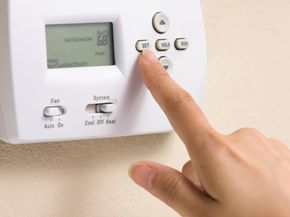
Introduction to How Home Thermostats Work

thermostat layers
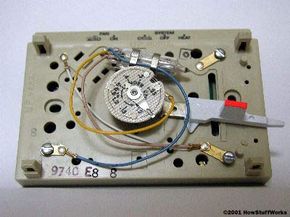
Most thermostats have three layers.
See more pictures of thermostats.

You've probably seen or used a thermostat a thousand times. This device controls the heating and air-conditioning systems in your house -- the two pieces of equipment that use the most energy. In these days of rising energy prices, you might be interested to see how your thermostat works. It is surprisingly simple and contains some pretty neat technology.

In this article, we'll take apart a household thermostat and learn how it works. We'll also learn a little about digital thermostats, talking thermostats, telephone thermostats and system zoning. Let's start by taking a look at the parts of a basic thermostat.

The mercury switch is a glass vial with a small amount of mercury in it. Mercury is a liquid metal -- it conducts electricity and flows like water. Inside the glass vial are three wires. One wire goes all the way across the bottom of the vial, so the mercury is always in contact with it. One wire ends on the left side of the vial, so when the vial tilts to the left, the mercury contacts it -- making contact between this wire and the one on the bottom of the vial. The third wire ends on the right side of the vial, so when the vial tilts to the right, the mercury makes contact between this wire and the bottom wire.

mercury switch
The mercury switch

­There are two thermometers in this thermostat. The one in the cover displays the temperature. The other, in the top layer of the thermostat, controls the heating and cooling systems. These thermometers are nothing more than coiled bimetallic strips. We'll look at them in more detail next.

Going Green
Adjusting your thermostat and shortening your showers aren't the only easy ways to go green. Learn lots more about how you can make a difference at Discovery Planet Green.

­

Thermometers and Switches

A bimetallic strip is a piece of metal made by laminating two different types of metal together. The metals that make up the strip expand and contract when they are heated or cooled. Each type of metal has its own particular rate of expansion, and the two metals that make up the strip are chosen so that the rates of expansion and contraction are different. When this coiled strip is heated, the metal on the inside of the coil expands more and the strip tends to unwind.

thermometer coil
A thermometer coil with bimetallic strips attached

The center of the coil is connected to the temperature-adjustment lever, and the mercury switch is mounted to the end of the coil so that when the coil winds or unwinds, it tips the mercury switch one way or the other.

Circuit Card and Switches
This thermostat contains two switches. The switches move small metal balls that make contact between different traces on the circuit card inside the thermostat. One of the switches controls the mode (heat or cool), while the other switch controls the circulation fan.

switches
The two switches: The fan switch moves one metal ball,
and the mode switch moves two.

­On the next page, we'll see how these parts work together to make the thermostat work.

Inner Workings

When you move the lever on the thermostat to turn up the heat, this rotates the thermometer coil and mercury switch, tipping them to the left.

thermostat layer
Inside the thermostat, there are two layers of controls.
The top layer houses the mercury switch and thermometer coil.

As soon as the switch tips to the left, current flows through the mercury in the mercury switch. This current energizes a relay that starts the heater and circulation fan in your home. As the room gradually heats up, the thermometer coil gradually unwinds until it tips the mercury switch back to the right, breaking the circuit and turning off the heat.

When the mercury switch tips to the right, a relay starts the air conditioner. As the room cools, the thermometer coil winds up until the mercury switch tips back to the left.

Heat Anticipator
Thermostats have a neat device called a heat anticipator. The heat anticipator shuts off the heater before the air inside the thermostat actually reaches the set temperature. Often, some parts of the house will reach the set temperature before the part of the house containing the thermostat does. The anticipator shuts the heater off a little early to give the heat time to reach the thermostat.

anticipator
The anticipator is a ring of resistive wire on the dial.

The loop of wire above is actually a resistor. When the heater is running, the current that controls the heater travels from the mercury switch, through the yellow wire to the resistive loop. It travels around the loop until it gets to the wiper, and from there it travels through the hub of the anticipator ring and down to the circuit board on the bottom layer of the thermostat. The farther the wiper is positioned (moving clockwise) from the yellow wire, the more of the resistive wire the current has to pass through. Like any resistor, this one generates heat when current passes through it. The farther around the loop the wiper is placed, the more heat is generated by the resistor. This heat warms the thermometer coil, causing it to unwind and tip the mercury switch to the right so that the heater shuts off.

Next, we'll take a more detailed look at the electrical circuits in the thermostat.

­

Wired

This thermostat is designed for a system with five wires -- the wire terminations are marked as follows:

  • RH - This wire comes from the 24VAC transformer on the heating system.
  • RC - This wire comes from the 24VAC transformer on the air-conditioning system.
  • W - This wire comes from the relay that turns on the heating system.
  • Y - This wire comes from the relay that turns on the cooling system.
  • G - This wire comes from the relay that turns on the fan.

thermostat layers
This circuit board is located in the base of the thermostat.
The five wires from the house hook up to the five screws.

The two transformers provide the power the thermostat uses to switch on the various relays. The relays in turn switch on the power to the fan and the air conditioner or furnace. Let's see how this power flows through the thermostat when the air conditioner is running.

Power from the air-conditioning transformer comes into the terminal labeled RC. The ball controlled by the mode switch jumps the current onto a trace that leads to the terminal in the lower-right corner of the circuit board.

This terminal connects to the top layer of the thermostat through a screw. It connects to the pink wire, which leads to the bottom wire in the mercury switch. If the switch is tilted to the right (as it would be if the air-conditioning were on), the current travels through the mercury into the blue wire.

top layer
This is the top layer of the thermostat. The three screws
visible in this photo connect to the circuit card
in the bottom layer of the thermostat.

Through a screw, the blue wire (see above) connects to a lug in the lower-left corner of the circuit card.

circuit card

­From there, it goes through a trace on the circuit card to the other branch of the mode switch. The ball in the mode switch jumps the current onto a trace that connects to the terminal marked G, which energizes the fan, and the terminal marked Y, which energizes the air-conditioning.

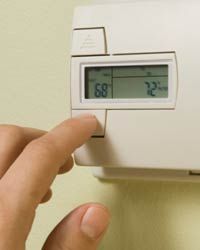
Digital thermostats use a simple device called a thermistor to measure temperature. A thermistor is a resistor whose electrical resistance changes with temperature. The microcontroller in a digital thermostat can measure the resistance and convert that number to a temperature reading.

A digital thermostat can do a few things that our mechanical thermostat cannot. One of the most useful features of a digital thermostat is programmable settings. In the winter, you can program it to automatically turn up the heat for an hour or two in the morning while you get ready for work, turn down the heat until you get home, turn up the heat in the evening and then turn down the heat while you sleep. This feature can save you money by turning down the heat when it isn't needed.

­

System Zoning

Often, there are rooms in your house that are always warmer or colder than others are, and there are many explanations for this. Because heat rises, rooms on second or third floors are often too warm, while basement rooms are frequently too cold. Rooms with vaulted ceilings have a difficult time retaining heat, while rooms that receive long hours of sunlight are often difficult to cool down. Regardless of why a room's temperature is uncomfortable, there is only one surefire way to even out your house's temperature: system zoning.

overheated dude
© Photographer: Soupstock |
Agency: Dreamstime

Feeling overheated?
System zoning can even out
your home's temperature.

­System zoning involves multiple thermostats that are wired to a control panel, which operates dampers within the ductwork of your forced-air system. The thermostats constantly read the temperature of their specific zone, then open or close the dampers within the ductwork according to the thermostat's settings. Not only is system zoning helpful for houses with inconsistent room temperatures, but it's also great for heating or cooling individual bedrooms based on the desired temperature setting.

If used properly, system zoning can help you save money on your energy bills. According to the U.S. Department of Energy, system zoning can save homeowners up to 30 percent on a typical heating and cooling bill. Those savings can add up to quite a sum -- the Department of Energy also estimates that heating and cooling account for 40 percent of the average household's utility costs. Because guest rooms and other seldom-used rooms do not require constant heating or cooling, system zoning allows you to save money by running temperature-controlled air to those rooms only when it is necessary.

Many homeowners are hesitant or unwilling to make the transition to programmable thermostats and system zoning because of the initial cost of installation. This is an understandable concern for anyone who is not building a new home or replacing an old HVAC system, but there are other options available. Even though installing a typical zoned system is not a do-it-yourself project, the Department of Energy's Inventions and Innovation Program funded the development of a damper system that can be retrofitted to existing ductwork. The system combines RetroZone's Flexdamper Air Control inserts with an electronic controller and air pumping system. There are no heavy motors involved, so existing ductwork does not need to be altered or supported.

The Flexdampers, which come in circular and square duct models, fill with air to constrict or block the airflow within the duct. They are resistant to heat, aging, moisture, airborne chemicals and ozone, and even if they are punctured, which is unlikely, most holes will not affect the performance. Flexdampers should be installed in steel or flexible ducts. The dampers can be serviced easily by gaining access through a register. Flexdampers also work with most brands of zone-control panels.

If you're planning to install a retrofitted zone-control system, here's what you'll need to put on your shopping list:

  • Thermostat for each zone
  • Solenoid pump
  • Solenoid panel
  • Zone control panel
  • Plenum tubing
  • Transformer
  • Fire rated tape
  • Control limit switch
  • Flexdampers

The number of zones your home needs will affect the way you set up the system. In a two-zone system, with the zones being fairly equal in size, each zone's ductwork must be capable of handling up to 70 percent of the total CFM (cubic feet per minute) of air produced by your HVAC system. In a three-zone system, the zones need to be as close in total area as possible. In this case, each zone's ductwork should be able to handle up to 50 percent of the total CFM. Installing a four-zone system requires a bit more work. The ducts need to be enlarged by one inch, and they require a static pressure relief damper and high- and low-limit protection. To avoid major damage, be sure not to completely cut off the airflow over the heat exchanger or coil of your HVAC system.

Now we'll look at another home-thermostat innovation -- the talking thermostat.

­

Talking Thermostats

Talking thermostats may seem like one of those unnecessary futuristic inventions straight out of an episode of "The Jetsons," but they are actually quite practical for senior citizens, people who are visually impaired or blind, and other people with special needs. Talking thermostats announce the time, day, temperature setting and room temperature, plus they have audio instructions for setup.

Even though talking thermostats are most helpful to people with vision impairments, they can also be useful to the general population.

digital thermostat­­

­It is often difficult to know when there is a problem in your heating and cooling system, and major problems can cost thousands of dollars to repair. Even minor problem can lead to far more serious and costly repairs if not diagnosed in a timely manner. Talking thermostats can end up saving you lots of time, money and stress because they alert you when you need to have your system serviced. They also let you know when you need to change the system filter. Promptly replacing the filter lowers the cost of heating and cooling your home and also helps people control allergies and asthma.

Some talking thermostats even recognize and respond to voice commands. You simply say an activation word, such as "thermostat," followed by a command like "raise" or "lower," and the rest is automated. Talking thermostats are able to do this because they use DSP, or digital signal processors, to process audio and speech. First, the DSP filters out real-world analog signals. Then, the microprocessor changes them into digital signals. After the signals have been converted, they're sent through application-specific integrated circuits, or ASICS, and the thermostat reacts in real time.

Because talking thermostats are high-end, cutting-edge accessories to heating and cooling systems, they come equipped with all of the user-friendly functions that other quality thermostats boast. A built-in time-delay function keeps your system from immediately starting or stopping if it is accidentally adjusted. Stopping and starting HVAC systems puts a lot of wear and tear on the compressor, which is the most expensive part of the system, so the delay function is quite important. Talking thermostats are also programmable, which allows you to heat or cool your home only when it is necessary.

Cutting Costs
If you turn down the heat 1 degree Fahrenheit (0.6 degrees Celsius) for eight hours a day, you can save about 1 percent of your heating energy costs. Turn it down 10 degrees Fahrenheit (6 degrees Celsius) to save about 10 percent. The same goes with the air-conditioning: Turn the temperature up 10 degrees Fahrenheit for ­eight hours a day to save approximately 10 percent on your bill.
­

Telephone Thermostats

If you happen to own a vacation home, you know the agony of paying to heat and cool two houses. Wouldn't it be nice if you could stop air conditioning your beach house or heating your mountain cabin when you're not there? The only problem would be that when you arrive at your vacation home, the temperature inside would be unbearable. That is, unless you program your thermostat to turn on before you get there. Programmable home thermostats could help solve this heating and cooling problem completely, but they require precise planning of your comings and goings in order to get the desired result. Telephone thermostats, on the other hand, allow you to heat or cool your home with a simple phone call.

phone
vygnyo, SXC
If you have a telephone thermostat, you can heat or cool
your home with a phone call.

Telephone thermostats replace your existing home thermostats. They connect to both the heating and cooling system and to your phone line. You simply have to call your property and enter a password on a touch-tone phone to access the controls. Then you can adjust not only the temperature setting but the entire system mode as well.

Telephone thermostats can also be handy accessories for permanent residences. The weather can take unexpected turns -- when that happens, preprogrammed thermostats might unnecessarily heat or cool your home. With telephone thermostats, you have complete control over your heating and cooling settings. If a cold front moves in out of nowhere, you can turn up the heat from your office. By the time you arrive home, it will be warm and cozy. Since you have the option to change the settings over the phone should the weather change, remote access like this can help you save energy and money.

Telephone thermostats not only allow you to phone in changes to your heating and cooling system, but they can also alert you, another chosen contact and even your local heating-and-cooling service company to any problems that arise. You can set a minimum and maximum temperature, and the thermostat will send out a message if either temperature is reached. There is also a battery backup in case of a power outage, so there is almost no reason for your pipes to ever freeze again.

Telephone thermostats can handle these functions because they use digital microprocessors as well as a touch-tone detector and telephone interface module. Essentially, you can "talk" to your home thermostat via telephone thanks to the internal telephone access module. A separate phone line isn't necessary, and the telephone thermostat can even coexist with answering machines or voice mail. However, if you have a DSL high-speed Internet connection, you will need a DSL filter on the telephone line that connects to your talking thermostat.

Thermostat Location
Ideally, the thermostat should be located in the part of the house where people spend the most time. It should be about 5 feet (1.5 meters) off the ground and at least 18 inches (46 cm) away from an outside wall. It should not be exposed to any heat sources other than the air in the room, such as sunlight, other appliances, heater vents, windows or hot-water pipes. It is also best not to put a thermostat near stairways or in corners because they affect the circulation of air.

­

As technological advancements make their way to simple devices like thermostats, consumers benefit greatly from the combination of features.

For more information on home thermostats, check out the links on the following page.

­

Lots More Information

Related HowStuffWorks Articles

More Great Links

Sources

  • http://www1.eere.energy.gov/inventions/pdfs/retrozoneimpacts.pdf.
  • http://www.eere.energy.gov/buildings/info/documents/pdfs/26459.pdf.
  • http://www.talkingthermostats.com/telephone.shtml
  • http://www.talkingthermostats.com/
  • http://www.smarthome.com/300601.html
  • http://yourhome.honeywell.com/Consumer/Cultures/en-US/Products/
    Temperature+Zoning/
  • http://www.enablemart.com/Catalog/Household/
    KELVIN-Voice-Interactive-Thermostat
  • http://www.talkingthermostat.com/