The traditional range or stove, a single unit with cooktop above and oven below, is an affordable, space-conserving solution still chosen by most homeowners. But it's just one of the cooking options offered today.
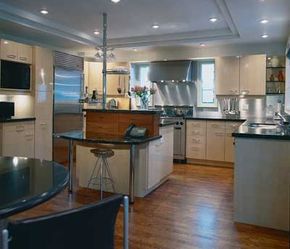
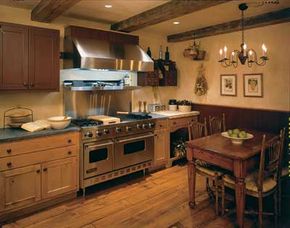
Some serious home cooks choose commercial-style stoves with six or eight burners instead of four, basting and grilling functions, and built-in warming ovens. (Real commercial stoves pose special challenges, such as special ventilation systems and noncombustible walls and floors, when used in the home, so commercial-style may be easier to live with.) Other people love the new modular cooktops that let you add burners, downdrafts, griddles, deep-fry and steamer units, woks, rotisseries, and grills. And these are just a few examples of what's available!
A modular approach to overall kitchen design is a pronounced trend. Wall ovens separate from cooktops let you create several cooking work stations instead of just one. A double wall oven stacks two ovens to save space and deliver twice the baking/roasting capacity, which many people find useful for special occasions. And you can still get two-oven stoves, with one oven below the cooking surface and the other well above, at cabinet height.
The first decision in range shopping has always been gas versus electric. Many serious cooks prefer gas for its instant response, precise controllability, and lower operating cost over time. Others praise the evenness of electric heat and the lower initial cost of the appliance.
Today, you can get the best of both heating methods with "dual fuel" ranges that let you mix gas and electric heat sources; for example, gas cooktop burners and an electric convection oven/broiler. Convection ovens, most often electric, use heated air to cook up to twice as fast as conventional ovens that rely on radiant heating action. You can even get a combination microwave/convection oven.
Electric coils are the most popular kind of electric burners, and the least costly. Smooth-top surfaces are offered with one of three heat source types: radiating electric coils beneath the glass surface, halogen burners, or magnetic-induction elements. All require thick, flat-bottom cookware. If gas is your choice, sealed burners are easiest to clean, and a pilotless ignition system means no hot spot when burners are off. Commercial-style glass stoves offer high BTUs (British thermal units, the measure of cooking heat) and high style. They require heavy-duty ventilation systems.
What about controls? Controls that are located on the front or on the side of the appliance are most common and convenient, but universal access means just that: While someone in a wheelchair can reach front-situated controls easily, unfortunately, so can a curious toddler. People with young children may prefer controls located on the backsplash, out of reach of exploring fingers. Wherever they're located, controls should be easy to understand and operate. Top-of-the-line ovens may include electronic temperature readouts and touch-pad, rather than knob or dial, controls.
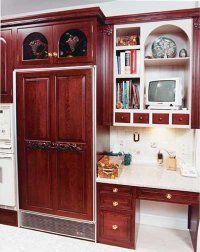
While many people like to blend refrigerators and dishwashers into the cabinetry with matching fronts, the latest trend is to keep ranges visible. However, if you do want to de-emphasize your oven, the easiest way is with an under-counter model. (Make sure the oven you choose is designed for under-counter use, because not all are.) You may install a cooktop directly above the oven or locate it elsewhere in the kitchen. A cooktop directly over an under-counter oven functions much the same as a conventional range, but, with no range backsplash and with the control knobs located on the countertop, the result is a more integrated look.
Cleaning baked-on spills from the cooktop has always been a challenge, but several options make short work of them. For easiest cooktop cleaning, consider ranges with ceramic glass cooktops housing electric or halogen burners; simpler knobs and handles; and a top and backsplash constructed from a single piece of metal, so there's no seam to collect spills. Self-cleaning ovens come in two varieties: one that uses a high-heat cycle that turns cooked-on spills into ash you can wipe away, another that offers a continuous-clean function.
Range Hoods
If you don't have a ventilation fan above your cooktop that vents to the attic or outside, you'll want a range hood with ventilation fan built in. Why? Even if you don't find some cooking odors objectionable, vaporized grease can dull beautiful new kitchen surfaces, and moisture can compromise the efficiency of home insulation. The solution is an updraft range hood that funnels cooking grease and smoke into one area so that the fan can draw it through a duct to the outside.
Filters capture additional grease and odors. Look for range hoods that come in copper, stainless steel, and other good-looking, easy-care materials, or customize a standard hood with ceramic tile to create a major focal point, furthering your decorating scheme. As an alternative, down-draft ventilation, usually part of a cooktop or grill, also employs a fan and duct arrangement. Units that rise above cooktop level provide the most effective venting.
On the next page, we're going from hot to cool and learn about how to choose a refrigerator.