Erasing Stains with Melamine Foam

Mr. Bubble meets Boeing
Foam is pretty broad term, so let's look a little closer at everything that falls under its umbrella. The term foam can describe the towering mounds of bubbles you get in a bubble bath, the lather of saliva and sweat animals produce when they're working hard, products like shaving cream and firefighting foam, thermal and audio insulation materials, packing peanuts and the froth that rides in on ocean waves.

The key to remember is that some foams are comprised of bubbles trapped in liquid, while other foams are solid porous materials (either spongy or semirigid) such as Styrofoam cups and seat cushions.

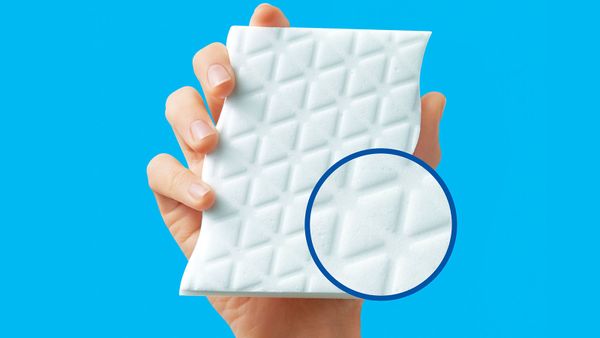
Magic Erasers, Easy Erasing Pads and similar products all have the same key ingredient: melamine foam. Melamine foam erasers are formed differently from other cleaning products and only need water to effectively clean most stains -- no chemical cleaners or soaps required. The only downfall is that melamine foam erasers wear out quickly -- just like pencil erasers do.

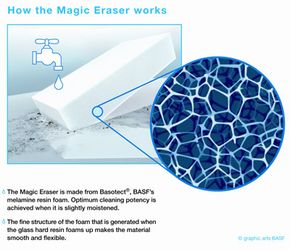
To all outward appearances, however, melamine foam erasers look and feel just like any other sponge. To view the crucial properties of melamine foam, you need to go down to the microscopic level. This is because when melamine resin cures into foam, its microstructure becomes very hard -- almost as hard as glass -- causing it to perform on stains a lot like super-fine sandpaper. You may be asking yourself, if this foam is almost as hard as glass, then how can it be like a sponge? Because it's a special type of open-cell foam.

magic eraser
Photo Courtesy of BASF
Get up close and personal to see what is going on inside a melamine foam eraser.

Closed-cell foam is easier to visualize, so let's start there. Types of closed-cell foam are usually the more rigid because they retain most of their air pockets intact, like a bunch of balls all crammed together. For open-cell foam (typically the more flexible) imagine that those balls have burst, but that some sections of their casings still remain. You can picture a squishy sea sponge as an example. In airy melamine foam, only a very limited amount of casing stays in place, and the strands that do are located where the edges of several air pockets overlapped. The foam is flexible because each tiny strand is so slender and small that bending the entire eraser is easy.

The Warning Label
Melamine foam erasers work well; but on surfaces that are painted, polished or easily scratched, they might work a little too well. It's recommended to test the eraser on a small, preferably unnoticeable, portion of whatever you're looking to clean before you dive on in.

A few years ago, Internet rumors spread that melamine foam erasers could cause serious health problems because they contained formaldehyde and had the potential to cause chemical burns. Check out Snopes.com for the outcome -- and a word to the wise: Don't go rubbing powerful abrasives on your face.

­­The cavity-ridden open microstructure of melamine foam is where the second major boost to its stain-removing capabilities comes in. Apart from being able to scrape at stains with extremely hard microscopic filaments, with a few quick runs of the eraser, the stain has already started to come away. That's aided by the fact that the dirt is pulled into the open spaces between the spindly skeletal strands and bound there. These two factors combined make this next-generation eraser seem almost magical.

Ready to start erasing some stains around your house? Now that we've unlocked the mystery to melamine foam erasers, check out some of the links on the next page for more interesting information.