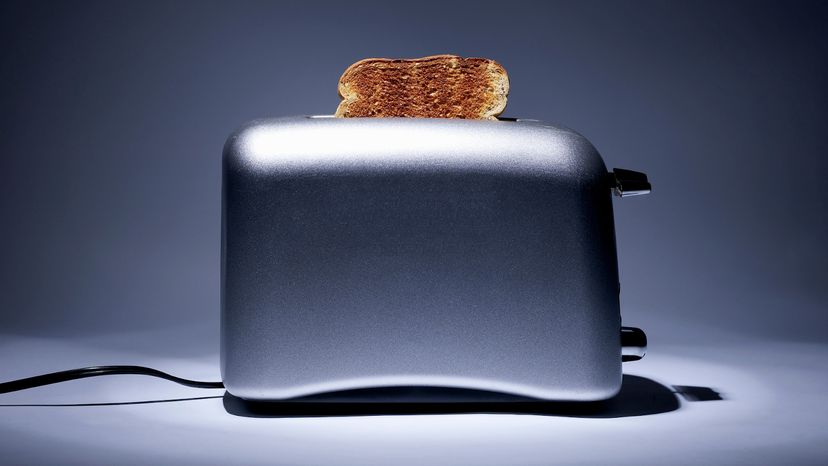
Toaster, a reliable appliance to make delicious toasted breads and waffles. ballyscanlon / Getty Images
For lots of people, the toaster is a daily part of breakfast (and lunch and maybe even dinner). The toaster seems like a pretty simple device, but some questions do come up: How, exactly, does the toaster toast the bread? How do all of the different settings work? How does the toaster know when to pop the toast up?
In this article, we'll dissect a typical pop-up toaster to answer all of these questions and more!
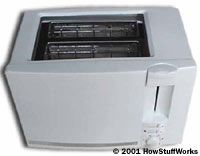
You can purchase a toaster at any discount store for less than $20 (U.S.). The particular model shown on the right allows you to set the darkness of the toast it produces and also has a defrost mode.
The basic idea behind any toaster is simple. A toaster uses infrared radiation to heat a piece of bread (see How Thermoses Work for information on infrared radiation). When you put your bread in and see the coils glow red, the coils are producing infrared radiation. The radiation gently dries and chars the surface of the bread.
Advertisement
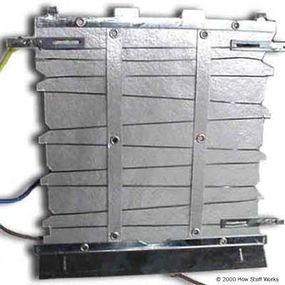
The most common way for a toaster to create the infrared radiation is to use nichrome wire wrapped back and forth across a mica sheet, like this:
Toaster heating element, nichrome wire on mica sheet
Nichrome wire is an alloy of nickel and chromium. It has two features that make it a good producer of heat:
Nichrome wire has a fairly high electrical resistance compared to something like copper wire, so even a short length of it has enough resistance to get quite hot.
The nichrome alloy does not oxidize when heated. Iron wire would rust very quickly at the temperatures seen in a toaster.
The very simplest toaster would have two mica sheets wrapped in nichrome wire, and they would be spaced to form a slot about an inch (2.5 cm) wide. The nichrome wires would connect directly to a plug. To make toast:
You would drop a piece of bread into the slot.
You would then plug in the toaster and watch the bread.
When the bread became dark enough, you would unplug the toaster.
Then you would tip the toaster upside down to get the toast out!
Most people don't have this sort of patience, nor do they like crumbs all over the counter. So a toaster normally has two other features:
A spring-loaded tray pops the toast out. This keeps you from having to turn the toaster upside down.
A timer turns the toaster off automatically and at the same time releases the tray so the toast pops up.
Advertisement
The Spring-Loaded Tray
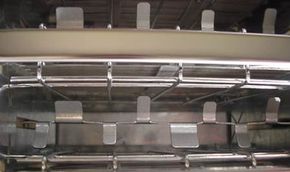
View of toast slot from above
The photo below shows you the view down one of the slots of a typical toaster. Two mica/nichrome sheets line either side of the slot. A metal holder rides up and down in the slot to raise and lower the bread.
Many toasters include a pair of grates on either side of the slot. The grates press against the bread and center it. Two metal springs get pushed when the holder nears the bottom of the slot, and they pull the grates inward.
Advertisement
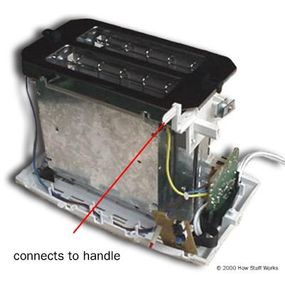
The holders in each slot are connected to the handle that you depress to lower the bread into the toaster, as shown below:
Toaster lowering mechanism
Advertisement
Popping the Toast Up
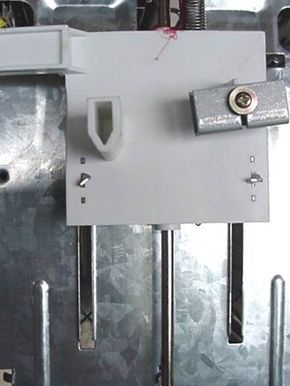
Plastic plate attached to toast-lowering lever, plastic wedge (on left) that switches on the power
When you push the handle down, three things have to happen:
Some sort of mechanism needs to hold the handle down to keep the toast inside the toaster for a period of time.
Power needs to be applied to the nichrome wires.
Some sort of timer needs to release the holder at the proper time so the toast pops up.
In this particular toaster, both the hold-down mechanism and the power switch are part of the handle:
Advertisement
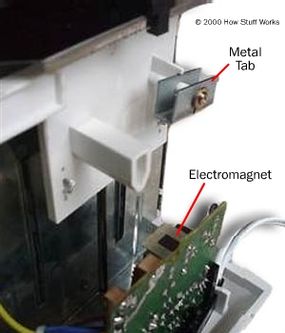
When the bar is lowered, the metal tab contacts the electromagnet.
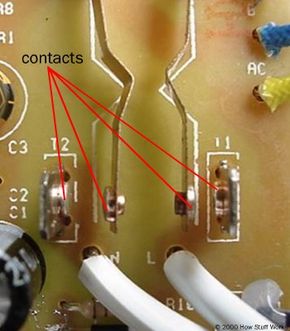
Above you can see a plastic bar and a piece of metal attached to the handle. The plastic bar presses into a pair of contacts on the circuit board to apply power to the nichrome wires, and the piece of metal gets attracted to an electromagnet to hold the toast down. You can see both the contacts (copper strips on the right) and the electromagnet (green block on the left) below:
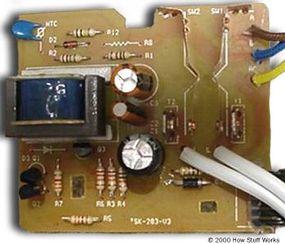
Toaster circuit board
Advertisement
Circuit Board
Toaster circuit card showing electrical contacts
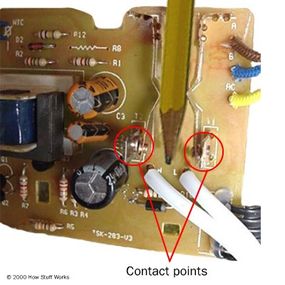
The following two photos show how the plastic bar applies power to the toaster. In the first photo, the plastic bar is being simulated by a pencil, and you can see how it pushes the contacts apart:
Toaster circuit board with contacts engaged
In this particular toaster, here is how the whole mechanism works:
Advertisement
When you push down on the handle, the plastic bar presses against the contacts and applies power to the circuit board.
120-volt power runs directly through the contacts to the nichrome wires to start toasting the bread.
A simple circuit made up of transistors, resistors and capacitors turns on and supplies power to the electromagnet.
The electromagnet attracts the piece of metal on the handle, holding the bread in the toaster.
The simple circuit acts as a timer. A capacitor charges through a resistor, and when it reaches a certain voltage it cuts off the power to the electromagnet. The spring immediately pulls the two slices of bread up.
In the process, the plastic bar rises and cuts off power to the toaster.
In this toaster, the darkness control is simply a variable resistor. Changing the resistance changes the rate at which the capacitor charges, and this controls how long the timer waits before releasing the electromagnet.
Less sophisticated toasters use a bi-metallic strip (see How Thermometers Work for details on bi-metallic strips) to turn off the electromagnet. As the strip heats up (due to rising temperatures inside the toaster), the strip bends and eventually trips a switch that kills the power to the electromagnet. The bi-metallic strip approach has two problems:
If the kitchen is cold, the first piece of toast will be darker than usual.
If you try to make a second batch of toast, it will be too light because the toaster is already hot.
The electronic circuit in this toaster provides much more consistent toast!
For more information, check out the links on the next page.