
The Magneto
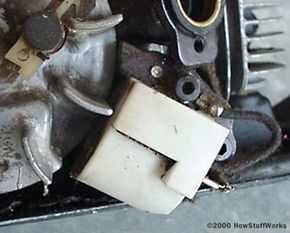
The magneto creates the electrical charge needed to fire the spark plug, and the spark plug creates the spark inside the combustion chamber to ignite the gasoline (see How Two-stroke Engines Work for details). The job of the magneto is to create a surge of high voltage (between 10,000 and 20,000 volts) at just the right moment during each revolution of the crankshaft. This voltage arcs across the tip of the spark plug to ignite the gasoline.
The magneto is the white block in the following photo:
Advertisement
The idea behind a magneto is simple. It is basically an electrical generator that has been tuned to create a periodic high-voltage pulse rather than continuous current.
An electrical generator (or a magneto) is the reverse of an electromagnet. In an electromagnet, there is a coil of wire around an iron bar (the armature). When you apply current to the electromagnet's coil (with a battery, for instance), the coil creates a magnetic field in the armature. In a generator, you reverse the process: You move a magnet past the armature to create electric current in the coil.
This magneto consists of five parts:
- An armature (In this magneto, the armature is shaped like a capital "U." The two ends of the U point toward the flywheel.)
- A primary coil of perhaps 200 turns of thick wire wrapped around one leg of the U
- A secondary coil of perhaps 20,000 turns of very thin wire wrapped around the primary coil
- A simple electronic control unit that commonly goes by the name "electronic ignition"
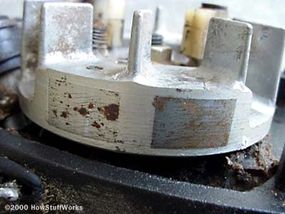
- A pair of strong permanent magnets embedded in the flywheel
You can see the two magnets in the following photo:
When the magnets fly past the U-shaped armature, they induce a magnetic field in the armature. This field induces a small amount of current in the primary and secondary coil. What we need, however, is extremely high voltage. Therefore, as the magnetic field in the armature reaches its maximum, a switch in the electronic control unit opens. This switch breaks the flow of current through the primary coil and causes a voltage spike (of perhaps 200 volts). The secondary coil, having 100 times more turns than the primary coil, amplifies this voltage to approximately 20,000 volts, and this voltage feeds to the spark plug.