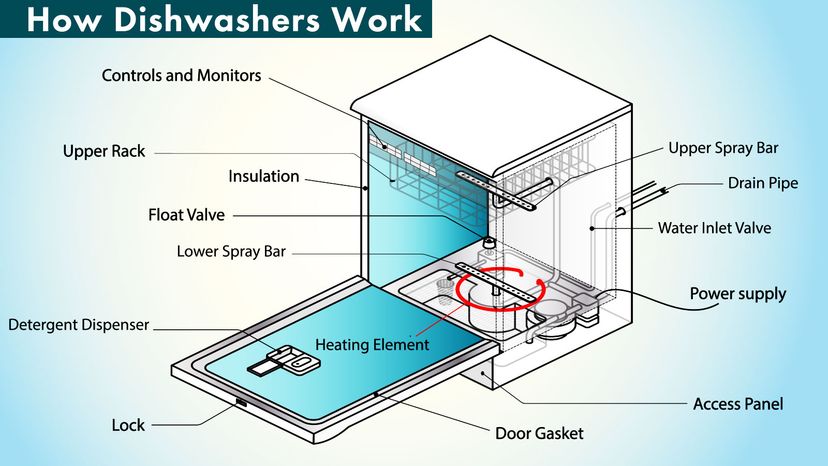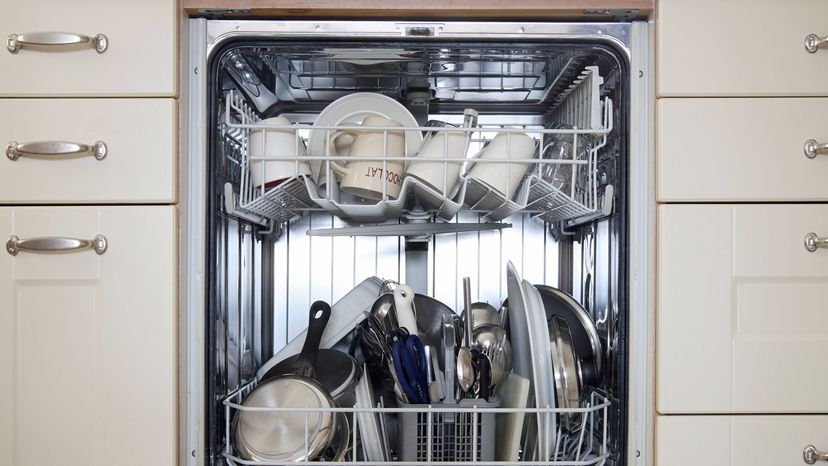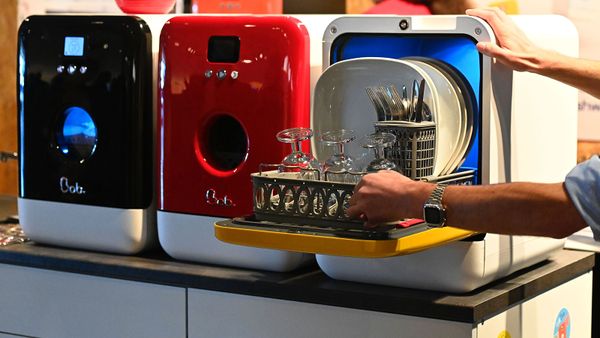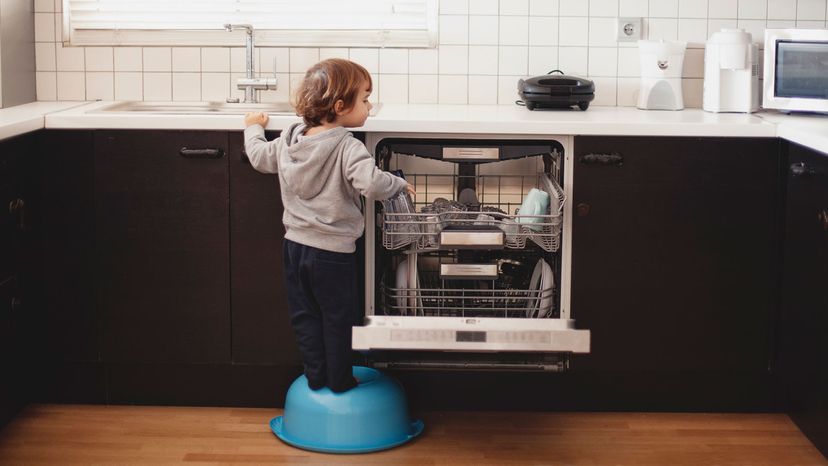
Basically, a dishwasher is a robot that cleans and rinses dirty dishes. Humans have to load the dishes, add detergent, set the proper washing cycles and turn it on, but the dishwasher accomplishes a whole series of functions by itself. A dishwasher:
- Adds water
- Heats the water to the appropriate temperature
- Automatically opens the detergent dispenser at the right time
- Shoots the water through spray arms to get the dishes clean
- Drains the dirty water
- Sprays more water on the dishes to rinse them
- Drains itself again
- Heats the air to dry the dishes off, if the user has selected that setting
In addition, dishwashers monitor themselves to make sure everything is running properly. A timer (or a small computer) regulates the length of each cycle. A sensor detects the water and air temperature to prevent the dishwasher from overheating or damaging your dishes. Another sensor can tell if the water level gets too high and activates the draining function to keep the dishwasher from overflowing. Some dishwashers even have sensors that can detect the dirtiness of the water coming off the dishes. When the water is clear enough, the dishwasher knows the dishes are clean.
Advertisement
Although dishwashers are watertight, they don't actually fill with water. Just a small basin at the bottom fills up. There, heating elements heat the water up to as much as 155 degrees Fahrenheit (68 Celsius) while mixing in the detergent. Then a pump propels the water up to the spray arms, where it is forced out and sprayed against the dirty dishes.
Think about a garden hose with no nozzle — if you put your thumb over the end of the hose, decreasing the space for the water to come out, it sprays out more forcefully. The dishwasher's jets work on the same principle. The force of the water also makes the spray arms rotate, just like a lawn sprinkler.
Once the food particles are washed off of the dishes, they are either caught in a filter or chopped up into small pieces and disintegrated, similar to the actions of a garbage disposal. Then the cycle of heating water, spraying it and letting it drip back into the pool below repeats several times.
When the washing and rinsing is finished, the water drains down to the basin again, where the pump propels the water out of the dishwasher. Depending on the type of dishwasher, the drained water might go right into the pipes under your sink or into your garbage disposal.
The final step in a wash cycle is optional — the dry cycle. The heating element at the bottom of the dishwasher heats the air inside to help the dishes dry. Some people just let them dry without heat to save energy.
Dishwashers are not very mechanically complex. In the next section, we'll take a look at the main parts of a basic dishwasher.
Advertisement