Please copy/paste the following text to properly cite this How Stuff Works article:
Club, Fix-It. "How to Repair a Washing Machine." 04 May 2006. HowStuffWorks.com. <http://home.howstuffworks.com/how-to-repair-a-washing-machine.htm> 13 May 2008.
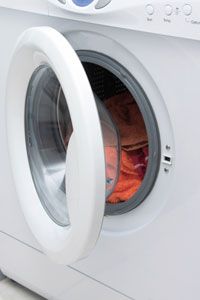
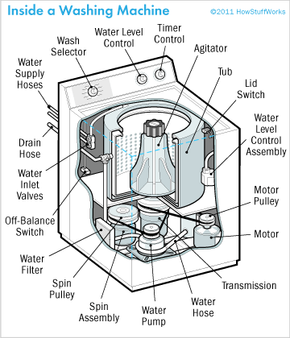
Unlike a toaster, which performs the exact same function over and over, washing machines run through elaborate cycles with multiple settings. The devices that control these cycles can occasionally fail. Here's how to repair some of the common switches and timers.
Servicing the Lid Switch
The lid switch on a washer often serves as a safety switch. If the switch is not working, or if the switch opening in the lid is clogged with detergent, the machine will not run. To check and repair the lid switch:
Step 1: Unplug the machine. Clean out the lid switch port with a wood manicure stick or chopstick. Clean off any detergent buildup around the rim of the lid. Sometimes there's enough detergent encrusted on the metal to prevent the lid from closing tightly and keep the washer from operating.
Step 2: If cleaning doesn't help, remove the top of the cabinet to get at the switch. With the switch exposed, check the screws for looseness. Loose screws can cause the switch to move when the lid is closed or as the machine goes through its cycles. Check the terminals of the switch to make sure they're tight. Tighten the mounting screws after the switch is in alignment.
Step 3: Test the switch with a VOM set to the RX1 scale; procedures for using the VOM are detailed here. Disconnect the power leads to the switch terminals and clip one probe of the VOM to each terminal. Close the lid of the washer. If the meter reads zero, the switch is working. If not, the switch is faulty and should be replaced.
Step 4: If necessary, replace the lid switch with a new one of the same type. Connect the new switch in exactly the same way the old one was connected.
Step 5: If the switch still doesn't work, it is probably misaligned. Realign the switch by repositioning the screws holding it in place, testing the switch as you go until it works properly.
Servicing the Temperature Selector Switch
This control panel switch regulates the temperature of the water in the tub. It also plays a role in controlling the fill cycle. If you suspect this switch is faulty, remove it and take it to a professional service person for testing (the test takes special equipment). Or, hook a test wire across the switch terminals; if water flows, the switch is faulty. If the switch is faulty, replace it with a new one of the same type. Connect the new switch the same way the old one was connected.
If there's a problem with both water temperature and tub filling cycles, both the temperature switch and the timer may be faulty. Test both components and replace them as necessary. Procedures for testing the timer can be found below.
Servicing the Water Level Control Switch
This is another control panel switch, usually located next to the temperature switch. There is a small hose connected to this switch, and sometimes this hose becomes loose and falls off the connection. When this happens, the water in the tub usually overflows. To solve this problem, cut about 1/2 inch off the end of the hose and use a push fit to reconnect it to the switch.
The switch itself can also malfunction, resulting in tub overflow and other water-level trouble in the tub. If you suspect this switch is faulty, remove it by backing out the screws holding it in place. Take it to a professional service person for testing. If the switch is faulty, replace it with a new one of the same size and type. Connect the new switch the same way the old one was connected.
Servicing the Timer
Most washing machine timers are digital or mechanical. The timer controls most of the operations of the washer: water level, tub filling and emptying, length of cycles, and cycle setting sequences. For this reason, any repairs to the timer should be made by a professional service person. However, there are a couple of checks you can make when you suspect the timer is faulty -- you may be able to install a new timer yourself.
Step 1: Unplug the washer. To access the timer, remove the control knobs and the panel that covers the controls. This may be a front panel, or access may be through a panel at the back of the unit. Carefully examine the wires that connect the timer to the other parts of the washer. If the wires are loose or disconnected, try pushing them into position; they usually fit into their terminals like plugs. Use long-nosed pliers to avoid breaking the wire connections -- never pull a wire by hand.
Step 2: To test the timer, use a VOM set to the RX1 scale. Disconnect the power leads to the timer and clip one probe of the VOM to each lead. The VOM should read zero if the timer is working. Since the timer is a multiple switch, turn it through its cycle and test each pair of terminals in turn. The meter should read zero at all of these points. If one or more readings are above zero, the timer is faulty and should be replaced.
Step 3: To replace the timer, unscrew and disconnect the old one. Install a new timer made specifically for the washing machine. If there are many wires on the timer, have a helper hold the new timer next to the old one as you work. Disconnect the old wires one at a time, connecting each corresponding new wire as you work, to make sure the connections are properly made. Or, draw a diagram showing the connections before removing the old timer. After all the wires are connected, check the connections again for correctness and screw the timer assembly into place.
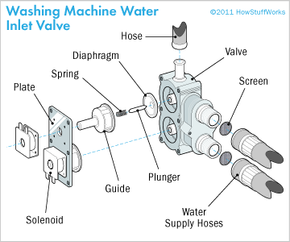
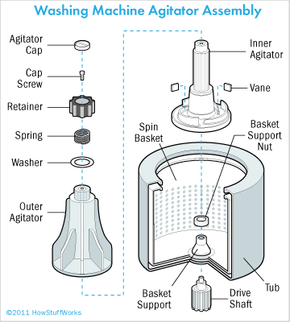
In the next section, we will examine two of the most crucial elements of a washing machine -- the water inlet valves and the agitator.
Please copy/paste the following text to properly cite this How Stuff Works article:
Club, Fix-It. "How to Repair a Washing Machine." 04 May 2006. HowStuffWorks.com. <http://home.howstuffworks.com/how-to-repair-a-washing-machine.htm> 13 May 2008.