Servicing Water-Related Problems, Belts, Pulleys, and the Motor

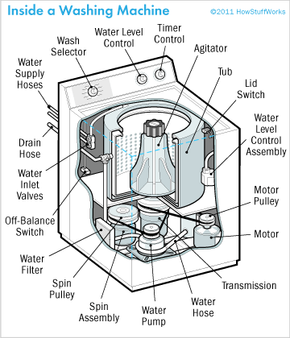
On this page we will explore some of the more mechanical parts of a washing machine like belts, pulleys and the motor. First, we have some tips for water-related problems.

Troubleshooting Water Leaks

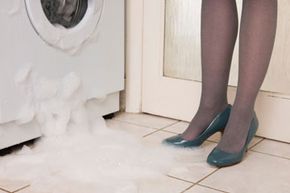
Water leaks in a washer are often difficult to trace. There are many possibilities to look for. The problem could be a loose connection, a broken hose, a cracked component, or a defective seal. It could also be a hole in the tub. If a hole in the tub is the problem, it's usually best to replace the washer.

Most leaks can be eliminated by tightening water connections and replacing deteriorated components. To stop a leak:

Step 1: Check the lid seal. If faulty, replace with a new gasket.

Step 2: Check the hoses at faucet connections. Tighten connections or replace hoses.

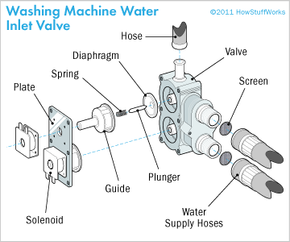
Step 3: Check the hoses at water valve connections. Tighten connections or replace hoses.

Step 4: Check the drain hoses. Tighten connections or replace hoses.

Step 5: Check the inlet nozzles. Tighten connections or replace nozzles.

Step 6: Check the splash guard. Tighten connections or replace.

Step 7: Check any plastic valve. Tighten connections or replace.

Step 8: Check the outlet hose to drain. Tighten connections or replace hose.

Step 9: Check the water pump, using the procedures that follow.

Servicing the Water Pump

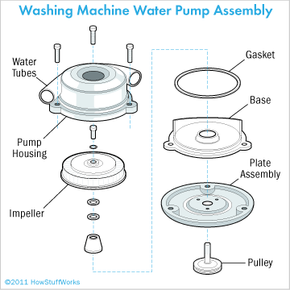
Of all washing machine parts, the water pump probably takes the most punishment, because it is constantly in use. When the pump fails, you can hear or see the trouble: a loud rumbling inside the machine, or a failure of the water to drain out of the tub. Here's what you can do to fix the problem:

Take the pump apart and clean away all debris inside the pump. Also clear away debris from the water tubes.
©2006 Publications International, Ltd.
Take the pump apart and clean
away all debris inside the pump.
Also clear away debris from
the water tubes.

Step 1: Check the drain hoses to make sure they are draining properly. Remove the water supply hoses from the back of the washer. With long-nosed pliers, extract the filter screens from the valve ports in the washer or from the hoses themselves. Wash the screens thoroughly. Then replace them and reattach the hoses. If the machine still rumbles or doesn't drain, examine the pump.

Step 2: To access the pump, first bail and sponge out any water in the machine's tub. Then tip the washer over on its front, using a heavy blanket or pad to protect the washer's finish. Remove the back service panel. The pump is usually located along the bottom of the machine, but with the unit tipped on its front it's easier to remove the pump through the back than through the bottom of the washer.

Step 3: Locate the pump. It has two large hoses attached to it with spring or strap clips. If the clips are the spring type, pinch the ends of the clips together with pliers to release them, and slide the clips down the hoses. If the clips are the strap type, unscrew the metal collar to loosen the clamp. Disconnect the hoses by pulling them off the connections. If the hoses are kinked or crimped at these connections, straighten them as best you can and reconnect them. Then try the machine again to see if this kinking was causing the problem. If the machine still doesn't drain, you'll have to remove the water pump.

Step 4: To remove the pump, loosen the bolt that holds the drive belt taut and move the washer motor on the bracket to loosen the belt. Move the motor out of the way and unbolt the pump; it's usually held by two or three hex-head bolts located on the bottom of the pump housing. As you loosen the last mounting bolt, support the pump with your hand. Then lift the pump out of the washer.

Step 5: You should take the pump apart if you can, because the trouble could be lint, dirt, or pieces of cloth or paper clogging the pump impeller. Clean away all debris inside the pump and clear any debris out of the water tubes. Then reassemble the pump. Hook up the pump again and test it. If cleaning the pump doesn't put it back into working order, or if the pump housing can't be removed, replace the pump with a new one of the same kind.

Step 6: To install the new pump, set it into position and connect the mounting bolts to the pump housing. Move the motor back into position. Tighten the drive belt on the motor by prying it taut with a hammer handle or pry bar; it should give about 1/2 inch when you press on it at the center point between the two pulleys.

Step 7: Reconnect the hoses leading to the pump.

Replacing Drive Belts and Tightening Pulleys

The drive belt (or belts) of a washing machine may become worn or damaged, causing noisy operation or stopping the washer entirely. A damaged drive belt is easy to replace. Remove the back panel of the washer to gain access to the belt. To remove the belt:

Step 1: Loosen the bolt on the motor bracket and move the motor to put slack in the belt.

Step 2: Remove the old belt and stretch a new one into place on the pulleys.

Step 3: To put tension on the new belt, use a hammer handle or a short pry bar to push the motor into position while you tighten the bolt in the adjustable bracket. The belt should have about 1/2 inch deflection when you press on it at the center point, midway between the pulleys. If the belt is too loose, it will slip on the pulleys, causing the machine to malfunction. If the belt is too tight, it will wear very quickly and will probably become so hot that it will start to smoke or smell.

Loose pulleys can also cause problems. Most pulleys are fastened to shafts with setscrews around the hub of the pulley. These screws must be tight or else the pulley or belt will slip. The resulting malfunction may seem to be caused by a faulty motor, but it can be corrected by tightening the pulleys and adjusting the belt. For this reason, always check the belts and pulleys before working on the motor.

Servicing the Motor

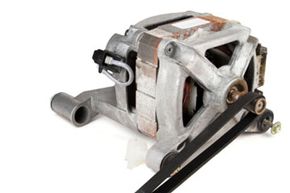
In most cases, motor malfunctions should be handled by a professional; do not try to fix the motor yourself. If the motor is a universal motor, however, you can change worn carbon brushes when sparking occurs, as detailed in the how to repair appliances article. To save the expense of a service call, remove the motor from the washer and take it to a professional service person, then reinstall the repaired or new motor yourself. To access the motor, remove the back panel of the washer. The motor is mounted on an adjustable bracket.

There is one other motor problem you can repair yourself. Washer motors usually have an overload protector clipped to the motor. When this component fails, the motor won't work. Before you take the motor in for service, test the protector with a VOM set to the RX1 scale. Disconnect one electrical lead wire to the protector and clip one probe of the VOM to each protector terminal. The meter should read zero. If the needle jumps higher, the protector is faulty and should be replaced. Pry up the protector with a screwdriver and replace it with a new one made specifically for the motor or washer. Connect the new protector the same way the old one was connected.

Servicing a washing machine can be a frustrating home repair project. Because a washer has so many different cycles and functions it's not always apparent what exactly is going wrong. With the troubleshooting tips in this article, you should be cranking out loads of clean laundry in no time.

©Publications International, Ltd.