Gas Oven: Gas Ranges, Door Gaskets and Burners

Gas and electric ranges and ovens operate fairly simply, and they're usually easy to repair, mainly because the components are designed for quick disassembly.

Most of the malfunctions that affect gas ranges involve the supply and ignition of gas in the burners and the oven. Most malfunctions that affect electric ranges and ovens involve faulty heating elements. In this article, we'll discuss how the main parts should work on gas and electric ranges and ovens and how to service them regularly to avoid larger, more expensive problems. The first step is taking a peek inside to assess the problem.

Caution: Before doing any work on a gas range or oven, make sure it's unplugged, or turn off the electric power to the unit by removing a fuse or tripping a circuit breaker at the main entrance panel or at a separate panel. If there is a grounding wire to the range, disconnect it. Also close the gas supply valve to shut off the unit's gas supply.

Disassembling a Gas Range

A gas range cabinet comes apart very easily. Here's how:

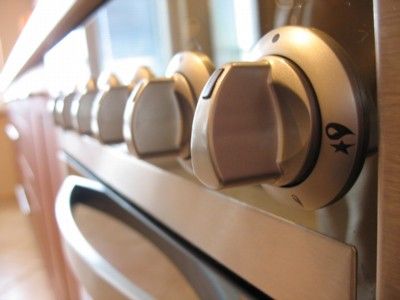
Step 1: Take out the screws that hold the panels, and pull off the control knobs. On the control panel the knobs are friction-fit; pull them straight off. Some knobs may have setscrews in the base of the knobs; back out these screws using a screwdriver or Allen wrench and pull off the knobs.

Step 2: Remove the back service panel on the control panel by backing out a series of screws around the edge of the panel. To remove the front panel, take off the control knobs and remove a series of mounting screws that hold the decorative panel to the frame. These screws may be hidden by molding or trim; pry off the molding or trim with a screwdriver, or take out several screws.

Step 3: To gain access to the burner assemblies, remove the burner grates and then the top of the range. The entire range top should either lift up and off the range or open up and back on hinges. The oven door can usually be removed by pulling it straight up off the hinges on both sides of the door. Some hinges have a latch that must be unlocked before the door can be removed.

Step 4: If the surface light of the range burns out, remove retaining screws and panels as necessary to gain access to the bulb. Replace the burned-out bulb with a new one of the same type and wattage; check the ends of the old bulb for this information. Then replace any retaining panels.

Step 5: If the oven light burns out, unscrew it and remove it from the oven. Replace the burned-out bulb with a new one of the same wattage, made for oven use.  

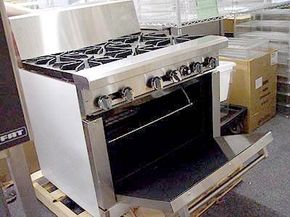
Gas ranges and ovens use gas burners to heat and cook food.
©2006 Publications International, Ltd.
Gas ranges and ovens use gas burners to heat and cook food. Most
malfunctions involve the supply and ignition of gas in the burners.

Replacing a Door Gasket

If the oven won't heat to the desired temperature or heats unevenly, the problem could be a defective door gasket. The best way to test for this is to pass your hand around the door, being careful not to touch it, while the oven is turned on. If you can feel heat escaping, the gasket needs replacement. Replace it with a new gasket made for the range. 

Gas Oven Safety Tip
If you smell gas, leave the house immediately. Do not try to turn off the gas from inside the house, or turn any lights on or off. Find and turn off the master gas valve outside the house. Go to a telephone and call the gas company or the fire department immediately to report a leak. Do not re-enter your home.

On most ovens, the gasket is located on the frame of the oven, and the door closes against it. This gasket is generally friction-fit in a channel and can be replaced. In other units, the oven door has two sections, and the gasket is not mounted on the door frame, but is installed between the front and back sections of the door. Don't try to replace this type of gasket; call a professional service person. Here's how to replace a frame-mounted gasket:

Step 1: Pull the old gasket out of the channel. On some oven door frames the gasket is held in place with screws. To get at the screws, bend back the exposed edge of the gasket.

Step 2: Clean the channel and the door frame with a solution of mild household detergent and water.

Step 3: To install the new gasket, start the replacement at the top of the door frame and work down the sides, easing the gasket around corners. Finish the installation along the bottom, butting the ends of the gasket firmly together.

Cleaning the Burners

Clogged burners are a very common problem with gas ranges because foods spilled on the burners block the gas ports and prevent ignition. On some gas ranges you can remove the top ring of the burner to expose the ports. Here's how to clean a burner:

Step 1: Turn off the power supply, both gas and electric, to the range. Then remove the burner.

Step 2: Soak the burner in a solution of mild household detergent and water. Clean it with a soft cloth.

Step 3: Clear the gas ports with a pin or needle, rinse the burner, and let it dry. Caution: Do not use a toothpick or matchstick to clean the gas ports. If the tip of the wood gets stuck in the burner ports, it could cause a serious blockage.

Step 4: When the burner is completely dry, replace it, and turn on the power and the gas supply.

An oven that won't heat can occur for a variety of reasons. Check out the next section for tips on where to look to solve this type of problem.