
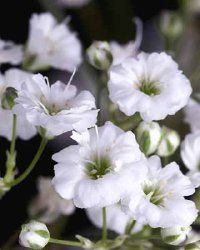
Almost everyone has given or received a bouquet of flowers from the florist that contained a few sprays of baby's breath. The genus is Latin for the phrase "friendship with gypsum," because one species, Gypsophila repens, has been found growing on gypsum rocks.
Description of baby's breath: Small, blue-green leaves, almost fleshy, on stems with slightly swollen joints bear a profusion of many-branched panicles containing numerous 1/8-inch wide flowers. Plants bloom in June and July.
Advertisement
Growing baby's breath: Baby's breath require full sun and a good, deep, well-drained garden soil with humus. Even though the plants have tap roots, they still require liberal amounts of water. If the soil is at all acid, a cup of ground limestone per square yard should be added into the soil surrounding these lime-loving plants. Tall plants will probably require staking. They will rebloom if spent flowers are removed. Note: This species is invasive in the Midwest and Great Plains on alkaline soils. Ease of care: Easy.
Propagating baby's breath: Start new plants from seed. Propagation by cuttings requires patience, skill, and luck.
Uses for baby's breath: Baby's breath are wonderful for filling in gaps in a bed or border. They are especially lovely when tumbling over rock walls or falling out of a raised bed.
Baby's breath related species: Gypsophila repens is a creeping baby's breath that grows 6 inches high, but covers an area to a width of 3 feet. Alba is white; Rosea is pink.
Baby's breath related varieties: Two popular varieties are Bristol Fairy, with pure white, double flowers, that grows to a height of 4 feet, and Pink Fairy, reaching 18 inches in height with pink doubles.
Scientific name of baby's breath: Gypsophila paniculata
Advertisement