Planning for a concrete countertop starts just like other countertops: with measurements and a template to indicate the size, shape, seam placement, location of the sink and faucets and other features.
While other countertop materials are cut from a slab, concrete countertops are formed in a mold. So the next step is building the mold. If you choose the pour in place method, the mold is built on top of your cabinets. Molds for precast countertops are built elsewhere, and the countertop is hauled to your kitchen after finishing and sealing.
After the mold is built, leak-sealed, cleaned and secured to a sturdy, level support surface, it's time to mix the concrete. The proportion of cement, sand, aggregate and water determine the fineness and strength of the concrete. Admixtures such as water reducer (an additive that allows you to mix workable concrete with minimal water), retardant (an additive that slows setting time), fibers (for added strength) and pigments are mixed into the concrete at this time.
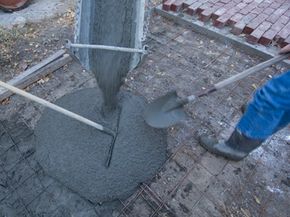
When the wet concrete loosely holds its form in your (heavy-duty rubber gloved) hand, muster your strength for the pour. After testing the consistency, or slump, of the concrete, you'll transfer it by the shovelful from the mixing vessel to the mold. You'll have no time for coffee breaks here. Concrete starts setting, or losing its plasticity, about 30 minutes after mixing.
Shovel the wet concrete into the mold until it covers the bottom, then vibrate the mold with hammer taps or a palm sander to help the mixture flow into corners and around reinforcement bars. Repeat the layering/vibrating process until the mold is full. Use a clean, straight 2x4 to screed (level) the bottom edge. If you are pouring in place, this will be the top.
After about half an hour, smooth the surface with a wooden float. Give the concrete a chance to set up, and then smooth the surface with the flat edge of a trowel.
The concrete may take anywhere from three days to a week to cure. Curing time depends on temperature, humidity and the type of cement you use. Ideally, your countertop will cure in a climate-controlled area with a median temperature of 75 degrees Fahrenheit (24 degrees Celsius) and high humidity.
The concrete is green, or not fully hardened, when you remove the mold, so the countertop must be carefully supported when it's moved off the mold and flipped for finishing. The incompleteness of the hardening makes it easier to grind and polish the concrete, but it also means it's easier to scratch or gouge the surface.
Grinding begins with a coarse grinding pad and progresses to a very fine pad. Polishing follows the same order. This is a labor intensive, time-consuming and costly job that's best finished within 10 days of the pour.
When the surface is as smooth and sleek as you want it, you should apply several coats of a food-grade penetrating sealer and top that with a coat of beeswax. Install the countertop on prepared and leveled cabinets, and fill the seams with a color-matched caulk.