Any household requires general home repair. Learn how to fix leaky roofs and sticky doors and use general home repair tips to knock items off your to-do list.
Please copy/paste the following text to properly cite this How Stuff Works article:
Club, Fix-It. "How to Do Home Electrical Repairs." 02 May 2006. HowStuffWorks.com. <http://home.howstuffworks.com/how-to-do-home-electrical-repairs.htm> 17 May 2008.
How to Do Home Electrical Repairs
Inside This Article
1.
Electrical Repair Basics
2.
3.
4.
5.
6.
Electrical Repair Basics
Your home's plumbing and electrical systems may seem as different as any two things could be. But there are significant parallels. Water enters your home through a pipe under pressure, and, when you turn on a tap, the water flows at a certain rate (gallons per minute). Electricity enters your home through wires, also under pressure (called voltage, measured in volts). When you turn on an electrical device, the electricity flows at a certain rate (current, measured in amperes, or amps).
Unlike water, which is used as it comes from the tap, electricity is meant to do work: It is converted from energy to power, measured in watts. Since household electrical consumption is relatively high, the unit of measure most often used is the kilowatt, which is equal to 1,000 watts. The total amount of electrical energy you use in any period is measured in terms of kilowatt-hours (kwh).
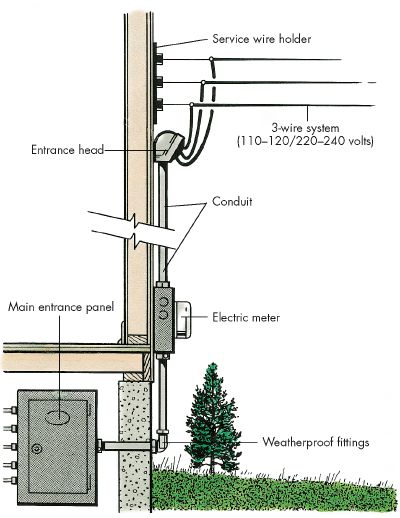
 ©2006 Publications International, Ltd. The electrical service drop, or supply line, and the meter are as far as the local utility company is involved in your home's electrical system. From that point on, the system is your responsibility.
|
The instrument that records how much electricity you use is called an electric meter. This meter tells the power company how much electricity they need to charge you for. There are two types of electric meters in general use. One type displays a row of small dials on its face with individual indicators. Each meter dial registers the kilowatt-hours of electrical energy. For example, if you leave a 100-watt bulb burning for 10 hours, the meter will register 1 kilowatt-hour (10x100 = 1,000 watt-hours, or 1 kwh). Each dial registers a certain number of kilowatt-hours of electrical energy. From right to left on most meter faces, the far right is the one that counts individual kilowatt-hours from 1 to 10; the next one counts the electricity from 10 to 100 kilowatt-hours; the third dial counts up to 1,000; the fourth counts up to 10,000; and the dial at the extreme left counts kilowatt-hours up to 100,000. If the arrow on a dial is between two numbers, the lower number should always be read.
The second type of electric meter performs the same function, but, instead of having individual dials, it has numerals in slots on the meter face, much like an odometer in a car. This meter is read from left to right, and the numbers indicate total electrical consumption. Some meters also use a multiplying factor -- the number that appears must be multiplied by ten, for instance, for a true figure in kilowatt-hours. Once you know how to read your meter, you can verify the charges on your electric bill and become a better watchdog of electrical energy consumption in your home.
Three main lines (older houses may have two) are responsible for supplying 110-120/220-240 volts AC (alternating current) to your home. The exact voltage varies depending on several external factors. This three-wire system provides you with 110-120-volt power for lighting, receptacles, and small appliances as well as 220-240-volt power for air conditioning, an electric range, a clothes dryer, a water heater, and, in some homes, electric heating.
Electricity enters your home through the power company's service equipment, which is simply a disconnect device mounted in an approved enclosure. It's used to disconnect the service from the interior wiring system. Usually called a main fuse, main breaker, main disconnect, or often just "the main," this disconnect might be a set of pull-out fuses, a circuit breaker, or a large switch.
Although main disconnects can be mounted outdoors in a weatherproof box, they are nearly always inside the house in a large enclosure that also contains the fuses or circuit breakers, which handle the distribution of power throughout the building. This is called a main entrance panel, a main box, or an entrance box. The three wires from the meter enter this box. Two of them -- the heavily insulated black and red lines -- are attached to the tops of a parallel pair of exposed heavy copper bars, called buses, at the center of the box. These two lines are the "live," or "hot," wires. The third wire, generally bare, is the "neutral." It is attached to a separate grounding bar, or bus, that is a silver-color strip in the main box. In most homes this ground bus is actually connected to the ground -- the earth -- by a heavy solid copper wire clamped to a cold water pipe or to an underground bar or plate.
Overload Protection
Power is distributed through your house through various electrical circuits that start in the main entrance panel. The 110-120-volt circuits have two conductors -- one neutral (white) wire and one hot (black) wire. The 220-240-volt circuits may have two hot wires alone or a third, neutral wire may be added. In all cases, the hot lines are attached directly to the hot main buses. The neutral wire is always connected to the ground bus and never, under any circumstances, should it pass through a fuse or circuit breaker.
 ©2006 Publications International, Ltd. Circuit breakers do not blow like fuses. They are switches that automatically trip open to interrupt the flow of electrical current when it overloads the circuit.
|
Fuses and circuit breakers are safety devices built into your electrical system. If there were no fuses or circuit breakers and you operated too many appliances on a single circuit, the cable carrying the power for that circuit would get extremely hot, short circuit, and possibly start a fire. To prevent electrical overloads, circuit breakers and fuses are designed to trip or blow, stopping the flow of current to the overloaded cable. For example, a 15-ampere circuit breaker should trip when the current through it exceeds 15 amperes. A 20-ampere fuse should blow when the current through it exceeds 20 amps. A fuse that blows or a circuit breaker that trips is not faulty; it is doing its job properly, indicating that there is trouble somewhere in the circuit. A blown fuse or tripped circuit breaker usually means there are too many appliances plugged in to that circuit or some malfunctioning device, like an appliance with an internal short, is connected to the circuit. Locate and eliminate the cause of the trouble before replacing a blown fuse or resetting a tripped circuit breaker.
Caution: Never try to defeat this built-in safety system by replacing a fuse with one of a higher current-carrying capacity. The fuse or circuit breaker capacity should be equal to or less than the current-carrying capacity of the conductors. For example, don't replace a 15-ampere fuse with a 25-ampere fuse. Replace fuses and breakers only with ones of the same size and amperage.
Circuit breakers do not blow like fuses; they are switches that automatically trip open to interrupt the flow of electrical current when it overloads the circuit. To reset a tripped breaker, turn it fully off and then back on.
Branch and Feeder Circuits
Circuits to all the devices in your home that require electrical power start from the fuses or circuit breakers. There are two types of circuits: feeder and branch. Feeder circuits use thicker cables that travel from the main entrance panel to smaller distribution panels called subpanels, or load centers. These auxiliary panels are located in remote parts of a house or in outbuildings, and they are used for redistribution of power, such as in a garage. Feeder circuits aren't found in all houses.
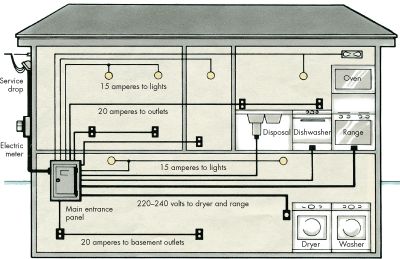
All of the circuits in a home that run from either the main entrance panel or from other smaller panels to the various points of use are branch circuits. For 110-120-volt needs, a circuit branches out through a circuit breaker from one of the main buses and from the ground bus. For 220-240 volts, many circuits use only the two main buses. But all three wires are needed for devices that operate on both 110-120 volts and 220-240 volts.
 ©2006 Publications International, Ltd. Newer homes have three incoming power lines that supply 110-120⁄220-240 volts AC. This provides 110-120 volts for lighting, outlets, and small appliances and 220-240 volts for heavier appliances.
|
The 110-120-volt branch circuits go through fuses or breakers, which are labeled either 15 or 20 amps. The 15-amp branches go to ceiling lamps and wall receptacles in rooms where less energy-demanding devices, such as table lamps, are found. The larger 20-amp circuits go to receptacles in the kitchen, dining, and laundry areas where heavy-duty appliances are used.
A 15-amp circuit can handle a total of 1,800 watts, while a 20-amp circuit can handle a total of 2,400 watts, but these figures represent circuits that are fully loaded. In practice, you should limit the load on a 15-amp circuit to no more than 1,440 watts, and the load on a 20-amp line should exceed no more than 1,920 watts.
How can you know the load on a circuit? Add up the individual wattages for all lamps and appliances plugged into each circuit. When computing the load on each branch circuit, allow for motor-driven appliances that draw more current when the motor is just starting up than when it's running. A refrigerator, for example, might draw up to 15 amps initially but will quickly settle down to around 4 amps. Suppose the refrigerator is plugged into a 20-amp branch circuit and a 1,000-watt electric toaster (which draws a little more than 8 amps) is also plugged into that circuit. If the refrigerator motor starts while the toaster is toasting, the total current load will exceed the current-carrying capacity of the circuit, and the fuse will blow or the circuit breaker will trip.
Keep reading to learn about proper safety practices when you're working with your home electricity system.
Inside This Article
1.
Electrical Repair Basics
2.
3.
4.
5.
6.
-
VIDEO SELECTIONS