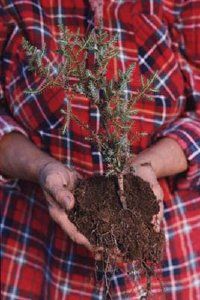
Most annuals are grown from seeds. However, impatiens, fibrous begonias, coleus, and geraniums can be grown from stem cuttings.
To propagate stem cuttings, select a mature plant that is in a stage of active midsummer growth. Prepare a container filled with rooting medium. It should be at least 3 to 4 inches deep, filled with 2 1/2 inches or more of rooting medium. Clean, coarse builder's sand, a mixture of half perlite and half peat moss, or half perlite and half vermiculite are good choices. Fill the container with the moistened medium, then let it settle and drain for a half hour.
Take stem cuttings in the morning. Using a sharp knife, cut off growth tips just above the node, or the point where a leaf or side shoot attaches to the main stem. Each of the cuttings should be between 3 and 6 inches in length and have 4 to 6 nodes. The stem tissue should be easy to cut through.
Don't spend more than five minutes taking cuttings from the parent plants. To prepare a cutting for rooting, remove the leafless piece of stem at the bottom. Cut it off about 1/8 inch below the first node with a clean knife or razor cut, leaving no torn or angling pieces of tissue hanging from the stem. Remove all of the leaves from the lower half of the cutting. These can be cut off with a knife or manually snapped off.
If there are any flower buds on the cutting, cut these off as well. Cut back the tips of any large leaves remaining on the cutting so that one-third to one-half of their surface remains.
To help stimulate root formation, it's helpful to coat the lower one-third of each stem cutting with rooting hormone powder. Just dip each stem in the rooting powder and shake off any excess.
Poke a hole in the dampened rooting medium, insert the cutting in the hole to one-third of its length, and press the medium firmly around the stem with your fingers. When all of the cuttings are set in the medium, water the surface.
Place a plastic bag over the cuttings to form a tent, using bamboo takes or wooden dowels as supports. This will serve as a mini-greenhouse, which should be kept out of direct sunlight. If the bottom edge of the plastic tent is left a bit loose, some fresh outside air will be able to circulate up inside. This will help reduce the possibility of mildew and mold problems.
Some growers prefer to hold the plastic tightly against the container with an elastic band. In this case, it's necessary to remove the elastic and lift up the tent sides for a short period each day or else to poke holes in the plastic bag in order to supply the cutting with necessary fresh air. With a plastic tent there will be little need for watering the cuttings.
Annual cuttings will root quickly. They should be checked in a week to ten days. Insert a narrow knife blade or a fork beneath one of the cuttings and gently lift it out. When the longest roots are 1/4 inch long, remove the cuttings from the rooting medium and transfer each to a 1 to 1 1/2-inch pot filled with planting mix.
Following are some additional tips for working with stem cuttings:
- Be sure to record when you took stem cuttings from roses, lilacs, geraniums, impatiens, chrysanthemums, dahlias, and other plants. Rooting success often depends on the season in which the cuttings were taken.
- Take softwood stem cuttings in late spring or early summer for fast rooting. New spring shoots are vigorous but soft and succulent. They may wilt before they root. But if the shoots are allowed to mature for a month or two, they firm up slightly and are ideal for rooting.
- Take stem cuttings in the morning when they are fresh and full of water. Once the stem is severed from its root, it will not be able to soak up moisture for several weeks or until new roots develop. If cuttings are started without enough stored moisture, they will simply wilt and die.
- Use rooting hormone on older or hard-to-root cuttings. Rooting hormones, available in powdered and liquid forms, contain chemicals (called auxins) that allow cut stems to begin to produce roots. They must be applied as soon as the cutting is taken and before the cutting is put into sterile planting mix. Not all stems need extra rooting hormone (mints and willows, for instance) as all plants produce some of their own. Adding rooting hormone can make slow starters much more reliable.
- Avoid feeding softwood shrub cuttings any additional nitrogen after rooting. A little nitrogen, which is available in nutrient-enriched planting mixes, can help the rooting process proceed. But excess nitrogen can encourage fast, tender new growth that is vulnerable to winter damage. Once the cuttings have survived the winter, transplant them into the garden or a larger pot and fertilize them normally.
- Set a clear glass jar over cuttings of roses, willows, dogwoods, or other easily rooted stems put directly in the garden. The jar will maintain high humidity around the cutting and help prevent wilting. But be sure to protect the jar from the hot sun so the cuttings don't get cooked.
- Test if a cutting has rooted by gently tugging on the stem. If it shows resistance, roots have formed. After first rooting, allow the roots to develop for several more weeks, if possible, before transplanting.
Keep reading to learn about cuttings from roots.
Looking for more information about gardening? Try these:
- Gardening: Learn the basics of successful gardening.
- How to Start a Garden: Even beginning gardeners can get a healthy garden in the ground and growing.
- Annuals: Plant these beauties in your garden for bountiful blooms all summer.
- Perennials: Perennial plants grace your garden year after year.